
I hate to do this but I gotta share some thoughts on today. What I see as the real tragedy of 9/11 is the loss of comfort and freedom that my generation is facing because of this. I was in eight grade on 9/11/2001. So I basically started maturing in the aftermath of the attack and never really got to experience a world without the TSA, government wire tapping, and seemingly never ending war. While I have come to realize this loss, many of my peers have not. It's tough to blame them however, it's the world we grew up in. Most of us don't know any better, we deal with what's around us. When commentators feel the need to bitch about how apathetic my generation is toward the wars raging on, what do they seriously expect? It's a new normal for all of us, we haven't seen anything different. And of course they never mention the fact that the number of these wars is growing as we are involved in 6 counties. Shit, those are the only countries we know about, God knows where else we are.
For my generation, the TSA, The Patriot Act, and continual war mongering in the Middle East is the new norm. The majority of us are complicit with all of these, including most of the general population. Osama bin Laden was basically successful in bleeding America dry in terms of financial resources. Paul Krugman, of all people, is actually right on in a post today:
What happened after 9/11 — and I think even people on the right know this, whether they admit it or not — was deeply shameful. Te atrocity should have been a unifying event, but instead it became a wedge issue. Fake heroes like Bernie Kerik, Rudy Giuliani, and, yes, George W. Bush raced to cash in on the horror. And then the attack was used to justify an unrelated war the neocons wanted to fight, for all the wrong reasons.Krugman of course neglects to mention his pushing for the housing bubble following 9/11 but that is expected. The direction this country took after 9/11 is shameful but the true tragedy is what my generation never got to see. Military intervention was always prominent in U.S. foreign policy at the beginning of the 20th century, but it accelerated to a pace unfathomable at the beginning of the 21st century. With those who experienced the world pre-9/11 compliant in the new state of affairs, what hope is there for my generation?
A lot of other people behaved badly. How many of our professional pundits — people who should have understood very well what was happening — took the easy way out, turning a blind eye to the corruption and lending their support to the hijacking of the atrocity?
The memory of 9/11 has been irrevocably poisoned; it has become an occasion for shame. And in its heart, the nation knows it.
I also want to point out an important point by Emmanuel Charles McCarthy:
Let us also remember to pray today for the repose of the soul of Salvador Allende, who was murdered 38 years ago on September 11, 1973, by Henry Kissinger operating on behalf of the US Government and American multi-national corporations.Allende was of course the democratically elected leader of Chile who was overthrown and assassinated with the help of our CIA. He was a socialist, but moronic economic policies are no excuse for murder.
One of the less talked about consequences of the 9/11 attacks was Alan Greenspan's genius decision to drop interest rates to historic lows, thus providing the easy credit to inflate the housing bubble. While we all give to live in the wreckage of bust, Robert Higgs has a great post on the real reason why job growth has been slow despite massive amounts of government stimulus spending:
According to these data, real personal consumption expenditure recovered from its recession decline by the fourth quarter of 2010. Continuing to grow, it now stands (as of the most recent data, for the second quarter of 2011) even farther above its pre-recession peak.Mark Perry has the graph:
Real government expenditure for consumption and investment (this concept does not include the government’s transfer spending, such as unemployment insurance benefits and social security benefits) is also running higher than its pre-recession level. In the second quarter of 2011, it was running more than 2 percent higher (recall that this is “real,” or inflation-adjusted spending; nominal spending has grown substantially more).
The economy remains moribund not because consumption spending has failed to recover and not because government spending has failed to increase, but because the true driver of economic growth—private investment—remains deeply depressed. Gross private domestic fixed investment fell steeply after the second quarter of 2007, and in the second quarter of 2011 it remained 19 percent below its pre-recession peak. This figure fails to show how bad the investment situation really is, however, because the bulk of the investment spending now taking place is for what the accountants call the ”capital consumption allowance,” the amount estimated as necessary to compensate for the wear and tear and obsolescence of the existing capital stock.


Update- Looks like the drachma may be finally coming soon to a currency exchange near you:
German Finance Minister Wolfgang Schäuble, who is reportedly doubtful that the country can be saved from bankruptcy, is preparing for the possibility of Greek insolvency. Officials in his ministry are currently reviewing scenarios for handling such a situation, exploring what it might mean for the rest of the euro zone. Under the first scenario for a Greek bankruptcy, the country would remain in the euro zone. Under the other, Athens would abandon the common currency and reintroduce the drachma.And here is a handy pic of all the relevant players in the Euro crisis:

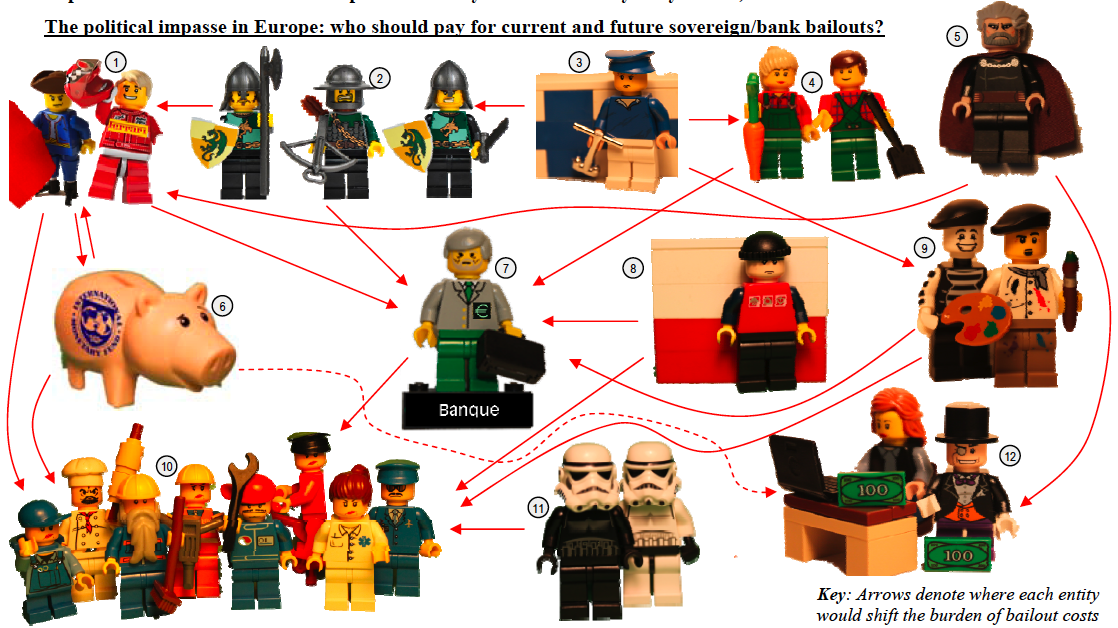
- The toreador in a floppy hat, and the F1 driver with his helmet, represent Spain, Italy and the rest of the Euro Periphery.
- The three men with helmets, shields, and medieval weaponry represent the CDU, CSU and FDP parties in Germany.
- The blue-and-white sailor boy is Finland. Obvs.
- The woman with an oversized carrot and her friend in overalls with a shovel represent the Social Democrats and Greens.
- Wotan represents the Bundesbank.
- The piggy bank is the IMF.
- The grey-haired Banque chap is the ECB.
- The chap in the red bib is Poland.
- The artists are France.
- The angry chef, the sweeper with a broom, the airline pilot, and the rest of the motley crew at bottom left, represent EU taxpayers in Core countries.
- The storm troopers are the EU Commission and Euro Group Finance Ministers, chaired by Jose Manuel Barroso and Jean- Claude Juncker.
- The monocled banker and his assistant are EU bondholders and shareholders.

Tidak ada komentar:
Posting Komentar