Rabu, 20 April 2011

Interactive Chart on Ryan Budget Vs. Obama Budget, Trailer for "Too Big to Fail," Silver at $45, and Greece Defaulting this Week?

Here is an interactive map of Ryan's Budget vs. Obama budget.  Ryan's budget looks a lot better fiscally than Obama's, but still doesn't go far enough (besides making many dubious assumptions).


Big thanks to Mish for the chart.
Also out today is a trailer for HBO Films' "Too Big to Fail":
Fantastic choice on Paul Giamatti to play Bernanke (such an uncanny resemblance!) and use of CCR's "Fortunate Son" in the background.  It is easily the greatest political song of all time.

Silver's rapid rise still shows no signs of stopping:
Remember the University of Texas Investment Management Co. ordering $1 billion in gold?  CEO Bruce Zimmerman explains why:
"We began buying gold in September of '09 at about $950 an ounce. Our average price is at about $1,150. We've invested around $750 million in gold over that twelve months and it now has a value around $1 billion." On what Texas thinks of gold (no surprise here): "The role gold plays in our portfolio is as a hedge against currencies. The concern is that we have excess monetary and fiscal stimulus. I noted a couple of days ago, i think there was a story out about Bernanke mentioning that while they may not increase quantitative easing, they may not necessarily reduce their exposure either. So i think that may be a signal that will continue to have a good deal of monetary stimulus.

Maybe Texas University could help out the Texas Teacher Retirement System?  From Bloomberg:
The Teacher Retirement System of Texas needs an annual return of 21 percent in the year ending Aug. 31 to maintain an 80 percent funded ratio, the level actuaries consider adequate to cover liabilities, said its deputy director.
The fund’s investment return was 14.7 percent in 2010, the best among large public pension funds, Chief Investment Officer Britt Harris said at an April 7 board meeting. The fund had about $109 billion on April 1, up from $95.7 billion in September.
Even with the gains, the pension’s funded ratio -- the portion of promised benefits covered by current assets -- dropped to 81.3 percent as of Feb. 28 from 82.9 percent on Aug. 31, 2010, because of trading losses in 2008 and 2009 included through a process called smoothing, Executive Director Ronnie Jung said April 7.
Public pensions nationwide are grappling with about $3.6 trillion in unfunded liabilities, according to a 2010 study by Joshua Rauh of Northwestern University and Robert Novy-Marx of the University of Rochester.
I love how Zimmerman mispronounces Bernanke's name.
John Tamny is predicting that $1,500 gold is a huge sign of a recession in his RealClearMarkets column today:
Though it traded in the then nosebleed range of $800/ounce back in 2008, gold has since nearly doubled to $1500/ounce. Its spike to previously unseen levels is a signal that all the chatter about whether there will be a downturn is well too late. Gold at these levels IS the downturn, and an eventual "recession" that hopefully includes a revived dollar to undo all the misallocations occurring at present will be the cure.
Tamny is a bright dude who understands the Austrian Business Cycle Theory, he knows the Fed money printing is now creating misallocations of productive labor and capital and a downturn is soon to come.  Let's see how long McDonalds' 50,000 new employees last.

So apparently there are rumors spreading that Greece may default this week.  Here is one leading indicator (2-year yield hits record 22% and 10-year .59 on Euro):
And civil disobedience of course follows.  From the U.K. Independent:
As unemployment rises and austerity bites ever harder, tempers seem to fray faster in Greece, with citizens of all stripes thumbing their noses at authority. Some refuse to pay increased highway tolls and public transport tickets. There has been a rise in politicians being heckled and even assaulted. Yesterday, in Thessalonika, scores of activists were arrested after violent clashes with police.
Looks like Spain just skated by a potentially disastrous auction:
Faced with a large capital funding need in advance of a substantial bond redemption next week, Spain had no choice but to hike rates on today's auction of €3.37 billion in 10 and 13 Year bonds.  Spain auctioned off €2.49 billion in April 2021 bonds at a yield 5.472% vs. Prev. 5.162% (5.5% interest) at a 2.1 bid/cover Prev. 1.81. it also sold €0.885 billion in 2024 bonds yielding a whopping 5.667% vs. 4.26% previously.
Who in their right mind is buying this stuff?

I will end some more tidbits of news.  First is Russian Prime Minister Vladimir Putin on U.S. Monetary policy via the Wall Street Journal:
Russian Prime Minister Vladimir Putin slammed expansionary U.S. monetary policy, calling it “hooliganism”, in remarks that followed more veiled criticism from China after Standard & Poor’s Corp. cut the outlook on its U.S. debt rating this week. “We see that everything is not so good for our friends in the States,” Putin told lawmakers Wednesday.
“Look at their trade balance, their debt, and budget. They turn on the printing press and flood the entire dollar zone — in other words, the whole world — with government bonds. There is no way we will act this way anytime soon. We don’t have the luxury of such hooliganism,” he said.
Anyone hiding money in Swiss bank accounts better start reconsidering a new place to hide, via the New York Times:
The Swiss are hoping to improve relations with their neighbors by making it harder for other Europeans to hide money there from the tax collector back home. While the planned new rules should preserve Switzerland’s prized banking secrecy, they are likely nonetheless to accelerate a shift in the country’s banking industry away from relying on undeclared assets. That, analysts say, could result in more consolidation and downsizing among the private banks.
The desperate search for more tax revenue continues.

And kudos to the legislature of Oklahoma:
The Senate on Tuesday sent Gov. Mary Fallin a bill that would strip collective bargaining rights from city employees in Oklahoma's largest cities.
House Bill 1593 passed Tuesday on a 29-19 vote supported entirely by Senate Republicans.
The bill would repeal a state law granting collective bargaining rights to nonuniformed city employees in cities with populations of more than 35,000.
Where is the public outcry on this one?

Update- Matt Yglesias may be beginning to see the light on Lincoln's true intentions from a paper by Zachary Liskow:
Specifically, using voting patterns as representations of the Northern population’s preferences, this paper tests empirically whether the economic motivations of its manufacturing interests might have been important components of Northerners’ support of the decision to fight. The hypothesis that the North had economic motivations for keeping the South in the Union yields a specific prediction: counties with relatively large amounts of these manufacturing interests should shift their votes from Democrats to Republicans between 1860 and 1864. The reason is the following: the best way to keep the South in the Union before the Civil War was to vote for the Democrats, reducing the likelihood of secession by voting for the party more accommodating to Southern slavery interests. However, the best way to keep the South in the Union during the war was to vote for the Republicans, who were more likely to pursue the war until victory was achieved.
Using county-level census data and voting data from the 1860 and 1864 presidential elections, I find that there is a significant shift toward the Republicans associated with manufacturing employment. This shift toward the Republicans associated with manufacturing together amounts to 2.25% of voters in Northern states; that is, taking the results literally suggests that 2.25% of Northern voters shifted their votes to the Republicans out of a desire to protect their manufacturing interests by keeping the South in the Union.
If you were looking for more economic illiteracy from government officials, forget Jessie Jackson Jr., check out the Metropolitan City Council of Nashville:
Until 2010, sedan and independent limo services were an affordable alternative to taxicabs.  A trip to the airport only cost $25.  But in June 2010, the Metropolitan County Council passed a series of anti-competitive regulations requested by the Tennessee Livery Association—a trade group formed by expensive limousine companies.  These regulations force sedan and independent limo companies to increase their fares to $45 minimum.
The regulations also prohibit limo and sedan companies from using leased vehicles, require them to dispatch only from their place of business, require them to wait a minimum of 15 minutes before picking up a customer and forbid them from parking or waiting for customers at hotels or bars.  And, in January 2012, companies will have to take all vehicles off the road if they are more than seven years old for a sedan or SUV or more than ten years old for a limousine.
Nothing like government stepping in on behalf of a certain business.  It never ceases to amaze me how lawmakers think forcing all consumers to pay a higher price for a good or service is a "moral" thing to do.  This is mercantilism of the highest kind.

Richard Epstein has a pretty good article out in Defining Ideas which refutes a progressive tax system and advocates for letting the rich get richer.  I only have one major beef with the article:
Levy taxes in ways that mimic market transactions.
Impossible, the compulsory nature of taxation takes it completely out of the realm of a mutual market transaction.  Things such as national security and infrastructure are possible to do in a non-statist society, it just requires a change in the public thought process and a system completely built upon private property.

And if you are looking for another federal tax receipt website, check out http://www.wheredidmytaxdollarsgo.com/

Selasa, 19 April 2011

New Slate Article, Roubini Proved Wrong, Canada Inflation Numbers, and "New York Fed Ponzi Circle Jerk Continues"?

My new Slate article has been uploaded:

Making Political Sense: The Myth of 'Too Big to Fail'

By: James Miller
Published 04/12/2011

A large and profitable corporation engages in extremely risky behavior. A disaster occurs. The corporation quickly loses all marketable value.
The government steps in to stop the fiscal unraveling by pumping in billions of taxpayer dollars.

The public is told that if said corporation fails, it will be the end of the world. Profits get privatized while losses are socialized.

The cycle continues. Sound familiar?

Once again, the wondrous notion of “too big to fail” is beginning to rear its ugly head.

Rather than be used to validate the socialistic “saving” of the global banking system, the disaster in Japan will be met with the same type of reactionary response that botched the Hurricane Katrina clean-up effort.

The Japanese government has announced it is ready to offer financial assistance to the owner of the now damaged Fukushima Power plant, Toyota Electric Power Co. (TEPCO).

TEPCO will most likely have a $1 billion bill on its hands whenever the accident at Fukushima is said and done.

This compensation will most likely bankrupt the company. Rather than look at the circumstances that led TEPCO to build a nuclear plant unable to withstand a natural disaster, the government is opting for what it is best at: a handout.

Like the financial crisis, bailouts only serve to reinforce the notion that “big daddy” government is always there to fix everything.

These guarantees only entice banks to rack up billions in mortgage backed securities without worrying about the risk they carry.

In essence, implicit guarantees of support encourage investors to devote capital without proper risk assessment. Making a quick buck becomes easy in the short-term when your losses are protected in the long term. The same concept applies to Fukushima, TEPCO and its financiers.

By bailing out TEPCO, the Japanese government not only sends the wrong signal to the operators of power plants, but to the public as a whole. Bankruptcy of TEPCO will be devastating to both the company and victims whom it owes compensation.

This is the price to pay for building a nuclear reactor unable to withstand a natural disaster. It is the price to pay for those who were willing to live within proximity of a nuclear plant.

Failure is a fact of life. It is a byproduct of the human condition. Protection from failure only inhibits success in the end.

“Too big too fail” is a myth perpetuated by those who have access to the government’s wallet.

Its enforcement needs to end immediately. This is not an issue of legislating barriers to taxpayer money. Barriers crumble as soon as the next disaster hits.

The real issue is one of altering the mindset of the public. Letting TEPCO and its investors fail sends the perfect message: “you failed to calculate the risk involved in building a nuclear power plant, you failed by on your own accord and the public will not suffer by absorbing your loss.”

It will be a tough lesson to learn, but it must start somewhere.

--------------------------------------------------------------
So were insiders betting that TEPCO was too big to fail?  New York Times reports:
Japanese regulators and executives of the Tokyo Electric Power Company are asking questions about a seemingly coordinated series of stock purchases two weeks ago that led to an undisclosed buyer or buyers acquiring a large block of the utility, which owns Japan’s dangerously damaged nuclear power plant. Regulators want to know whether the trades, valued at up to $600 million and placed from Hong Kong during the week of April 3, were structured to circumvent Japanese securities laws, which require the owner of more than 5 percent of a publicly traded company to file disclosure papers identifying the shareholder.
Robert Wenzel, once again, proves himself right on this:
Was this speculation by a hedge fund operator that Japan would deem TEPCO too big to fail, or was it an inside job by Japanese operators who understood government thinking on the degree to which TEPCO would be protected?
Of course, knowing how government's operate these days, you don't need inside information to understand that the elite will be protected. Those elite certainly included TEPCO bondholders
Now usually Nouriel Roubini is right on most predictions (financial crisis, Greece needing debt restructuring)
but he was proved wrong on one prediction today.  From Zerohedge:
Gold futures just passed $1,500. Silver touches $43.70. Nobody could have possibly seen this coming (certainly not the shorts). Time for CNBC to break out the "$1,500" hats.
Now Roubini from November 4, 2009:
Nov. 4 (Bloomberg) -- Nouriel Roubini, the economist who predicted the global economic crisis, said a forecast by investor Jim Rogers that gold will double to at least $2,000 an ounce is “utter nonsense.”
“Maybe it will reach $1,100 or so but $1,500 or $2,000 is nonsense,” Roubini said.
I am starting to like this"nonsense."  Granted the prediction was made about a year and a half ago, I wouldn't be surprised to learn that he is hoarding up on precious metals.  Oh, and to correct the Zerohedge post that was made earlier today, look at silver now:
Jim Rogers is scared on triple digit silver, he speculates that a bubble may be starting to blow up.  The growth that silver has seen recently has been rather worrisome, but he doubts the bubble is happening now.  Maybe 2017.

Marc Faber still asserts gold and silver are the "best currency." If silver continues its impressive climb in price at its current rate, Faber may change his mind.

In other news, Canada inflation numbers are in:
A surprise out of the Bank Of Canada, which just announced that despite expectations of CPI coming at a modest 0.6% and 0.2% for the core, inflation was a blistering 1.1%, and 0.7% ex-non core items.
What was the dollar's reaction?  From Zerohedge:
USDCAD moved a good 50 pips from 0.963 to 0.958 in seconds, giving the dollar another push in the race to the global currency bottom.
Now for that funny headline from Zerohedge:
Exactly one week ago, we commented on what many said was a "strong" 3 Year auction primarily courtesy of a 57.4% primary dealer takedown. We also said: "Keep an eye on CUSIP QC7: it will be the most monetized 3 year paper by the Fed over the next 2 weeks." Today was the first POMO operation since last week's auction focusing on 3 year paper. We present the results of the $6.678 billion POMO below. They, and the 28% flip of the entire PD take down, speak for themselves.
Ponzi scheme?  Well somebody is sure benefiting from the 3-year Treasury flips, and it sure isn't the dollar.  Circle jerk is a bit crude, but apt in this case.

I will end with a few tidbits.  First is from the U.K. Independent:
Plans to exploit Iraq's oil reserves were discussed by government ministers and the world's largest oil companies the year before Britain took a leading role in invading Iraq, government documents show.
The papers, revealed here for the first time, raise new questions over Britain's involvement in the war, which had divided Tony Blair's cabinet and was voted through only after his claims that Saddam Hussein had weapons of mass destruction.
A country engaging in war to benefit elite businessmen?  If you are surprised, please take off the rose-colored glasses.  Here is an interesting graph of Iraq's oil industry:
Government Motors stock takes another dip today below IPO:
Still think we are going to get our money back?  Not when Bill Gross still doesn't trust buying Treasuries:
Just to set the record straight following various spurious and less than credible reports floated in the peripheral media this morning, El-Erian sets the record straight on a Bloomberg radio interview.
  • Pimco's El-Erian says Pimco not buying US treasuries
And John Tamny jumps on the high education bubble wagon today in Forbes.

Update- The Tax Foundation has a graph on sales taxes within the U.S.
Rumor is that Google offered Twitter $10 billion to take it over according to MarketWatch but it hasn't been confirmed.

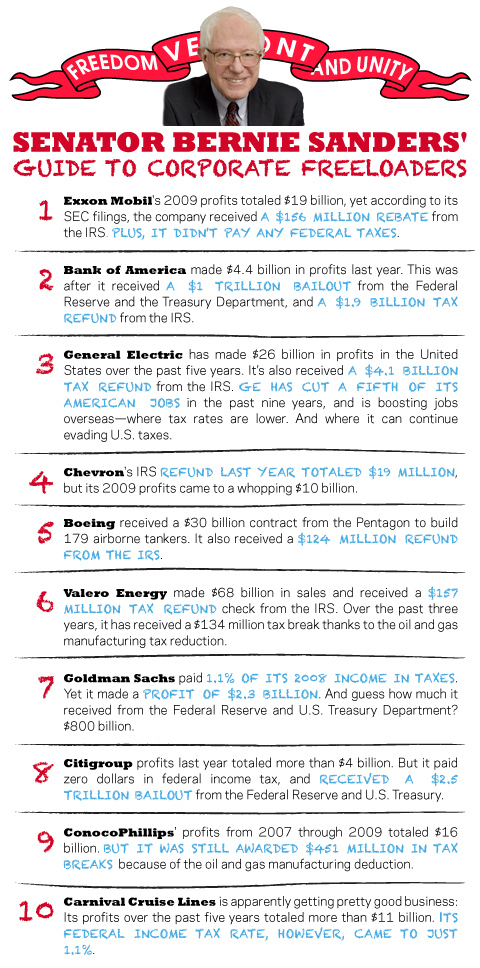
And here is Sen. Bernie Sanders' Guide to Corporate Freeloaders:

Senin, 18 April 2011

S & P Downgrades Long Term U.S. Debt., Greek 2-Year Hits 20%, Peter Thiel Recognizes Higher-Ed Bubble, and Interactive Federal Tax Reciept- Update- Simon Black and Dagon Global Credit Rating Co.

Big news as Standard and Poor's cuts U.S.'s AAA long term debt rating to "negative outlook."  From Bloomberg:
“We believe there is a material risk that U.S. policy makers might not reach an agreement on how to address medium-and long-term budgetary challenges by 2013,” New York-based S&P said today in a report. “If an agreement is not reached and meaningful implementation does not begin by then, this would in our view render the U.S. fiscal profile meaningfully weaker than that of peer ‘AAA’ sovereigns.”
Is this really a big deal though?  After all, S & P was not very insightful when it came to the financial crisis.  Barry Ritholtz and Joseph Stiglitz lay it out:
If ever there was an organization more corrupt, incompetent, and less capable of issuing an intelligent analysis on debt than S&P, I am unaware of them. Why do I write this? A huge part of the reason the US is in its awful financial position is due to the fine work of S&P.
Consider what Nobel Laurelate Joseph Stiglitz, economics professor at Columbia University in New York observed:
“I view the ratings agencies as one of the key culprits. They were the party that performed that alchemy that converted the securities from F-rated to A-rated. The banks could not have done what they did without the complicity of the ratings agencies.”
From what I have read of Stiglitz, I don't really agree with him on much (free markets didn't cause the financial crisis; there would have to be a free market in place to begin with), but he nails it pretty well here.  Apparently the White House knew the downgrade was coming on Friday, and sent tax cheatin' Timmy out to do the Sunday talk shows.  Maybe if he didn't say the exact same stuff (U.S. won't default, economy would implode, government shutdown would be Armageddon) every interview, people would take him more seriously.

The U.S. isn't the only one with less-than-desirable news today, the Greek 2-year bond yield has surpassed 20%:
Maybe this had something to do with it, Bloomberg:
Greece said it has no plans for a debt restructuring even as German officials openly discuss the possibility and investors charge a record amount to insure the country’s obligations.
Traders are betting on a default. The cost of insuring Greek sovereign debt jumped 56 basis points today to a record 1,211 points, according to CMA prices for credit-default swaps. That indicates there’s a 64.5 percent probability of default within five years.
On my post yesterday, I explained why I think U.S. higher education may be in a bubble.  It looks like someone else has joined the party:
Fair warning: This article will piss off a lot of you. I can say that with confidence because it’s about Peter Thiel. And Thiel – the PayPal co-founder, hedge fund manager and venture capitalist – not only has a special talent for making money, he has a special talent for making people furious.
for Thiel, the bubble that has taken the place of housing is the higher education bubble. “A true bubble is when something is overvalued and intensely believed,” he says. “Education may be the only thing people still believe in in the United States. To question education is really dangerous. It is the absolute taboo. It’s like telling the world there’s no Santa Claus.”
The New York Times had an article a week ago on the enormous load of debt many college students are accumulating.  Mish, whose post I got this stuff from, summarizes very nicely:
Student loans have done four things, all of them bad.
  1. Jack up the cost of education
  2. Make students debt slaves for the rest of their lives
  3. Unjustly hand over huge profits to schools like the University of Phoenix at taxpayer expense
  4. Add to the national debt
And now via Third Way, here is your interactive federal tax payment receipt. If you didn't already guess it, Social Security tops the list for the biggest payment.

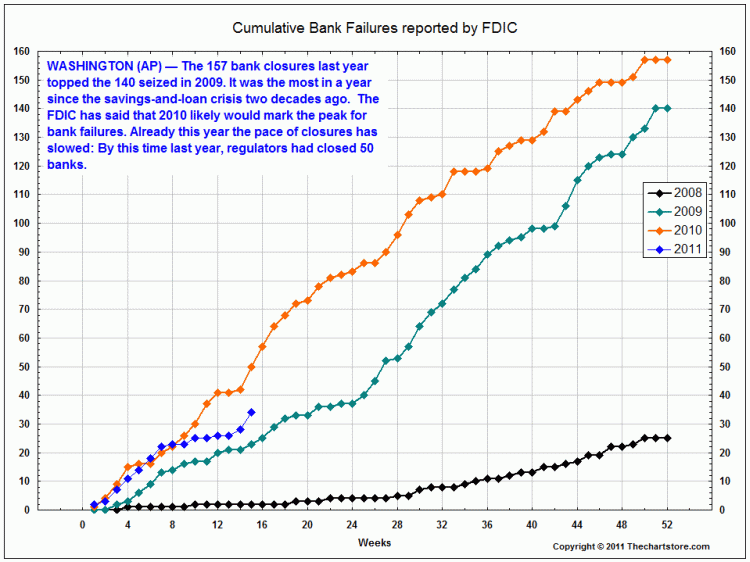
I will end with a few random tidbits.  First, here is a chart on the cumulative bank failures reported by the FDIC:
Hmm...2011 seem to be off to a good start, but is now beginning to lag.  Let's see what happens when QEII ends and the excess reserves start filtering through.  Next is JPMorgan calling out OPEC for the idiotic notion that demand for crude is "weak" and the market is oversupplied:
Undoubtedly demand for OPEC crude “feels” weak at the moment due to domestic refinery turnarounds and Japanese outages. Our refinery maintenance estimates show 6.5 mbd off line in April compared to peak throughput in December. But there is a real danger that by responding to regional market conditions for specific crudes, OPEC is setting the stage for further global price spikes.
For idiocy, Jesse Jackson Jr. really takes the cake:
So the iPad kills jobs?  My mom has hinted that she may get me one for a graduation gift.  I guess she will be throwing a few more Borders employees out on the street...

Update- Simon Black of Sovereign Man in his latest post calls Standard and Poor's out for what it is and recommends China's Dagon Global Rating Co. as the premier rating agency:
Dagong Global Credit Rating Co is China’s leading credit rating agency. Credit rating agencies are the firms who are responsible, among other things, for scoring the credit risk of a particular asset or sovereign nation.
When they rate a security as “AAA”, premium safety, investors pile in. They’re an integral part of the financial system.
You undoubtedly remember that the world’s leading agencies– Fitch, Moody’s, and S&P, were all complicit in slapping AAA premium ratings on so many toxic mortgage-backed securities… and maintaining sound ratings for far too long on bankrupt nations like Greece and Portugal.
The entire industry lacks credibility at this point, and China’s Dagong agency aims to do something about that.

Minggu, 17 April 2011

Higher Education Bubble Explained (The Bears are Back), University of Texas Stocks Up on Gold, China Raises Reserve Ratios (Again), and Interactive Map on Strenght of Real Estate Market Everywhere in U.S.

The bears from the infamous Quantitative Easing Explained are back.  This time they take on the higher education bubble:
You can only fit so much into a 5 minute cartoon, but the video does bring up some key points.  Bubbles develop when only when there is a widely held belief by most of the general public that whatever asset (housing, education, gold) is worth investing into.  This is why, as Marc Faber points out, gold is not in a bubble.  It is not being traded in massive amounts 24 hours a day and it is tough to find someone who has a significant part of their portfolio invested in gold.  Education is not the same thing as gold, but it is still considered an investment.  It's incredibly easy to find someone who thinks that investing in higher education is a great idea.  College tuition continues to rise in both public and private universities at a significantly higher rate than inflation.  It is precisely what the housing sector went through beginning in 90's:
Is higher education in a bubble? I believe so.  Its popping will result in high unemployment for college graduates, it is already happening now.  Concessions will need to be made by both university professors and administrative personnel.  The unions will fight this with warnings of massive layoffs.  The cycle will continue.  The best things college students can do is educate themselves with supplemental material that relates to their field of study and not rely on the piece of paper they walk for at the end of their 4-5 years.  People my age need to realize that a degree does not guarantee them a job, they must market themselves better than their peers in order to have a chance at employment.

Though gold may not be in a bubble yet, it is obvious demand is starting to pick up.  Record high prices are one sign, and here is another via Bloomberg:
Dallas hedge-fund manager J. Kyle Bass helped advise the University of Texas Investment Management Co. on taking delivery of 6,643 gold bars, worth $987 million on April 15, now stored in a bank warehouse in New York.
A university investing in gold?  It looks to be the beginning of a bubble, but its going to take more than one university investment to begin blowing it up.

Speaking of bubbles, China is trying desperately to control their own in housing.  Via WSJ:
BEIJING—China announced an increase in the share of deposits banks must hold in reserve for the fourth time this year, a fresh step in its battle against inflation that came after data showed consumer prices rose at their fastest clip in nearly three years in March.
"Beijing did not take long to respond to the strong inflation number on Friday," said Royal Bank of Canada economist Brian Jackson in a note. "Today's move suggests that another increase in interest rates is on the way soon."
China's central bank said Sunday it will raise banks' reserve requirement ratio by 0.5 percentage
This is, of course, the fourth time China has raised rates this year, demonstrating that they may not be able to control the inflation their massive money printing has caused.

This post has mentioned housing a lot, so I will provide a link to this great interactive map from Trulia Report on the real estate market in every zip code in the U.S.  From Barry Ritholtz:
The three key metrics:
1) How long a house typically goes before the owner cuts the price;
2) The size of that price reduction;
3) The likelihood that there will be another reduction in price
I will end with a warning on increasing gas prices.  OPEC has decided to screw us over yet again:
(Reuters) - Saudi Arabia's oil minister said on Sunday the market was oversupplied and the kingdom had reduced output, sending a the strongest signal yet that OPEC may not boost output in June to quell soaring oil prices.
Oversupply sure as hell isn't the result in oil trading at over $100 a barrel.  OPEC really knows how to work the market, too bad the rest of us will suffer.

Update- Coming doctor shortage? Via Mark Perry:
This is the result of government licensing of doctors.  The AMA holds down the supply of medical schools and thereby the supply of doctors.  Doctors can them command higher salaries and payments.  Tom Woods outlines the whole situation in his fantastic book Rollback.

Also Gerald P. O'Driscoll Jr. had a pretty good article in The Freeman back in February, I only just found it on Cato now.  The most interesting part:
Unfortunately for defenders of current Fed policy, inflation is accelerating around the world. Singapore's economy has benefited from revived global trade, but consumer price inflation is now running at an annual rate of 5.5 percent. In Vietnam, an emerging economy of note, consumer price inflation is running at 12 percent. Food riots plague India. It is not a question of whether inflation is on the horizon. Inflation is here.

Sabtu, 16 April 2011

Roubini Issues Warning on Spain, New MIT Billion Prices Project Data, Jim Grant Worries About 4-5% Inflation, and Oregon Legislature Thinks Wasting Taxpayer Dollars is a Joke

Though confirming what most know already, it's always nice to have your suspicions backed by someone who is as connected as Nouriel Roubini.  From Bloomberg yesterday:
Spain, the currency bloc’s fourth-largest economy, is trying to restructure its savings banks after a property-market slump left many with surging bad loans. Twelve lenders need to raise as much as 15.2 billion euros to meet new minimum capital standards set by the government.
“When Greece failed, they said Portugal is different,” Roubini said. “Now they say Spain is different. I am not sure Spain is different.”
“Spain is a country too big to fail but also too big to be saved,” Roubini said. There’s a “risk” of contagion spreading to Spain, and “that would be negative for financial markets and the global economy.”
And now Spain's Labour Minister is warning of record high unemployment if the labor force keeps rising:
April 16 (Reuters) - MADRID, April 16 (Reuters) - The number of Spaniards out of work could reach a record high of 5 million if the active workforce continues to rise, Labour Minister Valeriano Gomez said in an interview published on Saturday in Expansion.
Spanish unemployment is more than double the European Union average at 20.3 percent and has risen by around 2.5 million to 4.7 million since the beginning of the economic crisis in the first quarter of 2008.
5 million people out of work won't stand for another bailout of French and German banks.  Look for protests whenever, if ever, the day comes.

MIT's Billion Prices Project has new data out today showing inflation is not slowing down.  Via EPJ:
Thanks again to Robert Wenzel, the Atlanta Fed has data out on two new indexes entitled the "flexible CPI" and the "sticky CPI."  From EPJ:
The Sticky Price Index tracks prices that change slowly. In March, the index rose at a 1.5% annual rate.

But the Flexible CPI Index, i.e. the index of prices that move quickest is going through the roof.  For March, this index rose, on an annualized basis by 21.1%. In February, it rose on annualized basis at 17.5%.

As recently as June 2010, the rate over the previous 12 months was 1.77%. The 12-month rate ending in March is at 6.43%.
Here is a link to an interview with Jim Grant of Grant's Interest Rate Observer of WealthTrack.  Some highlights:
These are monetary events that have never before been seen, and indeed, never before imagined...The Fed's policies are certainly great for one class of society: the speculative classes.... We have socialized risk, we have privatized gains, much to the relief of Greenwich, CT where our zillionaires live, and the unconscionable and indefensible fallout of this is that savers get zero on their savings balances, and the speculative classes get to borrow in wholesale markets at zero and get to make their zillions all over again... The Chairman is whistling by the graveyard in this manner of 2% inflation rate being harmless."
"there will be a lot of suddenly - 4 or 5% let us say...So much of our speculative apparatus is powered on these zero percent interest rates... Think how hard it is to hold back a cash reserve in this economy... Your stupid neighbor who is watching this program is making a lot fo money in the stock market: how hard is it not to participate? You can't do it... But 4% inflation would mean that the party is over... Everything would fall out of bed... Gold and silver would right themselves, because they are money that would come into their own at the end of the cycle of disillusionment but for a time there would be terrific chaos in investment markets."
For some weekly humor, here is a joke the Oregon House of Representatives decided to play while in session
Because it's so hilarious wasting tax payer money on reciting cheesy 80's pop songs...

Jumat, 15 April 2011

Peggy Noonan Taking a Shot at Ron Paul?, Rand Paul Defends Tea Party in Senate, Kel Kelly Explains GDP and Money Supply Correlation, and California Teachers Association Resorts to Almost Militant Action

Peggy Noonan, always one of my favorites, seems to be taking a shot at Ron Paul today in her WSJ column:
You would think Democratic professionals, who read the same numbers Republicans do and pick up similar trends, would be hanging their heads in despair.
They are not. They have hope. Their hope is that Republicans in the early caucus and primary states will go crazy.
They hope the GOP will nominate for the presidency someone strange, extreme or barely qualified. They hope that in a mood of antic cultural pique, or in a great acting out of disdain for elites, or to annoy the mainstream media, Republican voters will raise high candidates who are unacceptable to everyone else. Everyone else of course being the great and vital center, which hires and fires presidents. The Democrats' hope is that centrists will look at the Republican nominee and, holding their nose, choose the devil they know. Especially if the one they don't know seems to have little horns under his hair.
Republicans voting in recent presidential primaries have tended to pick the candidates who are viewed as the moderate in the race—Bob Dole in 1996, George W. Bush in 2000, John McCain in 2008. But in truth, there are some pretty antic candidates out there this year.
There is a lot to draw from this.  First off, yes, Republicans do pick moderates for White House runs.  And yeah, she does seem to be taking a shot at Donald Trump with the "under his hair" line.  I can't tell if she is really talking about Paul when she says "antic" but that's how many on the right classify him.  Dems are hoping the Republicans run a supposedly crazy guy like Paul, but it's a damn shame Paul is considered crazy when he will most likely be the most conservative out of every candidate.  Getting Paul elected will be a lot more than people desiring to cut government spending, it will require a whole change in everyone's philosophy of how the government should be involved within our lives.

Well at least another Paul may be entering Congress soon, from the Star-Telegram:
After campaigning for his father, most notably giving speeches during the elder Paul's 2008 presidential bid, Robert Paul is considering whether to jump into the race to replace Sen. Kay Bailey Hutchison when her term expires in January 2013.
"I have thought about running," Robert Paul, one of five children, told the Star-Telegram. "I am very happy as a physician, but [I] have a lot of concern about the debt."
Let's check in with Robert's brother Rand:
Impressive as always.  Huey Long may have been a partial dictator, but at least he hated the Federal Reserve.

Kel Kelly has a great Mises Daily article out today in which he completely busts the myth of Japan having a "lost decade."  Probably the most eye-opening part of the article is where he shows how much GDP figures are influenced by money creation:
Now observe in figure 3 how much lower money-supply growth has been in the 1990s and 2000s as compared to the 1980s. In figure 4, describing that same time frame, you will notice a reduction of GDP; it went from being in the 4 percent to 10 percent range in the 1980s to the −2 percent to +2 percent range in the 1990s and 2000s.
The same evolution is presented from a slightly different angle in figure 5, where, instead of real-time changes as depicted in figures 3 and 4, GDP and money supply are smoothed in the form of a 40-quarter (10-year) compound annual growth in Japanese nominal GDP and the 120-month (10-year) compound annual growth in the Japanese M2 money supply.
It should be noted that, because it takes time for new money to multiply and be disseminated in the fractional-reserve system, money supply has a delayed effect of about one to two years on GDP growth.
Figure 3
Fig. 3. The decline in Japan's money-supply growth rate since the 1980s. The red line is M2, and the blue line is M3. Source: Bank of Japan.
Figure 4
Fig. 4. The decline in Japan's GDP growth rate since the 1980s. Source: Seeking Alpha.
Figure 5
Fig. 5. Japan's GDP and money supply moving together. 
The lagged money supply affects both GDP and prices (because GDP consists of prices). As would be expected, Japan's GDP and M2 have moved largely in line with each other (figure 5). Notice that after the money supply dropped precipitously in 1990 (as seen in figure 3), GDP, after peaking, fell off over the next two years (as seen in figure 4).
Kel Kelly's thoroughness in his article should be commended, it is absolutely fantastic.  I once tried arguing with my labor relations professor why GDP was not a great indicator of productivity but did not do very well.  As long as Sweden is more unionized than the U.S. and has better GDP measures, it will always be a better place. I wish I had read Kelly's article back then.

I bet my labor relations professor would love this:
The California Teachers Association is planning a week’s worth of Wisconsin-style protests and rallies, from May 9-13, to “force legislature to pass tax extensions.”
How do the CTA members plan to pressure California lawmakers on the tax extensions? With an allegedly $1 million budget and a 10-page action plan. You can read the organization’s full list of possible activities, but we present to you this snapshot (hat tip Hot Air):
* Target the businesses of legislators in their home districts.
* Circle the offices of “problem legislators.” Target them with various actions.
* Picket/rally in front of legislators’ offices/homes.
* Follow targeted legislators for the entire day.
* Have students and parents do informational picketing for one hour outside their school site.
* Have parents and students camp in front of schools all night.
* Have teachers being laid off contact parents and other CTA members.
* Make phone calls on Parents’ Day. Call parents to tell them how their child is doing and then talk about the budget cuts and invite them to attend the rallies.
* Refrain from Shopping Day. Show the value of educators and other public employees and the economic contribution they make to local communities by refraining from shopping one day.
* Throw monopoly money in the toilet to show that all our money is going down the drain
* Publish a list of companies that are not paying their fair share of taxes. Send letters to these companies and the media and picket their offices. Withdraw funds from banks that are not paying their fair share. (Editor’s note: CTA is a tax-exempt organization.)
* One-day boycott of Microsoft and other corporations that are pushing failed education reform efforts.
* Turn fire/earthquake drill into crisis response drill to the budget cuts (involve students and the community)
* Attempt to close a major artery into town/cities
Those are only a few of the tactics proposed.  I doubt most will be carried out, but they really do have their thinking caps on.  Maybe if the union would devote half of its time and money to actually educating kids instead of these idiotic pleas for more money, California kids would be a lot better off.  "Throw monopoly in the toilet?"  I bet whoever came up with that was taught by a teacher so inadequate at their job, they were unable to be fired.

I mentioned some inflation numbers yesterday, so you would know that following the PPI data comes the CPI.  Well here it is:
The Consumer Price Index  increased 0.5% March on a seasonally adjusted basis, according to the U.S. Bureau of Labor Statistics, This is an annualized growth rate of 6%.
Here is Bloomberg on India's inflation:
India’s inflation accelerated more than economists estimated in March as the cost of fuel and manufactured goods rose, putting pressure on policy makers to raise interest rates in Asia’s third-largest economy.
The benchmark wholesale-price index rose 8.98 percent from a year earlier after an 8.31 percent gain in February, the commerce ministry said in a statement in New Delhi today. That exceeded all 28 estimates in a Bloomberg News survey, where the median forecast was for an 8.36 percent increase.
Inflation is beginning to heat up worldwide, and reactions such as China proposing cost controls are only going to make things worse. At least you-know-what just keeps going up in price:
Hopefully this won't be what comes next:
MINSK, April 15 (Reuters) - Belarus' central bank has stopped selling gold to local retail customers for Belarussian roubles BYR=, it said on Friday, after demand for precious metals soared due to expectations of a currency devaluation.
The bank did not explain its decision.
The only person fighting to make sure there the Mint has enough precious metal is of course Ron Paul. It's sad that this is what it comes down to.

I will end the week with a fairly humorous clip of the E-Trade baby:
Should have gone with silver.

Kamis, 14 April 2011

Hoenig Doesn't See a Return to Capitalism on the Horizon, Silver Hits $42 on Threat of Bolivian Nationalization, Leak of China Econ Data, and More Signs of Inflation

George Will's column has a quasi interview with almost-former Kansas City Fed Prez and lone hawk Tom Hoenig today. He has some dire predictions:
Hoenig, an Iowa native, says the provinces have not cornered the market on provincialism. He warns "end the Fed" advocates to be careful what they wish for. The Fed will not go away; under "reform," regional banks such as his might. This, he says, would make the New York-Washington financial axis more powerful relative to "this part of the country."
"In 1999, the five largest U.S. banking organizations controlled $2.3 trillion in assets, or about 38 percent of all banking industry assets. Currently, Bank of America by itself . . . has the same level of assets - $2.3 trillion . . . and the top five now have 52 percent of all banking industry assets. . . . Creditors and uninsured depositors at too-big-to-fail organizations believe that there is almost no chance that they will have to take a loss."
With all this, could we ever get back to capitalism? "Not," he says, "in my lifetime."
This is why Robert Wenzel points out that those crazy "End the Feders" want to eliminate the thing all together, not settle for reform.  Notice who he thanks in at the end of the post.

Just when I thought the good times may have peaked for the time being, I am once again proven wrong:
Silver Hits $42!
This is probably the reason why though:
a far more troubling report from Bolivian daily La-Razon states that Bolivia's president Evo Morales is now planning on expropriating zinc, silver and tin mines sold off by previous governments. Bloomberg reports that "Morales will announce a decree May 1 to “dismantle the privatization model,” said Nicolas Fernandez, a spokesman for state mining company Corp. Minera de Bolivia, known as Comibol. "The government is recovering all the privatized companies,” Fernandez said today in a telephone interview from La Paz. “When the decision is taken, Comibol will be ready to manage these mines.”" Among the contracts to be affected are those with Glencore International AG, Pan American Silver Corp., and most importantly, Coeur d’Alene Mines Corp., which is operator of the San Bartolome mine: the world's largest pure silver mine.
The days of paying $26-$27 for an ounce are long gone ladies and gentlemen.

Nouriel Roubini has a column out today on Project Syndicate where he says what many know already, China's stimulus efforts are not at all sustainable and a crash is coming.  He predicts the party ending in 2013 yet homes prices in Beijing fell 27% in March alone.  Here is some leaked data on China that just came out today from Zerohedge:
Completing the trifecta of posts focusing on China, here is the (un)official leak of Chinese GDP data to Phoenix TV which is due out at 10 pm. In the past this has been roughly 100% accurate. So without further ado...
RTRS-CPI 5.3-5.4%         (BBERG est is 5.2%)                 
RTRS-PPI 7.4%             (BBERG est is 7.2%) 
                      
RTRS-IP  14.8%            (BBERG est is 14%)           
RTRS-RETAIL SALES +17.4%  (BBERG est is 16.5%)
RTRS-FIXED ASSET +25%     (BBERG est is 24.8%)               

* GDP also appears to be coming at 9.4%
9.4% GDP? Incredible, simply incredible.

Some new inflation numbers came out today, first we have the Bureau of Labor and Statistics reporting that the Producer Price Index has increased 5.8% for the year while the World Bank reports that food prices increased 36% compared to last year.  So what does this mean, well Joe LaGorna of the Deutsche Bank cut down Q2 GDP predictions:
Consequently, we are cutting our Q1 real GDP estimate another half of a point to +2.8%. Remember that we started the week at +3.8% on Q1 real GDP and then lowered it to +3.3% following weaker than anticipated net exports. We also decided to trim current quarter output by half of a point as well, reducing our forecast from +4.2% to +3.7%. Rising inflation is lowering real output, and the risk is that we may have to trim our second half forecast as well. But for now, we are keeping our Q3 and Q4 projections at 4.1% and 4.3%, respectively.
Greek 10-Year yields have passed 13% and Portugal's yield reaches 8.8%:
And now CEO of FX Concepts is calling for a recession toward the end of the year:


There is a little bit of hope though:
Ron Paul quietly took another step toward a presidential run recently, creating a so-called “testing the waters” account that allows him to start raising money toward a White House bid and could eventually become his official campaign account, a Paul aide confirmed to POLITICO.
If a recession does take hold (it probably will) it may last through the 2012 election cycle and may be the impetus for Ron Paul to make big strides.  A man can hope right?

I will end with some rather disturbing news from Neo-Con central The National Review:
The $38.5 billion includes real cuts, but also a dog’s breakfast of budgetary legerdemain. According to the Associated Press, the deal purports to save $2.5 billion “from the most recent renewal of highway programs that can’t be spent because of restrictions set by other legislation.” It gets another $4.9 billion by capping a reserve fund for the victims of crime that also wasn’t going to be spent this year — a long-standing trick of appropriators. The Washington Post reports that a notional $3.5 billion cut from the Children’s Health Insurance Program “would affect only rewards for states that make an extra effort to enroll children. But officials with knowledge of the budget deal said that most states were unlikely to qualify for the bonuses and that sufficient money would be available for those that did.” And so on.
According to the CBO, the real budget deal will only cut $353 MILLION, not billion.  Paul must take this and run with it when it comes to the Republican primaries.  John Boehner can swing on it for pulling this kind of crap.