Kamis, 13 Oktober 2011

Libertarian Theory on Bullying, Obama Punches Banker in Face, Capital Shortfalls in Europe Banks

(The following is some brainstorming for an article)
There has been some recent incidents involving suicide in response to bullying.  This is one of the latest examples:
Police have opened a criminal investigation in the suicide death of Buffalo, N.Y., 14-year-old Jamey Rodemeyer, who was bullied online with gay slurs for more than a year.
It's always sad and a great loss to the Earth when someone decides to take their life.  In an effort to right even the most miniscule of wrong (not to say this was miniscule mind you), proponents of the state are now pushing for anti-bullying legislation to deal with this issue.  The purveyor of all human wisdom, Lady Gaga, has weighed in on the issue:
"Bullying must become illegal. It is a hate crime," she tweeted. "I am meeting with our President. I will not stop fighting. This must end. Our generation has the power to end it.
Admittedly, I am not sure what constitutes a difference between a "hate" crime and a regular crime.  The end result of any crime in the libertarian sense tends to be aggression towards another.  Is the converse of a "hate" crime than a "love" crime?

While Ms. Gaga may feel inspired to take up the cause, her motives are ultimately misguided.  Those who push for the government to involve itself in such a matter are advocating for a dangerous precedent.  Enforcing such a policy as monitoring "bully" rhetoric would require a large level of bureaucracy.  Since the state would be in charge of enforcement, cost efficiencies in regard to taxpayer money would be an afterthought.  Speech police has been a subject warned about for decades through seminal works of fiction such as "1984" but that hasn't stopped emotionally driven responses for state-sanctioned banning of speech.

What this really comes down to is the philosophical belief of how much property rights extend to a person, their thoughts, their words, and their actions.  In the realm of physical locations, it is up to the property owner to decide what actions and language will be tolerated in the sphere of their control.  As Murray Rothbard points out:
"The right to free speech is only valid and workable when used in the sense of the right to talk to people, to try to convince them, to hire a hall to address people who wish to attend...the right to free speech is, in fact, part of a person's general right to property."
Much of bullying that Rodemeyer dealt with happened at school or over social media networks.  It is then up to the owners of such property and the discretion of Rodemeyer to address the problem.  One of the issues neglected is that Rodemeyer was legally forced to got to school.  Normally, those officials in the school should have followed through on his initial complaints and made an effort to put an end to the bullying to retain Rodemeyer's patronage.  In a free society where school attendance was voluntary and public school didn't exist, Rodemeyer would patronize those institutions he saw fit to protect him.  Public and compulsory schooling was an underlying issue here.

As for social media, Rodemeyer ultimately choose to engage in the practice and therefore opened himself up to bullying.  Not to defend bullying, but if Rodemeyer really opposed the treatment he received from his peers, he was free to log off and never visit Facebook again.  His right to engage and disengage was the same as the bully's.  The owners of Facebook/Twitter/whatever could put a stop to insulting language if they see fit, those who disagree with their reluctance to can use other social media networks.

In the end, the rights to your thoughts and subjective values are yours and yours alone.  The enforcement of property rights is the real solution to deal with a perceived problem such as bullying.  This isn't to defend bullying but to point out the real issues so please spare me any anecdotes about family or close friends who have suffered greatly from such treatment.
 --------------------------------------------------
Alright, on to some actual news now.  The Onion has this great spoof on Obama actually growing a spine:
Though I pride myself on coming up with snarky one liners, MFL8240 over at Zerohedge has the perfect observance:
And....after the punch he went down on him.  More like how the story line would read.
Considering how much the banksters pad Obama's campaign fund balance sheet, such a situation portrayed in the video is highly unlikely.  It would be wonderful to see however. 

Mish has an interesting post highlighting some news releases pointing out European bank capital shortfalls.  These shortfalls range from 8 billion to 413 billion euros.  Zerohedge points out the Swiss bank Credit Suissee's capital shortfall measurement of 400 billion euros:
The shortfalls are most likely worse than projected, as is the trend when it comes to European banking. The banking sector is probably insolvent due to fractional reserve lending, hence the push to stabilize Greece is really just to buy time for France and Italian banks to recapitalize themselves.  What will most likely happen is the ECB will step in to do it itself.  We are right on track judging by Slovakia's recent loss of spine;
  • SLOVAK PARLIAMENT APPROVES EXPANSION OF EFSF RESCUE FUND, CONCLUDES RATIFICATION IN ALL EURO ZONE COUNTRIES -RTRS
  • 114 voted for the EFSF, 30 against and 3 abstained from 147 present (out of 150)
Meanwhile back in the good ol' U.S. of A., Jamie Dimon is playing the role of mom and telling us everything is fine and dandy:
JAMIE DIMON DOES NOT UNDERSTAND WHY YOU FOOLS DON'T SEE THE ECONOMY IMPROVING!
No doubt he sees the growth in M2 and is salivating.  And here is your fun fact of the day from the Fed's "Fun Facts About Money":
The Bureau of Engraving and Printing produces 26 million notes a day, with a face value of approximately $907 million.
Wait, wait, here it is:
For example did you know that the Bureau of Engraving and Printing has two facilities, one in Washington, D.C. and the other in Fort Worth, Texas.  Together they use approximately 9.7 tons of ink per day.
Nothing like wasting a scarce resource like ink on a piece of paper not backed by anything but the promise of a bunch of crooks.  No wonder Congress' approval rating is at 13%:

The real question is who the hell are the 13% that approve?

Rabu, 12 Oktober 2011

3 Articles in 1 Day

Well this is a first, I just found out I got 3 articles published in one day.  As mentioned in my last post, I had "Where Google Gets Its Power" at the Mises Institute today.

Earlier I had "Trade Wars Exacerbate Recessions" at the American Thinker, here is an excerpt:
Trash talking China for artificially devaluing the yuan has recently become vogue in Washington.  Front running presidential candidate Mitt Romney has been critical of China's money manipulation on the campaign trail.  The Senate is considering a bipartisan bill to "punish" China for keeping the yuan under priced.  Pennsylvania Senator Bob Casey says the bill will "let the officials in China know that there are consequences to cheating."
Talk about the pot calling the kettle black.
With gold at $1,600, gas averaging $3.50 a gallon across the nation, and U.S. money stock growth hitting  23.3% at an annual rate for the past 3 months, the rest of the world is seeing the inevitable effect of Keynesian prime pumping.  When Fed chairman Ben Bernanke launched his last massive Treasuries purchase known as QE2 last fall, he boasted about the immediate effect of boosting the stock market.  Days later he blasted China for artificially fixing the price of the yuan.  Like a chain smoking dad lecturing his kids on the danger of cigarettes, its "do as I say, not as I do" for a Congress and Fed unwilling to acknowledge their own reckless fiscal policy.
(there seems to be an editing error with my post at the American Thinker with one sentence split and misplaced)
And I just had my first article published at Zerohedge titled "A New Boogeyman for America."  Here is an excerpt from that:
With bin Laden dead and the assassination (no sugar coat here, that’s exactly what it was) of the American-born Al-Qaeda recruiter known as Anwar al-Awlaki, one would hope that our Middle East presence would begin to diminish.  Judging by Senator Lindsey Graham’s prompting of a military reaction to Pakistan, you can pack that hope away along with naively believing Barack Obama would bring the troops home. If anything, our Nobel Peace prize winning president has been a boon for the military industrial complex.
The whole problem with Pakistan and Haqqani is that it’s not at all surprising when looking at the history of U.S. foreign policy.  When the Soviet Union invaded Afghanistan around 1979, it has long been asserted by experts such as U.K. Foreign Secretary Robin Cook and former Pakistan Prime Minister Benazir Bhutto that the CIA trained and provided financial support for Osama bin Laden and the Afghan Mujahideen insurgents.  During the recent Republican presidential debates, there has been plenty of talk of how to deal with Iran’s pursuance of a nuclear arms program.  Despite all the worshipping of the stalwart of conservatism, Ronald Reagan, no candidate brings up that nasty little non-secret of the Gipper selling arms to the Iranians in the 1980’s.  Most recently, after financing and assisting the Libyan rebels in overthrowing Muammar Gaddafi, the rebels are now detaining supposed Gaddafi supporters without cause or evidence.  So much for instilling western democracy.
The trend is no different with Haqqani.  Following Admiral Mullen’s accusation, Pakistan’s Foreign Minister Hina Rabbani Khar described the Haqqani as once being the “blue eyed boy of the CIA itself for many years.”  According to Eric Margolis, an expert on foreign affairs and an internationally syndicated commentator, the U.S. also had a hand in training and funding Haqqani along with Al Qaeda in the 80’s.
See the pattern emerging?
Big day indeed.

New Mises Article, Why Ron Paul is Really Winning, and the Funniest Take on Middle East Non-Peace Ever

Got a new article over at Mises Daily today entitled "Where Google Gets Its Power."  An excerpt:
Google wasn't the first Internet search engine, but it has progressed the industry far beyond its humble beginnings. Through the development of a unique algorithm called "PageRank," Google has become the world's leading Internet search engine. Its success and nearly 30,000 employees should be celebrated, not demonized and treated as a target by easily manipulated politicians.
Yet the congressional scrutiny Google is facing is nothing new. The US government's enforcement of "antitrust" law has consistently fallen on those companies who excel at lowering prices, innovating their products, and expanding their customer base. What every rational businessman strives to accomplish is essentially what the government attempts to slow down.
Some place blame on the state's parasitic need to control; I place it on the politicians' desire to live vicariously through bullying those whose success outshines their own accomplishment of deceiving more voters than their opponents on election day. It's no better than the schoolyard bully, whose reign is enforced by the threat of violence, forcibly taking the newest fad in electronic devices from another classmate.
I am hoping my next Mises Daily blows everything out of the water, stay tuned.
--------------------------------------------------------------------------
If they want to really change things, the first person to fire is Bernanke, who is a disastrous chairman of the Federal Reserve. The second person to fire is Geithner. 
Everybody -- everybody in the media who wants to go after the business community ought to start by going after the politicians who have been at the heart of the sickness which is weakening this country and ought to start with Bernanke, who has still not been exposed for the hundreds of billions of dollars.

And I'm going to say one last thing. I want to repeat this. Bernanke has in secret spent hundreds of billions of dollars bailing out one group and not bailing out another group. I don't see anybody in the news media demanding the kind of transparency at the Fed that you would demand of every other aspect of the federal government. And I think it is corrupt and it is wrong for one man to have that kind of secret power.
----Former Speaker of the U.S. House of Representatives Newt Gingrich
This was arguably the most important statement uttered during last night's otherwise pitiful GOP debate.  And it is because of this glaring admission of reality that it has become plainly obvious that Dr. Ron Paul is winning the primary contest for the presidential nomination.  Just take a look at the latest candidate poll positions from Reuters:

Romney was backed by 23 percent of Republicans in the October poll, up from 20 percent in the most recent comparable Reuters/Ipsos poll carried out in June.
Cain, a businessman who has emerged as a surprise front-runner after proposing a radical tax reform, nearly tripled his support among Republicans in the same period, leaping to 19 percent from 7 percent four months ago.
Texas congressman Ron Paul was third with 13 percent and Texas Governor Rick Perry fourth, with 10 percent.
To further drive home the point, see the latest candidate face time measurements from the last three presidential debate from Talking Points Memo:
Ron Paul has consistently polled in third place in most major sources yet has the least amount of speaking and face time compared to other candidates.  Despite his outside-the-conservative-mainstream views on foreign policy and drug legalization, Paul recently won the Values Voters straw poll.  He came, in the words of Jack Cafferty, "within an eye lash" of beating Michele Bachmann in the major Ames Straw poll.

This is all from a man who was, and is continually, regarded as an impossibility in the sphere of being a major contender.  Yet here he is consistently making the top tier in every poll while influencing the topics of discussion of every debate.  Four years ago, who in the world would have predicted Newt Gingrich, the man who rallied an offense of impeachment against Bill Clinton while cheating on his bed-ridden wife, would be issuing such a pointed and critical attack on an institution that was hardly mentioned in the confines of conventional policy discussion?  Political pandering or not, Gingrich tirade is the direct result of Paul's decades long endeavor to put the Federal Reserve directly in the limelight of mainstream talk.  Chairman Ben Bernanke can't utter one word without the talking heads of CNBC dissecting its meaning and consequence for hours on end.

Gingrich has admitted as such judging by this recent tweet:
"there is no question ron paul was the first serious national leader to take on federal reserve history will recognize him”
Bringing scrutiny to an institution that has operated almost a century in the dark is quite an accomplishment. And it's all due to Paul's unwavering drive to move the discussion from not limiting the growth of government but to stop it in its tracks and put the clutch in reverse.  The GOP presidential primary contest will ultimately come down to Mitt Romney vs. Ron Paul. Romney will get the financial backing of the banksters and K Street crowd.  If he goes on to face President Obama in the general election, America will be choosing between two shades of the same candidate.  It won't be an election but a continuation of the status quo.

Paul has an uphill battle to win the Republican nomination, but as far as making history and changing how millions of people view their government and equally corrupt financial system, he has already won.

Not too shabby for a country doctor.

Alright, enough about the only presidential candidate who matters.  Let's take a look at what the Fed is gearing up to do next.  From the latest FOMC minutes:
  • SOME FED OFFICIALS SOUGHT TO RETAIN OPTION OF QE3, MINUTES SAY
  • SOME FED OFFICIALS SAW QE3 AS 'MORE POTENT TOOL' TO SPUR GROWTH.
  • TWO FOMC MEMBERS FAVORED `STRONGER POLICY ACTION' LAST MONTH
And remember Golidlocks:
  • MANY FOMC MEMBERS SAID INFLATION RISKS `WERE ROUGHLY BALANCED'
  • FOMC MEMBERS SAW `RELATIVELY LITTLE RISK OF DEFLATION'
  • FOMC MINUTES SAY LABOUR MARKET COSTS REMAIN SUBDUED
Meanwhile, Geithner is trying to strong arm Europe into doing the same thing.  The printing presses will start up again (more than now anyway) soon.
I will end with two hilarious videos (as if imagining Geithner throw his weight around isn't hilarious as a mental image in itself).  First is a great take on the Israeli/Palestinian conflict:
Next is the near future of China:
If you haven't checked it out yet, see Kel Kelly's fantastic Mises Daily on the upcoming property bubble bursting in China.

Update- Ha! This was easily predictable, on the supposed Iranian assassination attempt:
The key to understanding just how fake this story is can be found in the New York Times report, which informs us:
“For the entire operation, the government’s confidential sources were monitored and guided by federal law enforcement agents, Preet Bharara, the United States Attorney for the Southern District, said in the news conference. ‘So no explosives were actually ever placed anywhere,’ he said, ‘and no one was actually in ever in any danger.’”
Translation: the whole thing is phony from beginning to end.
This is another one of US law enforcement’s manufactured “anti-terrorist” triumphs, where the feds set somebody up, fabricate a “crime” out of thin air, and then proceed to “solve” a case that never really existed to begin with. This has been the general pattern of our “anti-terrorist” operations in the US since the beginning – because finding and catching real terrorists is much too hard, at least for our Keystone Kops. Instead of going out and actually, you know, looking for the Bad Guys, and then apprehending them, they lure some unsuspecting Muslim immigrant into a trap, and spring it when the time is right.
The long narrative spun by the indictment tells us everything but what we really need to know, which is: how is it that these two Iranian “terrorists” just happened to meet up with a Mexican drug cartel assassin who just happened to be a longtime DEA informant? I guess that would be giving too much away: far better to spice up the story with scary details, such as the conversation between one of the alleged plotters and the informant, in the course of which the former says “If you have to blow up the restaurant and kill a hundred Americans, well then f*ck ‘em!”

Selasa, 11 Oktober 2011

Fed Excess Reserves Illegal? Another Faber/Rogers Double Team, and Slovakia Government Collapses

Watching the GOP debate right now (actually streaming it while at a Starbucks) and my God Newt Gingrich almost stole my heart at the beginning by going directly at Bernanke for lending to foreign banks.  He is of course ripping off Ron Paul but that's besides the point.  It was glorious to see and we can only hope for a lot more.

And perhaps we will see it with this crazy and shocking news, via Uneasy Money:
In a comment  earlier today to this post, David Pearson shocked me by quoting the following passage from the Financial Services Regulatory Relief Act of 2006:
Balances maintained at a Federal Reserve bank by or on behalf of a depository institution may receive earnings to be paid by the Federal Reserve bank at least once each calendar quarter, at a rate or rates not to exceed the general level of short-term interest rates.
As I said to David Pearson in my reply to his comment, I am flabbergasted by this.  The Fed is now paying 0.25% interest on reserve balances while and the interest rate on 3-month T-bills is now 0.01%.  Yet the statute states in black letters that the rate that the Fed may pay on reserves is “not to exceed the general level of short-term interest rates.”  In fact, as can be easily seen on the Treasury’s Daily Yield Curve webpage,  only on rare occasions was the 3-month T-bill rate as high as 0.25% in 2009 and it has been consistently less than 0.20% for most of 2009 and all of 2010 and 2011.  Perhaps the definition of short-term interest rates is more than 3-months, but the yield even on a one-year Treasury has been in the neighborhood of 0.1% for months and has been below 0.25% since April.  So can anyone explain to me by what authority the Federal Reserve System continues to pay banks 0.25% interest on their reserve balances held at the Fed?
As Robert Wenzel points out, this could be incredibly disastrous if the Fed had to release the excess reserves into the system.  It would be incredibly inflationary which is why nothing will most likely come of this.  Bernanke will be subpoenaed, nervously speak a bunch of wonkish crap to justify his policy, and it will be let go or the law will be reworded.  The powers that be know what the leaking of the excess reserves will do, it would be self destructive to let it happen.  We will be flooded with inflation, not hyper inflation until the majority of people finally realize what is going on.  Like lending to foreign governments, Bernanke breaking the law will again be overlooked.  It makes for great entertainment though to watch as it becomes more and more obvious how much we are being screwed over and who is really above the "law."

When it comes to entertainment though, no one beats Jim Rogers and Marc Faber.  First up is Rogers on the on the continuing Quantitative Easing going on through Bernanke's low interest rate policies and the coming money printing from the ECB:

(Not sure why but the above video is the same as below no matter how times I reenter the original code, to watch the video with Jim Rogers, go here)
If Kudlow wasn't such a Reagan worshiper, he would get a lot more respect from me.  Still, he agrees with Rogers a lot but I imagine that is mostly for show.

Faber is up next with his normal straight forward, unapologetic, and wonderful commentary:

"I will tell you what the US needs.  The US needs a Lee Kwan Yew who stands in front of the US  and tells them, listen you lazy bugger, now you have to tighten your belts, you have to save more, work more for lower salaries and only through that will we get out of the current dilemma that essentially prevents the economy from growing."  
"The problem i have with the investment universe is that i find it difficult to envision how the US and western Europe can return to healthy sustainable growth without a complete purge of the financial system and some type of catalyst. Something that restores some measure of social cohesion among people;  it could be hyperinflation, a complete credit market collapse, widespread sovereign defaults, civil strife, major military confrontation.”
Both videos are highly recommended.  

There are some more improving economic signs and inflation in the U.S. today.  First is hedge fund assets hitting $1.4 trillion:
Next are peanut butter prices going up:
WSJ reports that wholesale prices for Jif are going up 30 percent beginning in November. Peter Pan will increase its prices by as much as 24 percent in a couple of weeks. Skippy prices are already 30 to 35 percent higher now than they were a year ago, and Kraft Foods Inc., which launched Planters peanut butter in June, is raising its prices by 40 percent on October 31.
And of course the boom in oil drilling in the Mid-West:
"Tax collections in Oklahoma grew at a double-digit rate in September for the second straight month compared with receipts for the same period a year ago. Total collections for the state's general revenue fund, the principal funding source for state government, were $526.2 million in September, which was $66.5 million, or 14.5 percent, above collections for the same month in 2010.
Things aren't looking so good for the Euro zone though as Slovakia grew a pair and said no to continually bailing out the banks:
From Reuters:
  • RTRS-SLOVAK PARLIAMENT REJECTS PLAN TO EXPAND EFSF, GOVERNMENT LOSES CONFIDENCE VOTE
  • SLOVAK OUTGOING GOVERNMENT EXPECTS EFSF TO BE APPROVED IN REPEATED VOTE, LIKELY THIS WEEK
Such glorious defiance won't last but it was a great symbol.  We also have this hilarious news coming out of Greece:
Greece's oil refineries will continue their strike for “as long as necessary,” the president of the union representing refinery workers said late on Monday, as cars began lining up to fill their tanks at gas stations across the country from the early hours of Tuesday.
Meanwhile, speaking on the same program, gas station owner Giorgos Asmatoglou said that while his sector has not expressed any intention to join the strike that began at midnight on Monday, gas stations will be able to continue serving customers only for another three or four days before they begin running dry.
And this:
ATHENS — New strikes hit Greece on Tuesday as the government finalised talks with its EU-IMF creditors on additional spending cuts to secure payment of a bankruptcy-saving loan.
Civil servants blocked the entrance to several ministries, teachers and municipal staff walked out on their jobs and a key refinery began a protest shutdown ahead of a general strike on October 19.
Hospital workers and prison guards will go on strike later this week while Greece's tax collectors and bank workers plan stoppages next week with lawyers also threatening to join the fray.
Public sector workers are up in arms over pay cuts and government plans to put at least 30,000 on temporary leave this year, on top of cuts imposed last year to rein in a budget deficit five times over the European Union ceiling.
Lawyers, pharmacists, taxi owners and other self-employed professionals are protesting against a parallel deregulation drive to improve the competitiveness of the gridlocked Greek economy, which is in a deep recession.
Another strike by garbage collectors that began last week has left the capital Athens strewn with trash heaps.
And the drama continues.  At least the GOP debates are entertaining.  Paul called out Herman Cain and got him to lie on national television which will make for some nice fireworks as the media scrutinizes the whole affair in the next few days.

Paul highlights from last night:
You gotta love him calling out Cain and defending his supporters.  From such a great performance, was this really a big surprise:
Like I warned months ago, it has finally come:
Oct. 12 (Bloomberg) -- The city of Harrisburg, Pennsylvania, facing a state takeover of its finances, filed for bankruptcy protection following a vote by City Council, according to a lawyer for the council.
No surprises here, as usual.

Senin, 10 Oktober 2011

Market Surges On Euro News, New Nobel Prize Winners, and Why China Will Bust

Like clockwork, the market rallied today on another optimistic meeting between Sarkozy and Merkel:
Angela Merkel and Nicolas Sarkozy turned their crisis-fighting focus to banks, promising a recapitalization blueprint this month that will overtake a 12- week-old rescue plan that has yet to be put into place.
“We will recapitalize the banks,” the French president said in Berlin yesterday at a joint briefing with the German chancellor without providing details. “We’ll do it in complete agreement with our German friends because the economy needs it, to assure growth and financing.”
This is becoming a running joke as Merkel and Sarkozy control world markets by whatever garbage comes spewing out of their mouth.  Like vermins, the market sniffs out the good news, gorges itself on it, and goes crazy.  Yet underlying problems like oh say the Greek 1-year bond hitting a yield of 150% :
The Central Bank of Portugal saying that budget austerity marks might not be met:
he Central Bank of Portugal warned the economy might fail to meet budget deficit targets set for this year and next under the EU/IMF programme (5.9% and 4.5% of GDP, respectively), unless it takes "significant additional measures".
According to the report, lower-than-previously projected GDP growth and lack of implementation of structural reforms (as opposed to one-off actions) would be responsible for the anticipated fiscal slippage in 2012. The Central Bank expects GDP growth to contract 1.9% this year
Or Italian Prime Minister Silvia Berlusconi blaming market volatility on cocaine aren't ever considered:
"Italian Prime Minister Silvio Berlusconi's Undersecretary Carlo Giovanardi said the government will study if it's feasible to conduct drug tests on stock-exchange traders, with the help of the Milan Bourse and the country's market regulator. Giovanardi, who is in charge of family policy and drug prevention, said that the abuse of drugs including cocaine might explain part of recent stock volatility."
With such genius at the helm, patting us on the head, and telling us everything is going to be alright, what could there be to worry about...?

And of course there are those damn insignificant Euro countries that are reluctant to keep bailing out the banks:
  • SLOVAK COALITION TALKS ON EFSF END WITH NO DEAL, TO CONTINUE TUESDAY MORNING - PARTY LEADER
  • SLOVAK PM RADICOVA SAYS NO DEAL ON EFSF ON MONDAY, MORE TALKS 0700 GMT ON TUESDAY
So while all signs show that nothing has been solved, the market gobbles up the crap coming out of Sarkozy's and Merkel's mouth.  And you wonder how things went wrong.
Russel Napier nails it:
Oh well, at least there is Sausage the Greece Riot Dog to entertain us:
With much of the monetary chaos going on that is the result of failed Keynesian macro-econometric modeling, it only makes sense that the two newly dubbed winners of the Nobel Prize in Economics, Thomas Sargent and Christopher Sims, made their fame in econometrics.  Via Tyler Cohen:
Let’s go back to the Lucas Critique of 1976. Lucas looked at the large econometric models of the 1970s, models that contained hundreds of variables relating economic aggregates like income, consumption, unemployment and so forth. Lucas then asked whether these models could be used to predict the impact of new policies. One could certainly take the regression coefficients from these models and forecast but Lucas argued that such a method was invalid because the regression coefficients themselves would change with new policies.
If you wanted to understand the effects of a new policy you had to go deeper, you had to model the decision rules of individuals based on deep, invariant or “structural” factors, factors such as how people value labor and leisure, that would not change as policy changed and you had to include in your macro model another deep factor, expectations.
The Nobel for Christopher Sims and Thomas Sargent is for work each did in their quite different ways to develop ideas and techniques to address the Lucas Critique. Sargent’s (1973, 1976) early work showed how models incorporating rational expectations could be tested empirically. In many of these early models, Sargent showed that including rational expectations in a model could lead to invariance results, nominal shocks caused by changes in the money supply, for example, wouldn’t matter.
Time to queue in a relevant passage from Rothbard on the fallacy of applying constants (physical science and mathematics) with human action (praxeology and social sciences), thanks to EPJ:
Not only measurement but the use of mathematics in general in the social sciences and philosophy today, is an illegitimate transfer from physics. In the first place, a mathematical equation implies the existence of quantities that can be equated, which in turn implies a unit of measurement for these quantities. Second, mathematical relations are functional; that is, variables are interdependent, and identifying the causal variable depends on which is held as given and which is changed. This methodology is appropriate in physics, where entities do not themselves provide the causes for their actions, but instead are determined by discoverable quantitative laws of their nature and the nature of the interacting entities. But in human action, the free-will choice of the human consciousness is the cause, and this cause generates certain effects. The mathematical concept of an interdetermining "function" is therefore inappropriate.
Other metaphors bodily and misleadingly transplanted from physics include: "equilibrium," "elasticity," "statics and dynamics," "velocity of circulation," and "friction." "Equilibrium" in physics is a state in which an entity remains; but in economics or politics there is never really such an equilibrium state existing; there is but a tendency in that direction. Moreover, the term equilibrium" has emotional connotations, and so it was only a brief step to the further mischief of holding up equilibrium as not only possible, but as the ideal by which to gauge all existing institutions. But since man, by his very nature, must keep acting, he cannot be in equilibrium while he lives, and therefore the ideal, being impossible, is also inappropriate.
As long as economists continue to think that mathematical modeling can predict human behavior, we will keep seeing disastrous policies like the European currency union and crony capitalist bailouts.  Since we are on the verge of another large chain of bank recapitalizations (nationalizations) in Europe, it looks like China is getting in on the party as well with their state owned banks, via Financial Times:
The Chinese government will boost its stakes in the country’s largest banks, as it attempts to shore up slumping financial stocks and to restore investor confidence.
Central Huijin, the domestic arm of China’s sovereign wealth fund, will purchase shares in Agricultural Bank of China, Bank of China, China Construction Bank and Industrial and Commercial Bank of China, the official Xinhua news agency announced on Monday. Xinhua added that the purchases by Huijin – its first such public intervention since a similar decision at the onset of the financial crisis three years ago – would “support the healthy operations and development of key state-owned financial institutions and stabilise the share prices of state-owned commercial banks”.
While the banks being propped up in China are state owned, like Don Luskin says of U.S. banks,"They should really be seen as a highly regulated public utility."  And that's how politicians are going to continue to treat them.

Kel Kelly has a brilliant article out at Mises Daily today on the incoming China property bubble collapse.  Not only does Kelly show how the collapse is coming in brilliant and detailed fashion, he does so by tackling and eviscerating many modern monetary myths.  Some highlights:
The truth is that there is no such thing as importing or exporting inflation, because each country or currency area has its own individual currency, which is separate from another region's currency. Prices within a particular currency area can rise only when that particular currency is inflated. (A rare exception is when other currencies also circulate within the same currency area, and an increase in the quantity of the other currencies causes prices to rise in that currency. But even in this case, the depreciating currency will likely soon stop circulating as it will be shunned for the stronger currency.)
But currency changes can indeed affect prices by way of changes in the supply of goods. A country whose currency is artificially undervalued — such as China — will artificially export more and import less. If the currency is allowed to rise towards the market exchange rate, it will begin to export less and import more.
All else being equal, a higher-priced currency will indeed result in a lowered price of imported goods. When imported goods cost less, consumers have more money to spend on domestic goods; purchasing power increases. Or, if the amount saved from spending less on imports is spent on acquiring greater amounts of the imported goods, there will be less demand for domestic goods, causing domestic prices to be lower. In either case, what has lowered prices is a stronger currency.
A manipulated currency can cause domestic prices to be artificially higher or lower than they would otherwise be, but it cannot cause prices to rise on a sustained basis; it cannot cause price inflation.
There is no such thing as an overheated economy. "Overheating" is the Keynesian term for price inflation arising as a result of too much monetary pumping into the economy. It is the monetary pumping that has pushed China's GDP into double-digit gains. As for sustainable growth, it is only monetary GDP growth that is unsustainable. Real, true economic growth is always sustainable and could never exceed what Keynesians call an economy's "potential long-term growth rate."
Therefore, letting its currency rise will cause a recession, since reduced money-supply and credit-growth rates are the usual initiating factors that bring on recessions (reduced rates of spending alone can cause recessions, but they are usually preceded by prior reductions in money and credit). It has been rapid increases in money and credit that have driven the current boom in China, and it will be the reduction in the growth rate of those variables that causes the bust.
The economic boom in China has consisted of rapid increases in true economic growth accompanied by — but not driven by — an increase in monetary spending. The increase in monetary spending, in turn, has been driven by wild credit growth, and has resulted in massive overinvestment in particular industries. There has been no shortage of commentaries and videos highlighting building booms, mania-type herd-mentality home buying, and the mass creation of buildings, shopping malls, and even multiple entire cities in China that stand unoccupied — all dramatic yet classic symptoms of credit bubbles.
Though Kelly's article can be a bit technical at points, he ends up clearly tackling the issue and shows that China's imploding economy can't be stopped by hiking interest rates.  The fix is in from the previous money printing and the property and construction bubble will be popping soon.  This will put downward pressure on global commodities by which Bernanke mad money printing may or may not offset. Great article Kel!

Minggu, 09 Oktober 2011

The Benefits of Flash Trading, Dexia Officially Nationalized, and the Occupy Crowd Is Starting to Scare Me

(This is a draft of a new Mises Daily I am currently composing)
The Benefits of Flash Trading

“While in the physical sciences it is generally assumed, probably with good reason, that any important factor which determines the observed events will itself be directly observable and measurable, in the study of such complex phenomena as the market, which depend on the actions of many individuals, all the circumstances which will determine the outcome of a process, for reasons which I shall explain later, will hardly ever be fully known or measurable.” – Frederick Hayek The Pretense of Knowledge 1974 Nobel Prize lecture.

Frederick Hayek dedicated much of life’s work to showing us how knowledge and expertise is dispersed around society and can never reside in a single mind.  That is to say, while individuals may use their own expertise and labor to create, they will never be in full possession of all available knowledge to account for  the nuances of market and societal demands.  The same concept applies to a government composed of fallible men; much to the dismay of statist ideologues such as Elizabeth Warren.

The limit of individual knowledge is what provided the initial need for social cooperation.  Primitive man banded together with others not under the auspices of creating one great state but as a desire to utilize more resources and raise their own standard of living.  Out of this grew the division of labor and increased sharing of knowledge and information. As Mises said, “one must never forget that the characteristic feature of human society is purposeful cooperation; society is an outcome of human action.”

When it comes to the disbursement of information, none is more controversial than high speed “flash” trading.  A recent New York Times article documented the trend:
Regulators in the United States and overseas are cracking down on computerized high-speed trading that crowds today’s stock exchanges, worried that as it spreads around the globe it is making market swings worse.
The cost of these high-frequency traders, critics say, is the confidence of ordinary investors in the markets, and ultimately their belief in the fairness of the financial system.
“There is something unholy about them,” said Guy P. Wyser-Pratte, a prominent longtime Wall Street trader and investor. “That is what caused this tremendous volatility. They make a fortune whereas the public gets so whipsawed by this trading.”
The public gets whipsawed by this trading?  Funny how those on Wall Street no longer classify as the "public" when making a populist argument.  

What this demonization of flash trading really comes down to is the inability of regulators to monitor and control the phenomena of high speed trading.  What the state can’t control, it exerts more power and authority to tame.  Like a vampire to blood, the state never gets its fill of supremacy.

The justification for regulating flash trading comes down to a brief market crash back on May 6, 2010.  In the course of just sixteen minutes, the Dow Jones Industrial Average dropped 1,000 points only to rebound to its original level.  It was the largest intraday decline in the history of the Down Jones.  Despite the market's quick correction to the crash, a joint panel was created and headed by the Security and Exchange Commission and Commodity Futures Trading Commission to investigate the matter.  Their report, which was released back in February, recommended that new rules and regulations be adopted to address flash trading.  Considering how successful the S.E.C. and C.F.T.C. were at recognizing the housing bubble, it's a wonder anyone still takes them seriously. 

While flash trading can lead to sudden dips in the market, the market has proven to be quick in correcting itself.  The rapid nature of the stock market becomes its own self-correcting mechanism.

As society and technology progress, the instantaneous sharing of information is not something to fear but to celebrate.  In a world where, to borrow a phrase from John Tamny, “capital moves at the speed of light,” flash trading insures that resources will continue to meet more deserving hands and be put to more efficient use.  Clamping down on such a practice doesn’t just limit capital flow, it limits the markets mechanism by which to progress.  Like all government regulation, it will put the brakes on productivity and achieving a better standard of living. Attempting to level the field in the name of "fairness" is nothing but a power grab by a government already heavily involved with the banking sector.

Knowledge is best utilized when it reaches as many people as possible.  Hayek's lesson must not be forgotten because it not only shows the fallacy of central planning but the incredible benefit of social cooperation through instantaneous communication.
---------------------------------------------------------------
Enough about flash trading, let's look at the real problem with the financial system:
Earlier today, Reuters reported that the final solution for Dexia is imminent. "The governments of France, Belgium and Luxembourg reached agreement on Sunday on a rescue package for Dexia , which will be put to the stricken Franco-Belgian bank's board later in the day for approval. "The governments... have reaffirmed their solidarity in finding a solution to secure the future of Dexia," said a statement from the office of Belgium's caretaker Prime Minister Yves Leterme. "The suggested solution, which is also the result of intense consultations with all partners involved, will be submitted to Dexia's Board of Directors for approval." Sure enough, from Dow Jones:
  • GOVERNMENTS AGREE TO NATIONALIZE 100% OF DEXIA'S BELGIAN BANK
Of course this was expected, here are more details:
The Belgian government will buy Dexia Bank Belgium for $ 4 billion. In a second step, the regions could rise in the capital of the bank. The group will also lose his wing French, DMA, bought by the French State at a price of 650 to 700 million. The rest of Dexia becomes a bank or residual bad bank. Its liquidity needs, estimated at 90 billion euros, are guaranteed by Belgium to the tune of 54 billion. The Belgian government will buy Dexia Bank Belgium for 4 billion , has taught the writing of several government sources. A price located in the lower range mentioned by Yves Leterme. Initially, the state then own 100% of the capital."
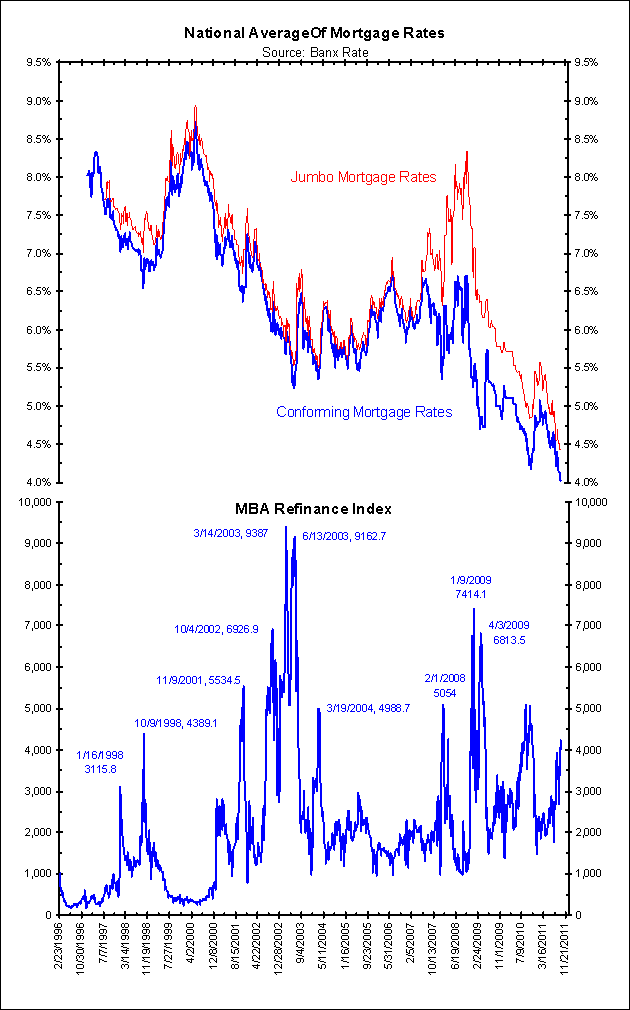
Bankers and investors f*ck up, the government comes to the rescue with taxpayer money.  The vicious cycle continues and no one bats an eyebrow.  What is indeed worrisome however is the effect of "Operation Twist."  While 30 year fixed mortgage rates have gone below 4% for the first time ever:
(Great time to refinance and lock in the new rate by the way) it looks like the Twist is providing the perfect opportunity for foreign central banks to dump their Treasuries, via Wall Street Examiner:
Foreign central bank dumping of Treasuries and Agencies reached record levels this week, far beyond anything seen in the 9 years since I started tracking this data. The last time anything remotely similar happened was at the top of the bull market in the summer of 2007, and those levels pale by comparison with what is going on today. Furthermore, this is no flash in the pan. This has been going on for 4 weeks, and has been growing for the past 3. Over the past 9 years, there has never been a time when FCBs were sellers of their Treasury and Agency debt for 4 weeks in a row. I do not believe that the bull market in bonds can survive under these conditions, regardless of what the Fed does. If the runs on European banks, bank paper, and sovereign debt subside, by even a little, it’s over.
Furthermore, this withdrawal of FCB liquidity from the US market, combined with no net new liquidity from the Fed, should keep stock prices under pressure. For months falling stock prices have gone hand in hand with rising bond prices and falling yields. Any reversal in the trend of bond yields may not be accompanied by a similar reversal in stock prices, or at least not to the same degree.
Bernanke isn't going to like this, not one bit.  And I doubt any of the central banks are going to be going back into the treasury market anytime soon.  Bernanke just bailed out foreign banks again, what a great guy.  Santa Claus isn't coming this year, he is outsourcing the elves to the Fed to work the printing machines.  That way the whole world is going to get its stocking stuffed with dollars this Christmas.

I have talked a lot about Occupy Wall Street on here, mainly on how their anger is understandable but misdirected.  This takes the cake however and is astonishing to watch:
John Lewis may suck as a politician but even he didn't deserve to put up with this crap.  I mean what in God's green Earth was that?  How in the world is one guy standing up there preaching egalitarianism while "leading" the crowd?  There must be something in the water at Atlanta.
Though Occupy Wall Street is becoming a joke, the great William Banzai strikes again:
This is a masterpiece:
Fantastic job again Banzai.  I will end with this great quote that sums up the whole movement and greatly reflects my current situation, via Wall Street Journal:
We have an entire generation of young people who were promised good jobs if they worked hard, played by the rules and attended college. They kept their end of the bargain and when they graduated they were left with no job prospects and a record amount of debt.
Though I would like to think I worked a hell of a lot harder than many of my peers, this is completely on point.

Update- Fantastic Tom Woods interview, if you got 45 minutes to spare check it out:

Sabtu, 08 Oktober 2011

Ron Paul Wins Values Voter Straw Poll- The Implications

Big news today as Ron Paul has an astounding victory at the Values Voter Summit in D.C.:
This is a big victory for Paul considering he was in relatively hostile territory.  Paul's stance on drugs, civil liberties, marriage, and war have never sat well with the mainstream conservative crowd so this says a lot.  What did it was this phenomenal speech.

Unfortunately I am unable to imbed the speech here right now but it is fantastic.  Paul invokes the Bible to make the case for dismantling the welfare state along with ending war.  The audience is very receptive and the straw poll votes agree.  Meanwhile we have Mitt Romney calling for more defense spending and imperialism yet most Repubs will just fall in line and vote for him because they think he is the only chance to beat Obama, it doesn't matter if they embody many of the same policies.  This was a great victory for Paul over all and just goes to show how a belief in limited government can be compatible with modern day conservatism.

Not too much other news today so I will end with 15 Things You Didn't Know About Steve Jobs:

Update- Very interesting...I will have to watch out for this guy: