Despite a lack of charitable giving, Jobs has done much more by selling a product that enriches consumers' lives. While the "Great Society" welfare programs have left inner cities a decaying corpse of what they used to be, Jobs gave electronics at an inexpensive price to those who still dwell in such living conditions. Ipods are as cheap and prevalent as ever; there is no doubt that iPads and MacBooks will someday be the same. While politicians never waste a minute to boast about welfare programs that have failed to deliver prosperity after nearly four decades, Jobs brought gadgets of wonder to the masses in a matter of years. He was not bound by the moral justifications of using other people's money to buy votes but to invent and create for the sake of profiting. Improving living standards in society was only a secondary effect to Jobs' visionary business model.
The world may have lost a great mind, but it can still learn a great lesson from the legacy of Steve Jobs.
Jobs was a great man who enriched all of our lives so it only makes sense that Obama and crew want to get their grubby little mitts on everything Jobs worked for. Via LRC Blog:
Writes Stephen Gross:
"It occurred to me that the Jobs estate will probably face about $2 billion in estate taxes. That is approximately what the Federal Government spends every hour. So he worked hard for a lifetime and now a third of his wealth will be squandered in one hour."
I hope the food stamps and drone strikes are worth it. Since I am on the topic of jobs, the official numbers were released today which showed a bit of improvement. Mish has the summary:
Here is an overview of September Jobs Report, today's release.
US Payrolls +103,000
45,000 Striking Workers Return
Net effect is +58,000 jobs
Of the 103,000 jobs added, 444,000 of them were part-time jobs
Thus, 341,000 full-time jobs vanished this past month, replaced by part-time workers
US Unemployment Rate Flat at 9.1%
Participation Rate +.2 to 64.2%
Actual number of Employed (by Household Survey) rose by 398,000
Unemployment rose by 25,000
Those not in the labor force dropped by 224,000
Civilian population rose by 200,000,
Civilian Labor Force rose by 423,000
Average Weekly Workweek rose .1 hours to 34.3 hours
Average Private Hourly Earnings rose 3 Cents 10 $19.52
Government employment decreased by 34,000
I highlighted the best part. Many are reasoning that a return of 45,000 Verizon workers contributed to the better-than-expected results which makes sense but there are other factors at work showing an improving economy as I pointed out yesterday.
While the jobs report is a bit of good news (for the short while anyway) we have party pooper ex commander Stanly McChrystal saying what most who hold an ounce of common sense about the way the government operates have already known. Via HuffingtonPost:
WASHINGTON -- The U.S. began the war in Afghanistan with a "frighteningly simplistic" view of the country, and even 10 years later lacks knowledge that could help bring the conflict to a successful end, a former top commander said Thursday. Retired Army Gen. Stanley McChrystal said in remarks at the Council on Foreign Relations that the U.S. and its NATO allies are only "a little better than" 50 percent of the way to reaching their war goals. Of the remaining tasks to be accomplished, he said the most difficult may be creating a legitimate government that ordinary Afghans can believe in and that can serve as a counterweight to the Taliban.
Hmmm, an industrialized country's military not understanding a tribal and underdeveloped society.....yeah no surprise there. That doesn't mean we shouldn't spend another trillion dollars and 10 years fighting over there of course. If you want to see one of the better anti-war, pro-Ron Paul videos out there, watch the great new Revolution Super PAC ad: I forgot to mention this yesterday, but check out this hardly reported but very important revelation Reuters reported on:
(Reuters) - American militants like Anwar al-Awlaki are placed on a kill or capture list by a secretive panel of senior government officials, which then informs the president of its decisions, according to officials.
Now of course this is a horrible thing and should be talked about more, but Anthony Gregory does a fantastic job commenting on it today in his LRCcolumn:
How fitting that the presidency that Tea Partiers accused of planning to convene death panels to handle health care rationing has openly admitted to having created such a panel whose declared purpose is not simply to withhold socialized medical resources, but to direct the cold-blooded murder of citizens who are sufficiently bothersome enemies of the regime. Yet in a majestic irony, many of the conservatives who feared Obama’s life-and-death bureaucracies are cheering on his most explicit and frightening seizure of dictatorial power in all his presidency, and perhaps one of the greatest of all presidential power grabs in the sweep of U.S. history.
Looks like we have another death panel Paul Krugman will approve of. Of course if this were Bush, the left would be having a field day with this one but we have Democrat and Nobel Peace prize laureate in office really showing the world how much we value freedom. Gregory's article is highly recommended. I will end with this hilarious image that sums up the Occupy Wall Street movement perfectly:
Like the tea party, it's a damn shame that the movement had to be hijacked by one of main political parties. What could have been a decent referendum on the government's extra cozy relationship with the big banks has quickly turned into another punching bag for the main stream media. Instead of MSNBC throwing rocks it's Fox News.
As you requested, CBO and the staff of the Joint Committee on Taxation (JCT) have estimated the budget impact of S. 1660, the American Jobs Act of 2011, as introduced in the Senate on October 5, 2011. CBO and JCT estimate that, in total, enacting S. 1660 would decrease deficits by about $6 billion over the 2012-2021 period (see enclosed table). That estimated deficit reduction of $6 billion over the coming decade is the net effect of $447 billion in additional spending and tax cuts in titles II through III and $453 billion in additional tax revenue from the surtax specified in title IV. S. 1660 is similar to S. 1549, the American Jobs Act of 2011, as introduced in the Senate on September 13, 2011. Provisions in title I, II, and III related to both federal revenues and spending are identical for the two bills. The only difference between the bills is that S. 1660 replaces the provisions in title IV (Offsets) of S. 1549 with a surtax of 5.6 percent, starting in 2013, on a taxpayer’s modified adjusted gross income in excess of $1 million (or $500,000 in the case of a married individual filing a separate return), indexed for inflation. JCT estimates that title IV of S. 1660 would increase revenues by $453 billion over the 2012-2021 period, whereas title IV of S. 1549 would increase revenues by $450 billion over that period.
In yet more other words, the great populist gimmick that is the Buffett Tax will have the great benefit of generating, between 2011 and 2021 enough money to plug a debt hole, at the rate America currently spends money, of 4 months.
There were a number of indicators today and yesterday all pointing toward an improving economy in the U.S. Considering the mess going on everywhere else and no actual improvements made to the structural problems we are facing, this has all the makings of fiat financed recovery. Here is the good news:
Amid slumping consumer confidence, shoppers remained resilient, and many retailers posted solid results for the month of September.
Helped by shoppers finishing up their back-to-school shopping and stocking up on fall apparel as the temperatures grew cooler, many retailers were able to outpace estimates.
This was encouraging for the economy, given that unemployment has been above 9 percent for more than two years, and news headlines about the U.S. budget deficit, European debt worries and a volatile stock market have given consumers little reason to spend more freely.
Next are less than expected unemployment claims via Bloomberg:
Claims for U.S. unemployment benefits rose less than forecast last week to a level that shows companies may be starting to slow the pace of dismissals. Applications for jobless benefits increased by 6,000 in the week ended Oct. 1 to 401,000, Labor Department figures showed today. Economists projected 410,000 claims, according to the median estimate in a Bloomberg News survey. The monthly average dropped to the lowest level since the end of August.
Here is an interesting one, railroad car load and traffic is up via the always great Mark Perry and Carpe Diem:
"The American Association of Railroads today reported gains in weekly rail traffic, with U.S. railroads originating 312,170 carloads for the week ending Oct. 1, 2011 (week 39), up 4.7% compared with the same week last year. Intermodal volume for the week totaled 250,864 trailers and containers, up 4.4% compared with the same week last year. This week’s U.S. carload volume is highest since Week 45 of 2008, and the intermodal volume is the highest since Week 39 of 2007."
Personal bankruptcy filings continued to slow in September as Americans were less eager to turn to the courts for financial relief. The number of consumer bankruptcies dropped 17% to 108,517 in September compared to the same month a year ago, the American Bankruptcy Institute and National Bankruptcy Research Centersaid Tuesday. So far this year, the number of consumer bankruptcies was 10% lower than the same time period a year ago.
I am even seeing a slight amount of success from my own job searching endeavor. I got a few phone calls today on possible openings. Whether this the making of a another Fed induced boom will remain to be seen but since everybody and their mother is bearish about the economy right now, it doesn't hurt to go against the flow and expect the opposite. One of the concerns I always had with the Austrian Business Cycle Theory was the assertion by some that businessmen can easily pick up on unsustainable booms and wouldn't buy into them if they expect a bust. William Anderson does a great job explaining this fallacy today in his Mises Daily article:
I have heard a number of Chicago School and affiliated economists critique Austrian business-cycle theory (ABCT) by saying that artificially low interest rates should not fool rational business owners and investors, so that there is no way that people would be "tricked" into making massive malinvestments, not to mention irrationally bid up assets into bubbles. That viewpoint is both shortsighted and unfortunate.
Bubble behavior can be seen as rational, even if market participants know they are seeing a bubble. After all, as long as one catches a bubble on the way up, buying low and selling high, one can make money. Furthermore, bubbles burst precisely because investors recognize that the asset prices at the top of the bubble are out of balance with market fundamentals; it is just that these things do not happen with the mathematical precision and smoothness of the mathematical models, so many academic economists simply turn away from looking at things as they really are.
Second, investors and entrepreneurs generally do not look at the economy from a universal viewpoint, instead looking at their particular opportunities. For example, during the housing bubble, a number of new mortgage firms came into being. From the ABCT viewpoint, this was throwing gasoline onto the fire, but to people entering the market, it seemed like a good and quick way to earn a lot of money. Moreover, there were plenty of people on the squawk box and elsewhere claiming that the housing market could sustain a lot more new money than it actually could.
In other words, people, even large groups of people, can be wrong.
I have been the victim of such a concept recently. I started buying physical silver about a year ago when the price was close to what it is now. It went up, I bought a bit during the run up, and the price has since gone down. I have written about this commodity bubble in an article I recently submitted so hopefully it gets approved and published soon.
In neutral but interesting news, check out the outcome of the Fed's first Open Market Operation since "Operation Twist" via Zerohedge:
In essence, by dint of its adjusted mandate, the Fed became the Treasury - what proceeded at precisely 11 am was the announcement of a sale of $8.87 billion in bonds with maturities from January 31, 2012 through July 31, 2012, bonds that were sold not by the traditional issuer of bonds, but by the Fed. Granted no new money was raised by the US in the process, but it was still a curious development. What was far more curious was the staggering turnout by the Dealer community, which indicated an interest for, wait for it, a whopping $242.6 billion in bonds! Said in conventional terms, the Bid To Cover was an unprecedented 27.3, or there was $27 in demand for every $1 of bonds finally sold by the Fed. Why is this worthy of bolding. Because, in a traditional Treasury auction, the Bid to Cover by the Dealer community is far, far lower.
When the hand that feeds tells you to jump, you really don't have a choice in the matter.
While things look a bit better in the U.S., Europe is once again seeing troubles, mainly based on rumors like always. Via Handelsblatt-Google Translate:
In Berlin and Paris argue about EFSF
Exclusive The euro rescue package to buy bonds from future debts States. But with how much money? France wants to give the fund a free hand - for the rescue could not stay no longer enough to fear Germany.
Brussels is a dispute between Germany and France erupted over the extent to which the euro rescue fund future EFSF may buy government bonds. France wanted to make the EFSF this respect no rules, told the Handelsblatt by a senior EU diplomat. This would theoretically mean that the EFSF could not use its entire volume of funding expended to buy bonds of a single Euro-state.
EFSF has a total of 440 billion euros, has been a part of it, however, scheduled for the loan packages to Ireland and Portugal. The federal government wants to limit the amount used for bond purchases per euro government, it said in Brussels. Think Germany will also share in a time limit on bond purchases.
The purchase of government bonds is one of three new instruments may have on the future of advanced EFSF. The design of these new instruments will be governed by guidelines to deal with the high officials of the euro finance ministers in Brussels at present. The guidelines must then be approved by the Budget Committee of the Bundestag. The German Parliament has made this a condition for agreeing to extended EFSF.
Check out IMF Advisor Dr. Robert Shapiro:
If they can not address [the financial crisis] in a credible way I believe within perhaps 2 to 3 weeks we will have a meltdown in sovereign debt which will produce a meltdown across the European banking system. We are not just talking about a relatively small Belgian bank, we are talking about the largest banks in the world, the largest banks in Germany, the largest banks in France, that will spread to the United Kingdom, it will spread everywhere because the global financial system is so interconnected. All those banks are counterparties to every significant bank in the United States, and in Britain, and in Japan, and around the world. This would be a crisis that would be in my view more serrious than the crisis in 2008.... What we don't know the state of credit default swaps held by banks against sovereign debt and against European banks, nor do we know the state of CDS held by British banks, nor are we certain of how certain the exposure of British banks is to the Ireland sovereign debt problems."
The powers-that-be won't let this happen of course but the fear campaign is always entertaining. Just see the Bank of England's latest only-surprising-to-the-critics announcement:
The Bank of England’s Monetary Policy Committee today voted to maintain the official Bank Rate paid on commercial bank reserves at 0.5%. The Committee also voted to increase the size of its asset purchase programme, financed by the issuance of central bank reserves, by £75 billion to a total of £275 billion.
Nothing like an increase of QE adrenaline to keep the zombie banks alive. Like I said, the fear mongering is only entertainment, central banks aren't going to let nature take its course if they can help it.
For the ultimate in fun, see this interactive Euro Bank Stress chart via Reuters:
Feel like telling the banks to take a hike and eat the haircuts inevitably coming their way, go hog wild!
Update- He just keeps getting better: The Q & A is also good but this speech is definitely on point. This is what we don't see with all the "why do you hate food stamps and want children to starve? You have 15 seconds to respond" crap that qualifies as a presidential debate.
Big news today as rumors fly that France seems to be considering emergency measures to capitalize its banking system should the need arise (it will) via Zerohedge- Google Translate- Le Figaro:
Paris prepares a plan to help its banks
The Agency for State Holdings (EPA), meanwhile, has been working for several days in a scheme that would allow the French to enter the capital of financial institutions.
In the heart of summer, the little phrase from the Executive Director of the IMF, Christine Lagarde , the need for recapitalization of banks in Europe had created an uproar on this side of the Atlantic, both in government than among bankers. In France, especially, we stick tooth and nail for several weeks this summer's strategy, namely the implementation of the plan to rescue Greece from July 21 will address concerns and to redress market the situation.
Yes, yes, I am sure everything is fine and there is no significance here. The truth is that France doesn't want to be caught empty handed like the U.S. was when TARP was needed. They are preparing for the big one in advance, if not just for when Dexia goes under. Nothing to see here, move along folks...
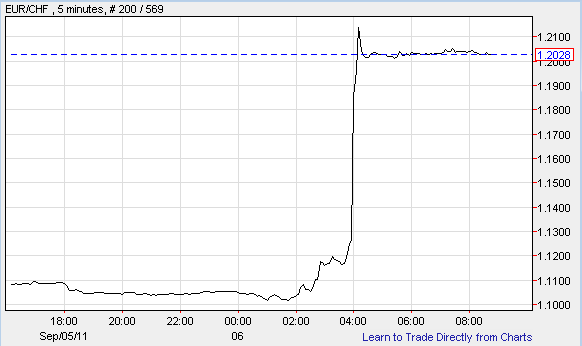
But tomorrow's release of the Swiss National Bank's balance sheet will sure be a sight to see, via Alexander Gloy of Lighthouse Investment Management:
We will know then how much Euros had to be gobbled up in order to defend the “peg”. Increasing tick volume in recent days looks suspicious – why would there be more volume than on days where the Swiss Franc reached parity? Or the day the SNB introduced the peg?
You can’t tell me that we recently had twice as much volume as on September 6, when this happened:
The SNB vowed to purchase “unlimited quantities” of Euros to defend the 1.20 barrier. How credible is that?
It will be very interesting to see how much the SNB destroyed another safe haven currency. Those days are over now, Cloy predicts the SNB balance sheet will have expanded dramatically in order to maintain the euro peg. Judging by the yield on U.S. Treasuries, it looks like the dollar is a safe haven in lieu of the franc and all the Euro zone trouble certainly isn't helping. Whatever gets reported at 3am tonight (the SNB may not have had to purchase euros just yet), you can be sure the currency race to the bottom will continue even as Vice Prez of the Cleveland Fed Joseph Haubrich acknowledges the true effect:
Recently, inflation, as measured by the headline Consumer Price Index, has been running at a sustained clip—prices have risen over 4.5 percent in five of the past seven months, and in July they increased at an annualized rate of 6.2 percent.
To add more salt in the wound, we have this via Telegraph:
Although ignored by most of America’s liberal-dominated media, several online US news sites are reporting that Michelle Obama’s grand tour of southern Africa earlier this year cost American taxpayers nearly half a million dollars – and that's just for the flights. This follows in the wake of claims this August from sources inside the White House itself that the First Lady may have spent “$10 million of taxpayers’ money on vacations alone in the past year.” Without all the figures available, it is impossible to establish the total cost to the public purse of Michelle Obama’s 42 days of holiday during that period, which included her trip to Spain last year (though not the Obamas' recent sojourn in Martha’s Vineyard).
Of course none of this will be acknowledged. Michelle needs her vacations while other nations with such alarming debt/gdp ratios usually start doing something about it like reform entitlements are slash their defense budgets. Unfortunately, there aren't any votes to buy by doing that. And of course the one man running for president who actually gives a crap about his supporters continues to be undermined by the establishment. Take a look at this kid's first hand experience with Ron Paul:
Ron Paul finished his speech, interrupted several times by the enthusiastic crowd, and hurried out the door to catch his plane. Spiker looked at me and gestured toward him. "You're on, get going" was the unspoken message. Rushing to catch up, I followed the congressman to his waiting car. "Here," Paul said, "you hop in this side. I'll go around." Say what? A congressman deferring his seat to a regular guy like me? Someone get me the weather report in Hell, quick. We got in the SUV and took off. "So," Ron says to me, "what did you think of the speech? Was it OK?" Yes, I told him. I enjoyed it very much. "I hope so. You know," he said with the wave of his hand, settling himself into the backseat, "I feel like I repeat myself a lot. I feel bad that I have to say a lot of the same things all the time, but the message of freedom is important." Clearly this was a humble man I was dealing with here, with a refreshingly human touch of insecurity. Congressman Paul and I talked casually, like old friends. We chatted about what I was doing in school, what I wanted to do in the future, some of his past trips to Iowa State, and the fast pace of the campaign. We pulled into the Nevada McDonald's. "I'm so hungry" Ron said. "We haven't had time to eat today." Paul had stopped in Dubuque, Clinton and Muscatine before arriving in Nevada. As we sat in the parking lot waiting for the congressman's value meal, a couple walked by. Illuminated by the dome light overhead, they could see Paul sitting there. The man peered in at us and did a double take, quickly tapping the woman's arm and pointing. The two grinned and waved excitedly, and Paul leaned forward between the front seats and waved back, no doubt making their night. Like I said, Paul's people love him, and it just goes to show that his people are everywhere.
Would Romney, Perry, Cain, Bachmann or any other candidate polling fairly high actually do this for a student reporter? I certainly don't think so, Paul continues to impress. I will end with another character that continues to impress, WilliamBanzai's Visual Combat Daily is always a bright spot in my day and today's is no different:
Banzai keeps getting better and better, keep up the great work!
Update- RIP Steve Jobs, a fantastic but ironic speech given at Stanford's commencement:
Got a new article on the Mises Institute today entitled "Cash for Clunkers: A Personal Look" which deals with my experience working at a car dealership and how it lead to my introduction to the Austrian school of economic thought. Here is an excerpt:
In the summer of 2009, I started working at a Hyundai car dealership in Harrisburg, Pennsylvania. Being a college student on summer break, I took the part-time position of detailer/reconditioner. My job was cleaning and preparing newly sold cars. I started in the month of May and prior to the implementation of "cash for clunkers," sales were steady. On average, three to four new cars were sold on weekdays. On Saturdays, about six to seven new cars were sold. By law in Pennsylvania, car dealerships must remain closed on Sundays — clearly another case of government knows best.
Once "cash for clunkers" went into effect, new-car sales shot up. Weekday average car sales increased to Saturday levels. Saturdays became a zoo with close to ten new cars being sold throughout the day. With so many car sales, I never had any downtime those weekends. Normally the dealership would close at 8 p.m. unless there was a pending sale. It was normal to stay until 10 or 11 p.m. on the days "cash for clunkers" was in effect, as customers waited for approved credit applications and cars needed to be cleaned.
From the perspective of immediate consumption, "cash for clunkers" was an astounding success. Working so many consecutive hours provided a substantial boost to my paycheck. The car salesmen increased their commissions. The dealership was very profitable. But like all government stimulus efforts, this effect was short-lived.
Around the time "cash for clunkers" ended, I started the fall semester. I still returned to work on Fridays and Saturdays but sales began to slow down dramatically following the program's end. Throughout September, Saturday sales fell with only four to five new cars sold each day. From what I heard, weekday sales had slowed down significantly. During October, I was lucky to clean two or three newly sold cars on a Saturday. Some Saturdays went by in November with zero cars sold. Car salesmen began to be laid off. The assistant manager of the dealership was let go, as were many of the mechanics and staff running the automotive-parts department. Because I only worked a day and a half a week and was paid a dollar an hour less than the other experienced detailers, I was kept around. Once December hit, the dealership finally shut down for good. It was quite the Christmas present.
On to the news of the day. Well, it had to happen sooner or later; it looks like Dexia, the largest lender in Belgium, is going to be the first casualty in the coming Greece default, via Bloomberg Businessweek:
Oct. 3 (Bloomberg) -- The board of Dexia SA, Belgium’s biggest lender, is meeting to discuss options including a possible breakup after Europe’s debt crisis reduced its funding, a person with knowledge of the talks said.
Dexia, which finances municipalities in France and Belgium, may split off its French business partly under the oversight of state-owned Banque Postale SA, said the person, who declined to be identified because the matter is confidential. The discussions are complex because Dexia is based in Brussels and Paris, and has both governments as shareholders. An announcement may come as soon as tonight, the person said.
So what does this mean for the U.S., well Reggie Middleton has some interesting charts outlining Goldman Sachs' amount of exposure to French banks:
Here is a bit more on Goldman Sachs:
With Dexia most likely being "saved" (nationalized with taxpayer money) tonight, it will be interesting to see where we go from here. French banks are currently undergoing an institutional bank run, Goldman's next move should be fun to watch. Good thing Goldman practically rules the world and will likely be saved by any central banker on the planet, even more so that a former exec. is about to take the reigns of the ECB and one has been nominated to head the Financial Stability Board. I should also mention that there are rumors floating around that the Fed is exposed to Dexia but with the power to create liquidity on demand, that is no problem.
For some reason, today seems to have an extra filling of economic idiocy, at least more than normal. First up is the list of proposed demands from the Occupy Wall Street crowd. The list seems to be composed by a sophomore political science major and contains such gems as these:
Demand one: Restoration of the living wage. This demand can only be met by ending "Freetrade" by re-imposing trade tariffs on all imported goods entering the American market to level the playing field for domestic family farming and domestic manufacturing as most nations that are dumping cheap products onto the American market have radical wage and environmental regulation advantages. Another policy that must be instituted is raise the minimum wage to twenty dollars an hr. Demand two: Institute a universal single payer healthcare system. To do this all private insurers must be banned from the healthcare market as their only effect on the health of patients is to take money away from doctors, nurses and hospitals preventing them from doing their jobs and hand that money to wall st. investors. Demand three: Guaranteed living wage income regardless of employment. Demand four: Free college education. Demand five: Begin a fast track process to bring the fossil fuel economy to an end while at the same bringing the alternative energy economy up to energy demand.
It's hard not to pound your head against the wall reading this. It looks copied and pasted from the American Communist Party website. One of the commentors made a very fitting addition to the demand list:
I'd like to add a few more: Make the Middle East stop fighting. Everyone gets a helicopter that runs on children's laughter. Gummy bears are free. Nobody judges anyone for having dumb ideas or lists of demands. (cough)
I find the immediate above list more feasible than the actual demands. While the Occupy Wall Street kids don't have a clue on how the real world works outside of their dorm rooms, they aren't all hopeless: Finally someone actually gets it. Mad props to this kid for actually having a brain. Next up in the sideshow is the U.S. Senate who has begun to consider passing some kind of bill to punish China for manipulating its currency, via Reuters:
(Reuters) - An angry China warned Washington on Tuesday that passage of a bill aimed at forcing Beijing to let its currency rise could lead to a trade war between the world's top two economies. China's central bank and the ministries of commerce and foreign affairs accused Washington of "politicising" currency issues and putting the global economy at risk after U.S. senators voted on Monday to start a week of debate on the bill.
How the hell is making goods at Walmart more expensive going to spur job creating? Are underwear factories going to make their glorious return to America where Richard Trumka can try and scoop up the workers? This is unbelievable, China is the one losing out by keeping the yuan undervalued, all they get is dollars and inflation while we get cheap goods. It's not like the U.S. even has to do anything, China is having to hike interest rates to cool down its economy already. Only complete and utter morons would actually believe that making goods more expensive would lead to economic growth, the same goes for those who want higher taxes. It's no surprise though considering we have this guy running things:
This is exactly why we need this Consumer Finance Protection Bureau that we set up that is ready to go. This is exactly why we need somebody who's sole job it is to prevent this kind of stuff from happening. ... You can stop it because if you say to the banks, ‘You don't have some inherent right just to – you know, get a certain amount of profit. If your customers – are being mistreated. That you have to treat them fairly and transparently.
Oh, I see, so Obama and the technocrats at the CFPB can decide on what the "right" amount of profit is for banks now. Super. It's a wonder they are even allowed to operate how they want. Clearly we need the government telling BoA execs how to run the business and treat their customers who voluntarily do business with the bank. And we are supposed to trust these guys?
This gave Freddie the option to sell the defective loans back to Bank of America, which then owned Countrywide. But proving that hundreds of thousands of loans were defective was a lot of work. Freddie only reviewed some of them, relying on a poor methodology that dramatically underestimated the number of defective mortgages. This increased losses to Freddie Mac -- losses that will eventually fall to Treasury and taxpayers.
And so you get this picture, from a 2011 report by Freddie's internal auditor. What you're seeing is that Freddie's review process (the black line) looked hardest at the bucket of loans containing 16% of total foreclosures. It mostly ignored the bucket containing 70% of the foreclosures. By comparison, this is a bit like searching for a lost salt shaker and spending more time looking on the roof than in the kitchen. We have reason to think Freddie was being willfully ignorant. An examiner at Freddie's regulator, the Federal Housing Finance Agency, warned that the majority of foreclosures were going uncounted in March 2010. Sure enough, in June 2011, regulators told Freddie that their review process was ignoring "over 93% of the year-to-date foreclosures from the 2005 and 2006."
So Obama plays the middle class warrior while simultaneously helping out those who he demonizes in public. Well you know what they say, if it smells like fascism and looks like fascism...
Bernanke faced the firing squad today at the Congress's Joint Economic Committee. Here is the live update blog from WSJ. The best exchange, which isn't mentioned in the link, came when socialist Sen. Bernie Sanders asked Bernanke why he doesn't make low interest loans directly to small business. Bernanke, knowing full well how inflationary and disastrous this would be, squirmed his way out of it and didn't have to admit that he is a tool for the banks and only makes low interest loans to them. It was incredibly entertaining and showed just how uncomfortable Bernanke can be under pressure.
Bulgarians appear to have a hard time letting go of communism. This month, many Bulgarians celebrated the hundredth anniversary of the birth of Todor Zhivkov, the country’s longstanding communist leader, according to the Wall Street Journal. Earlier this year, the Journal also reports, Bulgarians were outraged when vandals spray painted monuments to the country’s socialist past. While you might think that the country’s nostalgia for the communist era has little to do with its ability to foster entrepreneurship today, it turns out that the two are related. In the Eastern European countries that experienced several decades of communist rule, Karl Marx’s ideas still influence the views of many people about business ownership. According to a 2009 survey of more than 26,000 people in 36 countries conducted by the Gallup Organization, only 31 percent of Americans agree with the statement that “entrepreneurs exploit other people’s work.” By contrast, 70 percent of Bulgarians, 72 percent of Estonians, 54 percent of Latvians, 79 percent of Lithuanians, 70 percent of Poles, 63 percent of Romanians, 73 percent of Slovenians, 73 percent of Slovakians, and 69 percent of Croats agree.
Is it any wonder why the Occupy Wall Street crowd is so clueless when thoughts such as this still permeate?
I will end with one bright spot: this has got to be the greatest Ron Paul song ever written: Update- James Altucher has a fantastic post on one of my favorite authors entitled "6 Things I Learned from Charles Bukowski." I started reading Bukowski in high school; he is a depressed alcoholic who wandered the country during the Depression picking up odd jobs, writing, drinking, and screwing random and disgusting women. He hated himself and the women he was with but wrote like a madman about his depressing and hard life. He was the most anti-establishment guy ever and spoke so straightforward and truthfully that he made Ron Paul look like Mitt Romney. Ironically, I have lost all my Bukowski books to girlfriends who have dumped me over the years. I say ironic because Bukowski treated women like crap while every girl that has dumped me also eventually asked to get back together to which I always say no for personal reasons. So great job on the post James! I really gotta repurchase copies of "Factotum," "Women," "Post Office," and "Ham on Rye."
The Institute for Supply Management's Manufacturing Report for September is out today and contains some surprising numbers considering all the news of a global economic slowdown occurring. Here is the quick glance:
MANUFACTURING AT A GLANCE SEPTEMBER 2011
Index
Series Index Sep
Series Index Aug
Percentage Point Change
Direction
Rate of Change
Trend* (Months)
PMI
51.6
50.6
+1.0
Growing
Faster
26
New Orders
49.6
49.6
0.0
Contracting
Same
3
Production
51.2
48.6
+2.6
Growing
From Contacting
1
Employment
53.8
51.8
+2.0
Growing
Faster
24
Supplier Deliveries
51.4
50.6
+0.8
Slowing
Faster
28
Inventories
52.0
52.3
-0.3
Growing
Slower
2
Customers' Inventories
49.0
46.5
+2.5
Too Low
Slower
30
Prices
56.0
55.5
+0.5
Increasing
Faster
27
Backlog of Orders
41.5
46.0
-4.5
Contracting
Faster
4
Exports
53.5
50.5
+3.0
Growing
Faster
27
Imports
54.5
55.5
-1.0
Growing
Slower
25
OVERALL ECONOMY
Growing
Faster
28
Manufacturing Sector
Growing
Faster
26
As you can see, most measurements are reporting growing. Mish is concerned about the contracting backlog orders which makes it look like while production and employment is increasing, it isn't sustainable. This type of worry could easily fit into the ABCT model as the Fed has been increasing the monetary base (23.3% annualized increase for the past 3 months) and as the chart shows, prices and exports are creeping up. Whether Sept. was an blip in the radar of coming deflation and contraction or the beginning of another manipulated, sector wide boom will remain to be seen. Even more of a sign of the latter is the new car sales have increased:
General Motors said its U.S. sales jumped 20% to 207,145 vehicles compared with September 2010. Chrysler sales surged 27% to 127,334 vehicles, marking the company's best September since 2007. Volkswagen of America said sales of its VW brand rose 36% to 27,036 vehicles in September.
Gee, I wonder how much of the money made from those increased sales will go back to taxpayers for bailing out GM and Chrysler?
Once again, when Democrats don’t like the facts, they just ignore them with the help of the mainstream media.
On August 26, Investor’s Business Daily reported data from the Internal Revenue Service showing that the average U.S. income had increased every year for five straight years through 2006. In fact, the $58,029 average was $739 higher than the peak year of 2000, the year before the 2001 recession.
The following day, Sen. Joe Biden declared in his vice-presidential acceptance speech that “John McCain thinks that during the Bush years we’ve made great progress economically, I think it’s been abysmal!” Great progress or abysmal, you make the call.
On August 28, the Associated Press reported the latest Commerce Department data showing that the economy grew faster than previously thought in the April-June 2008 quarter. Gross domestic product (GDP) grew at 3.3 percent, exceeding both the initial estimate and economists’ expectations.
As a reminder, we still have not had a recession since 2001, using the standard definition of a recession as two consecutive quarters of negative GDP growth. But don’t tell the Democrats and the mainstream media. You might disrupt their imaginary recession.
So what is so awesome about this article? Well, it was published on September 1, 2008!!!! With this amount of genius foresight, it's a wonder that Cain can't tell us when the "recovery" is coming already. Being a college grad struggling to find work, I would really really like to know Mr. Cain.
About a week or so ago, I posted on Reggie Middleton's great layout of the current bank runs occurring in Europe right now. Well, add another stick to the pile, viaBloomberg Businessweek:
Oct. 3 (Bloomberg) -- The Federal Reserve Bank of New York may ask foreign lenders for more detailed daily reports on liquidity as the U.S. steps up monitoring of risks from Europe’s sovereign debt crisis, according to two people with knowledge of the matter.
Regulators held informal talks with some of the largest European lenders about producing a “fourth-generation daily liquidity” or 4G report, according to the people, who asked for anonymity because communications with central bankers are confidential. The reports may cover potential liabilities such as foreign-exchange swaps and credit-default swaps, said one person. The U.S. has already increased the number of examiners embedded in these banks, the person said.
While I doubt the NY Fed will stop providing emergency bouts of liquidity to Europe until the powers-that-be say it can stop, this should give investors even more of a chill up their spine if they have money in in Greece, Italy, or France banks.
I will end with a bit of history in the most unlikely of places:
Update- Bruce Krasting has nice (by nice I mean worrisome) update on the Swiss National Bank's balance sheet. As you should know, the SNB jumped in to devalue the franc over a month ago to stop hot inflows of capital into the country and prevent the franc from appreciating. Here is the result:
The Swiss National Bank released its 8/30 balance sheet the other day. The bottom line is that in August Swiss reserves rose by CHF 115b. A monthly increasing of 50% (Staggering). Domestic liquidity (sight deposits) rose an (unbelievable) 390% (CHF 49b to CHF 191B). This information covers the period when SNB bet the farm in an effort to stabilize/weaken the CHF. I’ve been looking at these results for days. Some very dramatic steps have been taken. To provide some perspective consider where Switzerland sits on the rankings of foreign currency reserves to GDP.
This is not a list that Switzerland really wants to be on top of. There is very little reward that can be realized, there is a great deal of risk. The increase in SNB sight deposits is somewhat analogous to the QE actions by the Federal Reserve. Both central banks have taken steps to electronically print money. The consequence is a sharp increase in the Balance Sheet of the CB. In both cases there is a huge pile of money created in the form of bank reserves (sight deposits). In the USA the Fed has done (so far) $1.35T of QE. That comes to 9%% of GDP. The SNB, on the other hand, has done an amount equal to 25% of GDP in just one month.
Consumption expenditures make up 70% of the American economy. When there is an economic downturn, spending should be stimulated because it constitutes so much of the economy. As people consume, businesses receive income and react by producing more. Therefore, deep economic downturns can easily be averted by government boosting aggregate demand through stimulus/deficit spending. Common sense right? Well that's what we should believe according to some economists.
The problem with such easily perceived arguments is precisely because it is so easily perceived. If we could just spend endless amounts of money to supplement consumption than the Great Depression would have ended a decade sooner than it did and the current unemployment rate wouldn't be hovering around 9%. To the aggregate demanders, the economy is a circular machine than just needs a measly trillion dollar injection to spin faster. But as Harvard economist Greg Mankiw points out, if this type of situation were true, then during the summer months when more teenagers are available to work, this shouldn't affect employment:
University of Chicago economist Casey Mulligan offers a challenge to that view. Casey points out that there is a regular surge in teenage employment during the summer months because more teenagers are available to work (that is, the supply of their labor has increased). That is no surprise: It is normal supply and demand in action. But if aggregate demand were the main constraint on employment, this increase in supply should not translate into higher employment during deep recessions such as this one. But it does!
In the view of aggregate demand, this increase in the supply of summer labor shouldn't automatically constitute a rise in employment, yet it does. After all, if the economy is chugging along and demand hasn't increased, why would employers anticipate any change in absence of hiring anyone? Obviously there is something else at work here and its the fundamental concept that Keynes thought he refuted but never actually did: markets clear. A perceived lack of aggregate demand doesn't mean products won't get purchased. Every consumer good will get purchased if the price falls low enough, producers must find this price in order to adopt a new production structure to begin meeting this demand. Think about it: who in their right mind is going to pass up a $5 36 inch television at Best Buy? Sure the producer might not make a profit on this new sales price, but that is precisely why price signals are so important. They give a signal to producers so the structure of production can be adjusted in order to meet this new equilibrium. This may result in the halt on producing 36 inch televisions but it also means that money will be invested in operations perceived as more profitable.
This obsession on "confidence" and "aggregate demand," though seemingly obvious, is way too simple of a mindset to deal with a now global economy consisting of billions, possibly trillions, of transactions a day. If handing out money drove demand and confidence, we would have been out of this current economic slump a long time ago. Increased production financed through accumulated savings ultimately drive sustainable growth. This goes hand and hand with entrepreneurial seeking of unmet demand, not aggregate demand in general. Did Steve Jobs create the ipod to please the animal spirits not yet familiar with mp3 players? No, not exactly. He speculated there was a demand for a portable device that could store a massive amount of music. He could have been wrong, thankfully for us he wasn't. It wasn't like he saw an increase of sales at Walmart and figured he should produce, it was a much more complex decision than that. He designed the product, determined a price he could potentially sell it at (called the marginally profitable price), and decided whether or not to invest his capital to make the whole thing happen.
To reiterate, focusing on aggregate demand misses the whole picture. Taken to its extreme conclusion, over consumption can ultimately lead to higher prices as supply diminishes and production can't keep up. Inflation only exacerbates the situation as wages and prices eventually adjust before distorting prices and thus production.
To end: screw aggregate demand.
Admittedly, this post was written on a whim and might not be thought through as much as other posts. I will probably elaborate on this whole thing more in a future article.
Update- Speaking as a recent college graduate who is struggling to find work, this is not only God awful but painful as well: At least there is always a bright spot:
So as I am sure most of you have heard, the American born Al-Qeada cleric Anwar al-Aulaqi was killed in Yemen yesterday by a drone attack. This was done without him being tried and charged with a crime despite him being an American citizen. Ron Paul said it best, like always:
“(al-Aulaqi) was never tried or charged for any crimes. No one knows if he killed anybody...if the American people accept this blindly and casually that we now have an accepted practice of the president assassinating people who he thinks are bad guys. I think it’s sad.”
The president and executive branch have now set the precedent of ordering the assassination of an American without due process or holding a trial:
The Justice Department wrote a secret memorandum authorizing the lethal targeting of Anwar al-Aulaqi, the American-born radical cleric who was killed by a U.S. drone strike Friday, according to administration officials.
What isn't being thoroughly looked at is not just the illegal and worrisome precedent this is setting, but the fact that it hasn't been confirmed if al-Aulaqi actually killed anyone. Sure, he may have influenced some into committing atrocious acts, but that would logically mean that we start prosecuting cigarette companies for influencing destructive behavior. What about the companies that design violent video games? The argument is no better than blaming society for a teenager shooting up a high school. If I were to tell a friend of mine to kidnap and murder someone, am I liable for their actions? Does this not fall into thought policing? And how can any of this be proven within a reasonable doubt?
These are the types of differentiations that should be theoretically made but can't be in reality. Anwar au-Aulaqi may be the scum of the Earth but even Nazi war criminals got trials.
On that note, Paul Craig Roberts has an extremely important and thought provoking LRCarticle today that appears to be written pre au-Aulaqi assassination. It is more in response to the FBI sting of Rezwan Ferdaus. Some excerpts:
In the past decade, Washington has killed, maimed, dislocated, and made widows and orphans millions of Muslims in six countries, all in the name of the "war on terror." Washington's attacks on the countries constitute naked aggression and impact primarily civilian populations and infrastructure and, thereby, constitute war crimes under law. Nazis were executed precisely for what Washington is doing today.
FBI undercover agents now number 15,000, ten times their number during the protests against the Vietnam war when protesters were suspected of communist sympathies. As there apparently are no real terror plots for this huge workforce to uncover, the FBI justifies its budget, terror alerts, and invasive searches of American citizens by thinking up "terror plots" and finding some deranged individuals to ensnare. For example, the Washington DC Metro bombing plot, the New York city subway plot, the plot to blow up the Sears Tower in Chicago were all FBI brainchilds organized and managed by FBI agents.
What is the terrorist organization that Ferdaus is serving? Surely not al Qaeda, which allegedly outwitted all 16 US intelligence services, all intelligence services of America's NATO and Israeli allies, NORAD, the National Security Council, Air Traffic Control, Dick Cheney, and US airport security four times in one hour on the same morning. Such a highly capable terror organization would not be involved in such nonsense as a plot to blow up the Pentagon with a model airplane.
Think about this: Are not you amazed that after a decade (2.5 times the length of WW II) of killing Muslims and destroying families and their prospects in six countries there are no real terrorist events in the US? Think for a minute how easy terrorism would be in the US if there were any terrorists. Would an Al Qaeda terrorist from the organization that allegedly pulled off 9/11 – the most humiliating defeat ever suffered by a Western power, much less "the world's only superpower" – still in the face of all the screening be trying to hijack an airliner or to blow one up? Surely not when there are so many totally soft targets. If America were really infected with a "terrorist threat," a terrorist would merely get in the massive lines awaiting to clear airport "security" and set off his bomb. It would kill far more people than could be achieved by blowing up an airliner, and it would make it completely clear that "airport security" meant no one was safe. It would be child's pay for terrorists to blow up electric substations as no one is there, nothing but a chain link fence. It would be easy for terrorists to blow up shopping centers. It would be easy for terrorists to dump boxes of roofing nails on congested streets and freeways during rush hours, tying up main transportation arteries for days.
Before, dear reader, you accuse me of giving terrorists ideas, do you really think that these ideas would not already have occurred to terrorists capable of pulling off 9/11?
A recent report put together by Mother Jones and the Investigative Reporting Program at the University of California-Berkley analyses some striking statistics about the role of FBI informants in terrorism cases that the Bureau has targeted in the decade since the September 11 attacks.
The report reveals that the FBI regularly infiltrates communities where they suspect terrorist-minded individuals to be engaging with others. Regardless of their intentions, agents are sent in to converse within the community, find suspects that could potentially carry out “lone wolf” attacks and then, more or less, encourage them to do so. By providing weaponry, funds and a plan, FBI-directed agents will encourage otherwise-unwilling participants to plot out terrorist attacks, only to bust them before any events fully materialize.
After bringing up these eye opening points, for the first time I have seen, Roberts reveals just how much of an insider he used to be:
I am a former staff associate of the House Defense Appropriations subcommittee. I required high security clearances as I had access to information pertaining to all US weapons programs. As chief economist of the House Budget Committee I had information pertaining to the US military and security budgets. As Assistant Secretary of the US Treasury, I was provided every morning with the CIA's briefing of the President as well as with endless security information. When I left the Treasury, President Reagan appointed me to a super-secret committee to investigate the CIA's assessment of Soviet capability. Afterwards I was a consultant to the Pentagon. I had every kind of security clearance. Despite my record of highest security clearances and US government confidence in me including confirmation by the US Senate in a presidential appointment, the airline police cannot tell me from a terrorist.
Like David Stockman, Paul Craig Roberts has definitely redeemed himself with his scathing critique of our over growing police/war state. With much of Al-Qeada's leaders gone or in custody, it only makes sense for another boogeyman comes along. Roberts even tackles this:
John Glaser reports that, according to anonymous CIA officials, US Joint Chiefs of Staff chairman Mike Mullen "exaggerated" the case against the Haqqani insurgent group when he claimed, setting up a US invasion of Pakistan, that the Haqqanis were an operating arm of the Pakistan government's secret service, the ISI. Adm. Mullen is now running from his "exaggeration," an euphemism for a lie. His aid Captain John Kirby said that Mullen's "accusations were designed to influence the Pakistanis to crack down on the Haqqani Network." In other words, the Pakistanis should kill more of their own people to save the Americans the trouble. If you don't know what the Haqqani Network is, don't be surprised. You never heard of Al Qaeda prior to 9/11.
Here comes another propaganda campaign in the name of American exceptionalism. The overseas military excursions aren't stopping anytime soon as long as the dollar stays propped up and we are kept out of the loop by "our" government. See this wonderful yet unbelievable exchange between White House Pres Sect. Jay Carney and ABC's Jake Tapper: It's nice to see Tapper engaging in some actual journalism for once but it won't amount to anything ultimately.
So as Operation Occupy Wall Street continues, there are rumors flying around that a large amount of people were arrested on the Brooklyn bridge. You can watch the Livestream action here. As I have said before, it doesn't look like many of these kids actually understand economics or how the financial system really works. Meanwhile, it looks like the far left has hijacked the operation and wants criminal charges brought to the banksters. But the solution is far simpler than locking up folks like Jamie Dimon and Lloyd Blankfein as Robert Wenzel so eloquently puts it:
If the government didn't backup the banksters, these clowns would be out of business.
Anthony Wile has a fantastic article on the subject today in The Daily Bell:
There are very large centers of money power in Wall Street such as Goldman Sachs; and Goldman Sachs is certainly an integral and purposeful part of the modern corporatist system. But even much of what Goldman Sachs does is essentially transactional. It's fundamentally a business, an intermediary, and its employees are paid (a lot, admittedly) to perform certain functions. The real control, I'd argue, lies elsewhere. To get at the root of the problem, one should be protesting, say, in London's City where central banking originated. Or protesting in front of the Federal Reserve in Washington DC. These are real seats of power. But the shadowy and excessively powerful and wealthy individuals who have created the modern economic system are quite satisfied no doubt to have Wall Street take the blame. It suits their purposes.
Regulation doesn't work at all. Regulating Wall Street doesn't work. Using the Leviathan (federal government) to tame the abuses of the securities industry only makes things worse. Giving unelected bureaucrats power over banks and the securities industry centralizes the corruption and guarantees more of the same in bigger amounts. Unfortunately, Occupy Wall Street has taken a (predictably) anti-free market turn. It's apparently being hijacked by the modern Left, and the rhetoric of individuals involved increasingly mimics the socialist heyday of the early 20th Century. On purpose, they are creating a straw man. Free markets don't really exist these days. Today's corporatist capitalism, fighting for life within the ambit of regulatory democracy, has little to do with vibrant entrepreneurialism or even allowing people a chance to control the monetary and fiscal levers that dominate their lives.'
This is 100% correct. I can never express the amount of frustration I experience every time someone tells me the financial crisis was the result of free markets. Since when did organizations such as the Federal Reserve, the S.E.C., the F.D.I.C., the C.F.T.C., and Fannie Mae and Freddie Mac exist in a free market? Yes, Wall Street overleveraged itself on toxic garbage (approved by government sanctioned rating agencies mind you) and brought the world economy to its knees, but hardly anyone who treats Keynes' "General Theory" like the Bible actually questions why this occurs. The idea that perhaps the federal government provided an implicit bailout guarantee is like pre marital sex on "Leave it to Beaver," it just doesn't happen. And unlike Jude and Ward Cleaver, large financial institutions don't sleep in a separate bed from the government. Just ask current White House Chief of Staff and former JP Morgan executive Bill Daley or former Treasury Secretary and Goldman Sach CEO Hank Paulson.
And because of this footsie relationship, the Federal Reserve and federal government have made a habit out of bailing out losers to save the economy from what should be a short term crash. Chrysler going bankrupt in 1979 or Lockheed declaring Chapter 9 in 1971 wouldn't have been the end of the world. Yet their subsequent bailouts proved to be as much as they put that dangerous little thought of "Uncle Sam will be there in case of a mess" in the back of the head of every major business in the country. You can see a pretty good history of government bailouts here or just read Barry Ritholtz's fantastic Bailout Nation to learn more.
Where the trust fund, pinko loving crowd being arrested for innocent protests should direct their anger towards is not profit seeking banks but the Federal Reserve that provides them with infinite supplies of liquidity. As Gary North points out:
The New York FED is the most important private economic organization in the world.
Primary dealers serve as trading counterparties of the New York Fed in its implementation of monetary policy. This role includes the obligations to: (i) participate consistently in open market operations to carry out U.S. monetary policy pursuant to the direction of the Federal Open Market Committee (FOMC); and (ii) provide the New York Fed's trading desk with market information and analysis helpful in the formulation and implementation of monetary policy. Primary dealers are also required to participate in all auctions of U.S. government debt and to make reasonable markets for the New York Fed when it transacts on behalf of its foreign official account-holders.
BNP Paribas Securities Corp. Barclays Capital Inc. Cantor Fitzgerald & Co. Citigroup Global Markets Inc. Credit Suisse Securities (USA) LLC Daiwa Capital Markets America Inc. Deutsche Bank Securities Inc. Goldman, Sachs & Co. HSBC Securities (USA) Inc. Jefferies & Company, Inc. J.P. Morgan Securities LLC MF Global Inc. Merrill Lynch, Pierce, Fenner & Smith Incorporated Mizuho Securities USA Inc. Morgan Stanley & Co. LLC Nomura Securities International, Inc. RBC Capital Markets, LLC RBS Securities Inc. SG Americas Securities, LLC UBS Securities LLC.
The fermenting anger of bailouts and special privileges should be focused on the institution that grants monopolies over money creation to a select few elite bankers, not the bankers themselves. They are, after all, acting in their own interest to increase their stake of wealth in a society of scarce resources, just as everyone else is. Profits normally drive innovation toward providing better goods and services but not when Uncle Sam builds a fence of regulation to keep competitors from crashing the party. Drop the monopolization and protection and Goldman Sachs, JP Morgan. and their friends will undoubtedly crumble on their own only to rebuild themselves on more solid and sustainable business models that don't rely on taxpayer bailouts. And of course all the time and resources spent buying favors can be used to invest in more productive outlets.
I have already admitted it before, the Occupy Wall Streeters have lasted a lot longer than I originally thought. Anyone who peacefully protests for longs periods of time should be respected despite the naive nature of their beliefs. They still stand to learn a great deal by studying basic economics, namely of the Austrian tradition. Putting their faith in an institution that brought us such crony capitalist successes as Solyndra and Obamacare is not only idiotic but makes the problem much worse.
I will end with this fantastic comic strip I saw in the Allentown Morning Call today: