Senin, 22 Agustus 2011

Fed Bailouts Revealed, Gold On Its Way Up, and Antiwar.com Being Investigated by FBI?

Remember when Bloomberg's "right-to-know" request on the Fed's records during 2008 was held up by the Supreme Court?  Yes, it was a glorious day indeed, and Bloomberg finally has the goods after sifting through almost 30,000 pages of documents:
Citigroup Inc. (C) and Bank of America Corp. (BAC) were the reigning champions of finance in 2006 as home prices peaked, leading the 10 biggest U.S. banks and brokerage firms to their best year ever with $104 billion of profits.
By 2008, the housing market’s collapse forced those companies to take more than six times as much, $669 billion, in emergency loans from the U.S. Federal Reserve. The loans dwarfed the $160 billion in public bailouts the top 10 got from the U.S. Treasury, yet until now the full amounts have remained secret.
Fed Chairman Ben S. Bernanke’s unprecedented effort to keep the economy from plunging into depression included lending banks and other companies as much as $1.2 trillion of public money, about the same amount U.S. homeowners currently owe on 6.5 million delinquent and foreclosed mortgages. The largest borrower, Morgan Stanley (MS), got as much as $107.3 billion, while Citigroup took $99.5 billion and Bank of America $91.4 billion, according to a Bloomberg News compilation of data obtained through Freedom of Information Act requests, months of litigation and an act of Congress.
Don't forget about the foreign borrowers of course:
Almost half of the Fed’s top 30 borrowers, measured by peak balances, were European firms. They included Edinburgh-based Royal Bank of Scotland Plc, which took $84.5 billion, the most of any non-U.S. lender, and Zurich-based UBS AG (UBSN), which got $77.2 billion. Germany’s Hypo Real Estate Holding AG borrowed $28.7 billion, an average of $21 million for each of its 1,366 employees.
And of course those ultra low low rates that only the Bernank can supply!:
While the Fed’s last-resort lending programs generally charge above-market interest rates to deter routine borrowing, that practice sometimes flipped during the crisis. On Oct. 20, 2008, for example, the central bank agreed to make $113.3 billion of 28-day loans through its Term Auction Facility at a rate of 1.1 percent, according to a press release at the time.
The rate was less than a third of the 3.8 percent that banks were charging each other to make one-month loans on that day. Bank of America and Wachovia Corp. each got $15 billion of the 1.1 percent TAF loans, followed by Royal Bank of Scotland’s RBS Citizens NA unit with $10 billion, Fed data show.
Here is the real kicker:
The Fed’s liquidity lifelines may increase the chances that banks engage in excessive risk-taking with borrowed money, Rogoff said. Such a phenomenon, known as moral hazard, occurs if banks assume the Fed will be there when they need it, he said. The size of bank borrowings “certainly shows the Fed bailout was in many ways much larger than TARP,” Rogoff said.
Awww, corporate welfare at its finest.  I guess this is why Bernanke got Man of the Year from Time.  Thankfully Bloomberg has put all the data together in a handy interactive graph for all of us, click to be linked:

So how did all this Fed stimulus help the well-connected banks?  See Bank of America today:
How about everyone's favorite Goldman Sachs:
There is a good reason for Goldman's sudden drop though, it looks like the SEC may be starting to do their job, albeit a few years too late.  Via Reuters:
Goldman Sachs Chief Executive Lloyd Blankfein has hired Reid Weingarten, a high-profile Washington defense attorney whose past clients include a former Enron accounting officer, according to a government source familiar with the matter.
Hmm, looks like something big is coming Blankfein's way.  Speaking of big, look at gold prices today:
Silver isn't gonna be left out of the fun:
As the world crumbles, precious metals soar.  And here I thought a correction was coming soon (it still may).  Looks like Krugman has some explaining to do!

Now that it looks like Libya may finally be in the rebels' hands, it looks like the internet's premier news site on everything American imperialism, the great Antiwar.com, is under investigation by the FBI.  I am not making this up:
It was a beautiful Saturday afternoon and it was my day off. Sitting in my rather neglected garden, as the late afternoon light sparkled golden on the tops of the plum trees, I put down my book – the 1995 edition of The Year’s Best Science Fiction, edited by Gardner Dozois – with more than a little annoyance. I was smack dab in the middle of a short story, “Asylum,” by Katharine Kerr, a tale about a future military coup in the US, written from the point of view of a particularly earnest liberal with faintly radical leanings. The main character is a woman writer who is abroad when the generals take over, and is marked as an enemy of the state on account of her book, Christian Fascism: Its Roots and Rise. Her San Francisco office is raided and her files carted away. She gets a call from a friend before the coup plotters cut off all communications with the outside world: “It’s seven days in May – stay where you are!” She stays, but is tortured by the prospect of her daughter being in harm’s way: when communications with America are finally restored, she wrestles with the question of whether to pick up the phone and make a call that might endanger her daughter. After all, what if the Christian Fascists are listening?
The phone kept ringing. I picked it up with annoyance: it was our webmaster, Eric Garris, telling me about this – FBI documents recovered through the Freedom of Information Act that detail surveillance of Antiwar.com, the staff, and specifically yours truly.
A word about the authenticity of the documents and their provenance: they were posted on a public website, Scribd.com: their form, including the extensive redactions, the acronymic bureaucratese, and the lunk-headed cluelessness which dominates the FBI’s corporate culture, so to speak, combine to verify their authenticity.
Now this isn't really surprising considering some of things that are written on Antiwar.com.  The same goes for Lewrockwell.com.  Still, it is quite disturbing to see a site that reports on news with plenty of opinion get this kind of scrutiny from the federal government.  Just see this excerpt:
I saved the best for last: the “action” recommendations contained in the memo. While directing the Washington FBI’s Electronic Communication Analysis Unit (ECAU) to “further monitor the postings of website www.antiwar.com,” the San Francisco office – where both Eric and I lived at the time – is tasked with the following:
“It is recommended that a PI be opened to determine if [redacted] are engaging in, or have engaged in, activities which constitute a threat to National Security on behalf of a foreign power.”
Reading that, I could hardly believe my eyes. Yielding to a sudden need for fresh air, I went out into my garden and just sat there for a few moments, warming myself in the last rays of the setting sun. It all seemed so unreal. Was this really happening, or had I imagined the whole thing? I returned to my computer and read it again, just to be certain, and – sure enough – there it was, plain as the pixels on my screen: I was accused of being “a threat to National Security” and working “on behalf of a foreign power.”
What “foreign power” would that be – Libertopia? Galt’s Gulch?
Tomorrow I am off to a conference in Seattle, expect no posting.  I will happily take bets on whether or not some news will leak that the U.S. financed and provided a lot more support to the rebels then originally let on.  I will also take bets on what kind of government the rebels will implement; something tells me it will be worse than democracy, which is already pretty bad.

Minggu, 21 Agustus 2011

Works Progress Administration in Hungary, Nick Gillespie Defending Child Labor and on Bill Maher, and a Revealing Insight on Welfare

Paul Krugman and Robert Reich have got to be salivating over this disturbing report via Spiegel:
They set out at seven in the morning, carrying spades, axes and scythes, and climb one of the hills above Gyöngyöspata, a wine-growing village in northern Hungary: Forty gypsies and their supervisor.
This group of dark-skinned men and women, consisting of old and young people, teenagers and widows, represents the advance guard of a massive undertaking currently underway in Hungary. Under Hungarian Prime Minister Viktor Orbán's plan to promote national renewal and moral rearmament, more than half of all the unemployed nationwide are to be put back to work.
The 40 gypsies from Gyöngyöspata, who don't even use the more acceptable term Roma to describe themselves, have been assigned the job of clearing hibiscus bushes and undergrowth for four months. They are among 300,000 Hungarians who will soon be performing "community" work under a new law, which dictates that anyone who is out of work for more than 90 days in a row forfeits the right to social welfare and membership in the social insurance system.
Are "forced labor camps" being created here, in the middle of the European Union, as the Hungarian daily newspaper Népszava wrote? Are unemployed people from remote villages being housed in worker camps on large construction sites? No one has to work against his will, but everyone who does show up for work is paid the legal minimum wage, says Karoly Papp, the state secretary in the Interior Ministry in charge of the program.
 Wait, it gets worse:
The government is still searching for projects to put the army of the unemployed back to work, at a monthly wage of roughly €290 ($418). There is talk of building dikes, planting trees and collecting herbs. The crew in Gyöngyöspata is "de-bushing" 16 hectares (40 acres) of overgrown community land to make way for the planting of "real Hungarian oaks," as the local mayor, a member of the radical right-wing Jobbik Party, puts it.
Well blow me down!  Looks like we have a genuine government make-work program creating billions of dollars in wealth!  What? You mean "de bushing" a bunch of brush fields with tax dollars probably isn't an efficient use of resource and money?  Don't be silly, all government stimulus money creates wealth!  Those dastardly rich and their hording of capital are to blame!

But in all seriousness, I can understand why the unemployed in Hungary might like this, but how do the taxpayers put up with it?  Just read this:
The things Prime Minister Orbán and his friends in the Fidesz Party are prescribing don't always make sense. However, there is no mistaking that they are in a hurry. The package of laws, ordinances and guidelines to define labor policies, which Orbán got off the ground in only 15 months, reads like the minutes of a top-down coup d'etat.
Orbán's concept of moral renewal and economic rehabilitation for Hungary has several tenets: Those without work are to be given work; those who are already working should work more in the future, but without being paid more; in the interest of the country's "stability," those who hold political power today should be allowed to remain in office for as long as possible; and those who once had power and did not use it for the benefit of the people should now be punished.
Well if it smells like dictatorship and totalitarianism, looks like dictatorship and totalitarianism, you know what comes next.  I bet this is what Keynes was talking about in his introduction to the German edition of The General Theory.

Yesterday, on the John Stossel show, he had Reason's Nick Gillespie and Vice President of the Cato Institute David Boaz on defending such liberal punching bags like child labor, insider trading, and organ sales:

Also be sure not to miss Gillespie's great appearance on Bill Maher just a few weeks ago:
"I'm the mayor of the poorest town in the U.S."
Gillespie- "You must be very proud."
Classic.  When I was down in D.C., everyone was raving about the video.  Thankfully I finally got around to watching it.

I will end with this very insightful e-mail via the LRC Blog:
My wife works for the state. As an anarcho-capitalist, that drives me crazy. But she is one of those folks who has honest intentions and chose her career path because she wanted to help people. She is a counselor (social worker) whose job is to help single mothers get off of government welfare. However, having worked in this area for years, she sees government welfare for what it is—a means to foster dependency. It breaks her heart to see the people who really do try beat down, and those who are perfectly happy mooching off the system rewarded.
A number of times we have gone into our own pockets to help individuals who we thought were serious about improving their lives but were discouraged by the state. Her employer prohibits this practice, and my wife could lose her job if they found out.
My wife is currently working with a woman who is in desperate need of transportation. She lives in a rural area where there are virtually no employment opportunities, and has no family to help her. She was recently accepted at a local community college to take classes in cosmetology, but the state-provided public transportation service twice failed to pick her up to go to the orientation despite the arrangements being made by my wife. The result is that the woman won't be able to start school until next year.

After looking at what is available from the state (nothing) and the area churches (very little), my wife decided that the only alternative would be for us to buy this woman a used car. So my wife contacted a friend of hers in that business. Of course, as you well know, the government's Cash for Clunkers program decimated the used car market. My wife's friend said that he has never seen prices this high for used cars. So instead of getting her a $500 car, the best he could do was a car for $1,900. Okay, that stinks, but it wasn't like it was totally unexpected.
So now we look into getting the woman a drivers license (she moved from another state and hers had expired). It turns out that it will be a month before the DMV even has an opening so she can take the test!! And now the state requires two separate tests, the written test and then the driving test, on two separate days. This woman lives nowhere close to us, but it will be up to my wife and I to get her to the DMV not once, but twice because of stupid bureaucratic rules.
I cannot express to you how frustrating this has been. Every time you think you're clear, another obstacle is placed in your way. We hear all the time from the Limousine Liberals and the politicians that only the state can take care of the poor. Yet, it is this very institution which hampers us, or, in some cases, completely prohibits us from helping those who really need it. I truly believe that most human beings are compassionate and empathetic. Or, at least, enough of us are that poor people aren't going to be left starving in the streets absent government "assistance." Once again, the state is not the solution. As always, it is the problem.
While it is aggravating to read something like that, this is a good pick-me-up:
Update- It looks like Libyan rebels are finally making headway on overthrowing Gaddafi by capturing his sons.  There you have, our Nobel Peace Prize winning President just financed the overthrowing of a government with our tax dollars and the left has nothing but praise for him.  Oh how the tides do change with the President has a D next to his name.  At this point we can only hope that no blowback (see CIA trains bin Laden and U.S. backing Shah coup in Iran) comes from this.  Seeing as how we don't really know the rebels' true intentions or beliefs, God knows what happens from here.  In other news, it looks like the BBC has finally come clean in its role of promoting the overthrow of the democratically elected government of Iran in 1953.

Sabtu, 20 Agustus 2011

Why We Got Out of WWII, Ron Paul's Stock Portfolio, and the Benefits of Space Exploration

Mish has an interesting post today highlighting some Bank of England idiocy and F.D.R. revisionism.  While Mish is right that banks in England would be dumb to start lending in such risky economic conditions and that massive New Deal spending didn't get us out of the Depression, I have a slight issue with this claim:
It was war that started the recovery, not the policies of Roosevelt. That statement may sound contrary to Austrian economics but it's not.

Destruction of productive capacity and assets is always a net loss. War is never a good thing in this regard. To believe otherwise is to believe in the Broken Window Fallacy.

However, the US was the only major country that did not suffer major losses in production capacity. Following WWII, the US became the growth engine of the world, further fueled by war-weary soldiers who returned home and started families, kicking off the "baby boom" and all of its ramifications.

Europe followed eventually, but no one in their right mind could suggest that WWII or wars in general are a good thing for stimulating economies.
While Mish is right that its lunacy to think wars are good for economic growth, he is missing a crucial element on why the U.S. experienced such post war boom following WWII.  The Austrian school, and Say's law for that matter, states that savings and capital accumulation are the keys for sustainable growth.  For conditions of civilian life during WWII, please refer to this great post by Mary Theroux of the Independent Institute:
As Dr. Robert Higgs has more than ably shown, the Great Depression continued, and deepened, throughout the New Deal and throughout World War II. The World War II years were a time of shared privation, with virtually every item that we take for granted today either rationed: e.g., meat, gasoline, sugar, clothing; or not available at any cost: e.g., new cars, appliances, etc. The American standard of living throughout World War II remained at an excruciatingly low level that no 21st century American would accept. Meanwhile, unemployment disappeared simply because 16 million able-bodied people were sent to war, paid below-market rates and subject to danger, death, and maiming they may not have preferred to unemployment.
I have always theorized that government rationing and wage/price controls during WWII practically forced the U.S. population to increase their savings (same with military personnel who were too busy being shot at to buy anything).  Also, during my labor relations class last fall, my union loving professor talked about the huge profits many big corporations made during the War due to such government regulations.  All of this, I believe, laid the groundwork for the post war boom.  Eventually I hope to find data to back up this theory.  While Mish is right in some sense that literally destroying your competitors is good for bolstering your market share, he falls for the broken window fallacy himself.  Even if England, France, Germany, etc. industrial infrastructure miraculously stayed in tact, the capital accumulation and savings achieved in the U.S. would have still ushered in a boom.

It still sickens me to think that the likes of Paul Krugman are practically dying for another war (without explicitly saying it of course) just to show off the great benefits of massive government spending.
Speaking of sickening pro-government quotes, check out this one Bob Wenzel dug up from Mr. Stimulus himself:
Keynes stated:

…the new system is now sufficiently crystallised to be reviewed. The result is impressive. The Russian innovators have passed, not only from the revolutionary stage, but also from the doctrinaire stage….They are engaged in the vast administrative task of making a completely new set of social and economic institutions work smoothly and successfully over a territory so extensive that it covers one sixth of the land surface of the world….Methods are still changing rapidly in response to experience. The largest scale empiricism and experimentalism which has ever been attempted by disinterested administrators is in operation. Meanwhile, the Webbs have enabled us to see the direction in which things appear to be moving and how far they have got.
This is even more damming than his infamous introduction to the Germany edition of The General Theory.

Barry Ritholtz, quoting of a Barron's column by Jim McTague, has a great post today on Ron Paul's stock portfolio:
He looks at the financial holdings of Ron Paul via congressional financial disclosures:
“Gold-mining stocks, where Paul has the bulk of his money, have also hit pay dirt, albeit rising at a slower pace. Gold is up about 28% this year, through Thursday, to $1,823.80 a troy ounce, and 106.8% since 2009. In the same periods, the NYSE ARCA Gold Miners Index is down 2.9% and up 78.6%. The S&P 500 is down 9.3% and up 26.3%.
In his most recent financial disclosure, which covers the year 2010, Paul had $1.6 million to $3.5 million in gold- mining stocks. He also has a stake in three bear-market funds—and has for many years.
In all, Ron Paul’s portfolio amounts to a super bearish bet against the U.S. economy. If the country had defaulted on its debt earlier this month, he likely would have made a bundle. The congressman voted against House Speaker John Boehner’s plan to lift the nation’s $14.3 trillion spending cap.”

Pot of Gold: Ron Paul’s Top 10 Holdings


Return* Return* Size of
Company/Ticker 1-Yr 3-Yr Holding
Goldcorp / GG 19.13% 17.00% $500,001 – $1,000,000
Barrick Gold / ABX 12.24 15.49 $250,001 – $500,000
Newmont Mining C Stock / NEM 1.12 12.02 $250,001 – $500,000
Agnico Eagle Mines / AEM 1.13 5.88 $100,001 – $250,000
AngloGold Ashanti / AU 2.02 19.33 $100,001 – $250,000
IAM Gold / IAG 3.69 52.07 $100,001 – $250,000
Mag Silver / MVG 39.97 9.75 $50,001 – $100,000
Pan American Silver / PAAS 22.72 4.71 $50,001 – $100,000
Silver Wheaton / SLW 74.51 49.54 $50,001 – $100,000
Virginia Mines / VGMNF.OTC 28.05 31.11 $15,001 – $50,000
Gold 48.34 31.61
S&P 500 6.04 -1.25
*All returns are as of 8/18/11; three-year returns are annualized.
How the hell The Big Picture qualifies as the 5th most visited libertarian site is beyond me.  Ritholtz, as much as I like him, can be just as Keynesian as Krugman sometimes.  Judging by the comments on the Ron Paul post, many of the readers are as well.  Some accuse Paul of voting the way he does in order to increase his financial profit.  Too bad Ron Paul has consistently voted against the kind of policies that drive up the price of gold!  That fact seems to be lost on those who actually think the U.S. defaulting on its debt would cause economic calamity.

Since I am talking about Ron Paul, I should wish him happy 76th birthday!  As for his birthday money bomb, so far he has raised almost $1,200,000 so far.  Here is a pretty good McLaughlin Group discussion on Paul's growing influence:
Pretty good discussion besides Eleanor Clift's swipe at capitalism toward the end.

I will end with pointing out this intriguing excerpt from a new Doug Casey interview on the potential benefits of space exploration:
L: Let’s talk about that for a moment. You and I see eye to eye on this, but some of our readers may not. At a time when people are worried about basic things like having a job tomorrow and food the week after, why should anyone care about exploring space? Why on earth – or off it – would anyone want to move out there? And how would one make money off it, justifying the R&D expenses?
Doug: Well, on the most fundamental level, getting out there makes the pie bigger for everyone. If it’s done economically, and for economic gain, we’re talking about whole new worlds to develop – that’s valuable real estate. There are vast new resources to make use of, ranging from metals in the asteroid belt to all that solar energy that’s just being radiated off into space right now. There’s the ability to manufacture in zero gravity, which has enormous efficiency implications, as well as other technical advantages. Space access is extremely valuable, and those who get there first are going to make fortunes. Mobilizing that wealth could and would create far more work than there are people to do it – not just in America, but even for the hungry masses in Africa and Asia. Simply put, adding to the net wealth in the world is good for everyone.
And in true Doug Casey fashion, he takes rips apart NASA:
L: Perhaps an ethically superior idea might be to auction the assets and distribute the proceeds to taxpayers who were plundered to pay for NASA in the first place. A sort of delayed restitution. But that would never happen. Getting the government out of space is so important, I’d be willing to encourage them to disband NASA and sell the parts to pay down the national debt. That idea might actually gain some traction in D.C., and the proceeds wouldn’t be enough to really help the government much.
Doug: Yes. But I fear NASA will never be abolished simply because it’s effectively an arm of the military. Anyway, you can never really reduce bureaucracy by trimming it back. It just grows again in subsequent appropriations rounds. The only way is to totally abolish the bureaucracy, cut it out by the roots, and ban the state from getting involved in its former functions.


That would create the space for a phoenix to rise from the ashes. That’s important, because a lot of people who should know better are still sympathetic to NASA. When it was a brand-new bureaucracy with a clearly defined and powerful mission, full of young, idealistic hotshots, it actually was an organization that got things done. That was before it became corrupt, stodgy, concrete-bound, and constipated. People remember the glory days and don’t see that NASA is just another bureaucracy today. It’s not quite like the post office playing with rockets, but it is unfocused and inefficient. I wonder if NASA even could put a man on the moon today, if it were given the green light to do so. It’s not a certainty, even though the technology has taken quantum leaps forward since 1969. Do you realize it’s been 39 years since a man last walked on the moon?
L: Yes – and if the government hadn’t been left in charge of space exploration, I think we’d be able to vacation there as easily as Argentina these days. The technology exists.
Not to long ago, I heard a report on how even if we tried going to the moon again, we wouldn't be able to.  That should strike everyone as incredibly absurd.  How do we now have the internet, iPads, and cell phones, yet we don't have the ability to replicate something we did almost 40 years ago?  The answer is obvious from the interview.

Jumat, 19 Agustus 2011

Stephen Moore the Austrian, Tamny Rips Apart Bernanke, Rick Perry Getting Help from BoA, and Robert Reich on the Downgrade

A few mainstream commentators actually had some pretty lucid economic insight today.  First up is Stephen Moore in his latest Wall Street Journal piece "Why Americans Hate Economics" who does a terrific job of tearing modern day Keynesianism to shreds:
Mr. Carney explained that unemployment insurance "is one of the most direct ways to infuse money into the economy because people who are unemployed and obviously aren't earning a paycheck are going to spend the money that they get . . . and that creates growth and income for businesses that then lead them to making decisions about jobs—more hiring."
That's a perfect Keynesian answer, and also perfectly nonsensical. What the White House is telling us is that the more unemployed people we can pay for not working, the more people will work. Only someone with a Ph.D. in economics from an elite university would believe this.
Economic bimboism is rampant in Washington. The Center for American Progress held a forum earlier this summer arguing that raising the minimum wage would create more jobs. For this to be true, you have to believe that the more it costs a business to hire a worker, the more workers companies will want to hire.
A few months ago Mr. Obama blamed high unemployment on businesses becoming "more efficient with a lot fewer workers," and he mentioned ATMs and airport kiosks. The Luddites are back raging against the machine. If Mr. Obama really wants to get to full employment, why not ban farm equipment?
Or consider the biggest whopper: Mr. Obama's thoroughly discredited $830 billion stimulus bill. We were promised $1.50 or even up to $3 of economic benefit—the mythical "multiplier"—from every dollar the government spent. There was never any acknowledgment that for the government to spend a dollar, it has to take it from the private economy that is then supposed to create jobs. The multiplier theory only works if you believe there's a fairy passing out free dollars.
Wow, if only Moore would write like this more often maybe the Wall Street Journal wouldn't be such a laughing stock amongst those who actually understand economics.  Look for the editorial page to embrace Rick Perry for president (or better yet Mitt Romney) sometime soon.

Next up we have Mr. Ronald Reagan cheerleader himself Larry Kudlow who talks a lot about the dilemma we are facing of either an oncoming recession or a Fed-induced boom:
Amidst the financial flight-wave to safety, with stocks plunging, gold soaring, and Treasury bond rates collapsing -- and all the European banking fears which go with that -- there's an important sub-theme developing: An almost-forgotten monetary indicator, M2, which is mostly cash, demand-deposit checking accounts, savings deposits, and retail money-market funds, has been soaring.
According to the St. Louis Fed, M2 is up 24.2 percent at an annual rate over the past two months. Almost out of the blue, that comes to a near $500 billion increase. In rough terms, the M2 explosion breaks down to $165 billion in demand deposits and $335 billion in savings deposits.
What's going on here? There's a flight to government-guaranteed accounts. Some people believe Europeans are withdrawing from their own banking system and parking their money in the U.S. banking system, guaranteed by Uncle Sam. Kelly Evans reports in her Wall Street Journal column of a $30 billion outflow from equity mutual funds that has probably gone into cash.
This is a very disconcerting development. Normally, big M2 growth would signal a faster economy, and maybe even higher inflation. But as economist Michael Darda points out, the velocity, or turnover, of money seems to be plunging.
What's going on indeed.  While the Euro crisis is contributing to an overall reluctance to lend, such lending will most likely translate into inflation.  As Bob Murphy points out in a new post, it looks like the excess reserves stored at the Fed are indeed starting to leak out while reserve requirements are being increased.  In other words, not a good sign.

John Tamny has an interesting RealClearMarkets article today on whether or not Bernanke's policy of money printing is treasonous.  While Tamny has been a continual critic of the Fed over the years, his comparison of Osama bin Laden to Bernanke is compelling:
Back to reality, Perry's words hit a nerve because he spoke honestly about what many voters feel. As Keynes long ago noted, currency devaluation is the best way to inflame society, and voters are mad.
Osama bin Laden was a terrorist by all accounts, and by many accounts the terrorist act that he helped orchestrate on 9/11 inflicted great economic damage on the United States beyond the generalized horrors of that day. But were bin Laden's actions worse for the economy than those of Ben Bernanke? Let's see.
On 9/11 the price of gold was trading around $286/ounce, a gallon of gasoline (according to the Energy Information Administration) went for $1.53, and the U.S. unemployment rate stood at 5%. One year later, with the economy having absorbed the bin Laden body blow, gold traded at $317/ounce, a gallon of gas sold for $1.35, and unemployment had risen to 5.7%.
So while gas actually ticked downward somewhat, it's fair to presume that the risk aversion wrought by Osama's act had some kind of negative impact on the dollar such that gold was trading higher.
Looking at the numbers, Bernanke took over in February of 2006. At the time an ounce of gold was selling for $569/ounce (notably, gold spiked from $480 upon his nomination; this jump presumably the markets pricing in what was ahead), a gallon of gas retailed for $2.24, and unemployment had fallen back down to 4.8%. Not great numbers, particularly those of gas and gold, but somewhat calm.
Fast forward 5 ½ years later, however, and the situation is ugly. Gold, the most devaluation/inflation sensitive of all market indicators has more than tripled to over $1,800/ounce, the price of a gallon of gasoline has jumped to $3.58, and the rate of U.S. unemployment has nearly doubled to 9.1%. In the real world our blundering Fed Chairman would be gone by now, but in a Washington largely oblivious to market discipline, Bernanke has failed upward; graduating to "the world's foremost Great Depression scholar" despite economic instincts that suggest he would have felt right at home in the Hoover and FDR administrations that gave us the 1930s.
Now Tamny is smart and doesn't call Bernanke a terrorist, but the comparison of bin Laden's economic damage to Bernanke's is riveting.  Of course killing thousands of people shouldn't be compared to making the lives of millions a lot more difficult, but if commodity prices continue to soar and inflation takes hold round the world (if Ben won't let market clearing deflation do its job), Bernanke may have blood on his hands.  Arab spring wasn't due to discontent with political leaders alone.

Now this is interesting, here we have James Mahoney, Bank of America's Director of Public Policy, pledging his support to Governor Rick Perry:
"Bank of America...We will help you out.."
Any bets on whether they are bankrolling Obama's reelection too?  You gotta love plutocracy.

I will end with this humorous video from none other than Robert Reich on what the downgrade for the U.S. credit rating means:

Of course the end point Reich makes is wrong, but if the chowder Bernanke makes is as good as his monetary policy, I will pass.

Kamis, 18 Agustus 2011

New Philly Fed Numbers, What We Are Facing, Obama's New Job Killing Labor Regulations, and Monorail! D'oh!

Stocks tanked today, oh what a joy was it to watch CNBC.  At one point Jim Cramer got into this hilarious shouting match with a guest:
Somebody is still embarrassed about the whole Bear Sterns controversy.  You gotta love these guys.
Anyway, here are the conflicting numbers today, first is the new Philly Fed index data that points to a possible double dip recession in the works:
The Philadelphia Federal Reserve Bank’s index of economic activity in the mid-Atlantic region plummeted to a negative 30.7 this month, down from a positive 3.2 in July and the lowest since a negative 30.8 reading in March 2009 -- in the depths of the last recession.
Pushing against a downturn are the new CPI number:
NEW YORK (CNNMoney) -- Americans paid more for necessities like gas, food, clothing and shelter in July, as prices rose more than expected over the month.
The Consumer Price Index, the government's key inflation measure, rose 0.5% in July, led by a 4.7% increase in gas prices.
Hmmm, I think I hear crickets coming from Paul Krugman on this number.
Zerohedge outlines what I have been talking about for a while now with this very apt blog title:

Hyperinflation Vs Hyperdeflation: Take Your Pick

The market is now at a very simple crossroads: bonds are pricing in the hyperdeflation that the resumption of the global depression brings in, while gold is pricing in the central planning policy response to that hyperdeflation, which is nothing but print, print, print. Anyone who feels like arbing the spread on the trade (which has a very unpleasant end in either case), should go ahead and do it now.
While there seemed to be a flight to security in U.S. bonds today, gold's price went soaring to record highs.  One explanation I can think of: the market is predicting a slowdown which will immediately spark QE3 and more ECB bond buying.  Once again, time will tell what happens, but if deflation is already be priced in along with counter inflationary moves from the Fed, than it looks like slow inflation on the horizon.

As for stock market volatility, I love this quote from commenter jadecahesis over at Mish:
If you have kids, you probably know what "Guitar Hero" is. It's a videogame in which the player pretends he's a rock star by playing on a 5-button plastic guitar with no strings If you don't have kids, you know the game as the stock market.
I just got done watching a segment on Fox News Special Report on how the black community is pushing for the Obama administration "to do something" (I still think the fundamental problem of our society is the public asking politicians "to do something" whenever there is a problem) about raging unemployment.  Too bad the black community isn't composed entirely of veterans because it looks like vets are gonna get some of affirmative action love thrown their way with new regulations from the Labor Department, via Diana Furchtgott-Roth over at RealClearMarkets:
• Contractors would have to list job openings for veterans with an "appropriate employment service delivery system." This means that the Office of Federal Contract Compliance has to approve of the employment agencies where job vacancies are posted.
• Contractors would have to maintain annual records of referrals of all job candidates, referrals of veterans, and the ratio of veteran referrals to all referrals. This would be substantial paperwork burden. If employers did not get enough veteran referrals, they could get dropped as federal contractors.
• Employers would have to print notices of employee rights and contractor obligations in Braille and large print for workers who are visually impaired. If they are visually impaired, additional accommodations would have to be made.
• Contractors' affirmative action programs for veterans would have to be reviewed and updated annually, as well as mental and physical requirements for job descriptions.
• Contractors would have to engage in outreach and recruitment efforts in order to make sure that veterans hear about the openings and apply.
• Employers would have to conduct mandatory all-employee and management meetings to discuss their affirmative action policies and make sure everyone understands them. Currently, such notices must be posted on employee bulletin boards in full view, often in cafeterias or outside human resources offices.
There are two things to take from these new rules:
  • The Obama administration is truly clueless when it comes to removing burdensome regulations that require businesses to waste money on such things as "affirmative action workshops."

  • A silver lining- perhaps the administration really is planning on bringing some of the troops home....please don't chuckle...I am trying to be optimistic.

If I were to make a bet, I would go with the former and bet the whole house against the latter, but it sure is nice to hope, right?

Despite the dire economic numbers, there is always comic relief somewhere out there if you look for it.  Check out this wonderful article from Zerohedge:

Monorail.... Monorail...Monorail...Is Coming To A Broke State Near You

Gov. Jerry Brown said this afternoon that California's embattled high-speed rail project should move forward, despite growing criticism about the project's management and cost.
While the nation is in a "period of massive retrenchment," Brown told The Fresno Bee's editorial board, "I would like to be part of the group that gets America to think big again."
The Democratic governor has said little publicly about the project since it came under fire this year in Sacramento, with cost estimates rising and lawmakers questioning its oversight. The project, to connect San Francisco and Los Angeles, was once expected to cost about $43 billion, a figure the California High-Speed Rail Authority is expected to update this fall.
Oh it gets way better:
The rail project is one of two major infrastructure projects on Brown's agenda. He said today that he will have a plan for the other project - a peripheral canal or other way to move water through or around the Delta - within a year.
Stupidity on the left coast, it never gets old.

Rabu, 17 Agustus 2011

Ron Paul on the Right to Life, PPI Climes, Prolonging the Inevitable, Chavez Ready to Naitonalize that Old Relic

Two nights ago, Ron Paul was on Piers Morgan Tonight and discussed among various things his blackballing by the media and his position of being totally pro-life:
Now Paul presents a very interesting argument here that I must admit, I have never thought of.  So basically if a pregnant woman is driving and is hit by an oncoming car and dies along with her unborn baby, why is the driver who hit her charged with murdering two people?  Paul also asks, because of his doctoral experience, that why is it considered murder when he is operating on a pregnant woman and just so happens to kill the unborn child somehow.  Both questions come down to the ultimate question of why is a woman not charged for murder when having an abortion when the driver and doctor are?

These are very important questions.  Whatever side of the pro-life, pro-choice debate you are on, our current system of laws is incredibly contradictory when it comes to this issue.  If one were to argue that a woman has a right to get an abortion because the child is somehow her property, than does that justify her killing him/her outside of her body?  Personally, I have always had an issue with the abortion question.  It all comes down to when property rights are designated to the fetus.  That specific moment has never been clear to me so I have strayed away from judging accordingly.  Paul brings up some very interesting points though that really challenge the status quo of how our legal system deems an unborn child's death as murder.

Now on to less theoretical issues of life and rights, let's take a look at the new Producer Price Index numbers:
In July, the advance in the finished goods index was led by prices for finished 
goods less foods and energy, which rose 0.4 percent. Also contributing to higher 
finished goods prices, the index for finished consumer foods increased 
0.6 percent. By contrast, prices for finished energy goods declined 0.6 percent.
Here are the 12-month changes in producer prices since the start of 2011:
Jan    3.6
Feb   5.4
Mar   5.6
Apr   6.8
May  7.3
Jun    7.0
Jly    7.2
Hmmmm, doesn't look like an economic slow down to me.  How lagging this data is when it comes to macro-econ trends, I don't know but will surely find out soon.  The whole issue of whether we are entering a double-dip recession (stupid terminology seeing as how we never got out of the original downturn) or an inflationary boom is all the rage right now.  David Rosenberg, whom I respect, is betting on the former:
  • Challenger layoffs have surged 80% in the past three months. That will lead to higher jobless claims in the near-term.

  • Consumer buying intentions for big-ticket items has sagged to recession levels. Watch the savings rate in the next six months — this will be key to the macro outlook.

  • Productivity has declined for two straight quarters and actually, unless companies wilfully want their margins to implode, will soon respond by shedding labour input.

  • This already goes down as the weakest recovery on record despite unprecedented policy stimulus. Every dollar of balance sheet expansion at the Fed and the Treasury since the beginning of 2009 has generated 80 cents of incremental GDP gains. Not only is that a pitiful multiplier but now that there is no more stimulus, it is a legitimate question as to how an economy that only operated on policy steroids for the past two-and-change years is going to perform.

  • There is no doubt that the economy is not yet contracting, but the debate is whether it will start to by year-end. The withdrawal of stimulus is feeling like a policy tightening. And after coming off a mere 0.8% annual rate of gain in GDP so far this year, the question is how the financial shock since mid-year in the form of higher debt levels and equity cost of capital is going to impact an already near-stagnant economy.

  • The data on a three-month basis are following a classic pre-recession pattern and so is the stock market. Only three times in the past did the S&P 500 go down as much as it has without a recession ensuing. Market signals are important and this is what most economists missed in 2007. The 5-year note yield at 0.93% is a tell-tale sign — and is negative in real terms. Even with the speculative grade default rate falling in July to 2.3% from 1.9%, spreads are 150 basis points wider now than they were a month ago.

  • Do these economists realize that S&P financials are down 25% from this year's highs? Can they explain how this fits into their forecast? The economy can hardly grow without credit unless it receives ongoing doses of government support, which for now is no longer forthcoming. The bank stocks are down more from their early highs than they were from January to August 2007 when the downturn was right around the corner.

  • In plain-vanilla manufacturing inventory cycles, recessions are typically separated by five years, sometimes even longer as we saw in the 1980s and 1990s. But in a balance sheet/deleveraging cycle, recessions come more quickly — every two-to-three years. That puts late 2011/early 2012 in the spotlight. The imbalances in housing and debt were not fully resolved in the last recession, unfortunately enough (there is a nifty article on page A2 of today's WSJ, which cites Zillow research showing that only one-third of the 130 housing markets across the country can be considered "undervalued"). In a vivid sign that housing is no longer responsive to interest rates; mortgage applications for new purchases cratered 10.1% in the August 12th week. They have declined now for three of the past four weeks and are at the lowest level since July 2010.

  • In a sign that households are concentrating more on getting their financial conditions into better shape than making that additional debt-financed purchase, the rate of late credit card payments fell to a 17-year low in the second quarter. Of course that is good news for the future, but going on a diet is never easy over the intermediate term (take it from me). The U.S. consumer is on a debt-reduction plan, having taken the aggregate level of liabilities down $50 billion in Q2. If we're not mistaken, Wal-Mart had some pretty cautious things to say about the U.S. consumer yesterday and we see that Dell, having missed its estimates today, also discussed that it is seeing a lack of "confidence" in "both corporate and household sectors" and "uncertain demand" as it cut its guidance for the year.

  • Core Europe is stagnating and the Asian economy is cooling off. The Q2 contraction in Hong Kong GDP was the canary in the coal mine; Chinese industrial production contracted 0.4% MoM (based on a seasonally adjusted basis calculated by Haver Ana lytics) in July as well. We always said that Korea is important to watch because of its global export exposure, and with this in mind we recommend that you read Global Woes Land a Punch in Korea on page C5 of the WSJ. This bodes ill for the U.S. export sector. Also take note that the sharp slowing in core Europe is spreading through the entire continent — have a look at Slowdown Spreads to Central Europe on page 3 of today's FT.

  • We have to understand that recessions are part of the business cycle. There is no reason to be fearful. Just be prepared. Hedge funds that are long high- quality, non-cyclical companies with strong balance sheets and dividend growth and yield attributes while being short small-caps that are highly cyclical and expensive is a money-making strategy in a recession. Hybrids with low equity correlations and BB-like yields, corporate bonds in defensivesectors with a visible cash-flow stream and a pervasive focus on energy, raw food, and gold — that is the ideal portfolio in an environment like this (as far as the food theme is concerned, go to page Cl of the WSJ and have a read of Chinese Hunger for Corn Stretches Farm Belt).

  • Finally, if you're looking for the next shoe to drop, it may very well be in U.S. commercial real estate. We highly urge that you have a look at REITs Losing Haven Appeal on page C6 of the WSJ as well as Buyers Wary of Building Bubble on Cl (institutional investors are starting to back away from what appears to be an oversupplied and overpriced commercial property market in several major cities).

Compelling evidence yes, but money growth numbers say otherwise.  As always, time will tell.

Speaking of money printing, check out this neat Bloomberg graph on the failure of BOJ at devaluing the yen:
Ahh, if only I could attract the kind of love from girls that exporters attract from central banks, I would be swimming in women.  The chart clearly shows that Japan's recent efforts to keep the yen devalued will be, judging by previous efforts, futile.

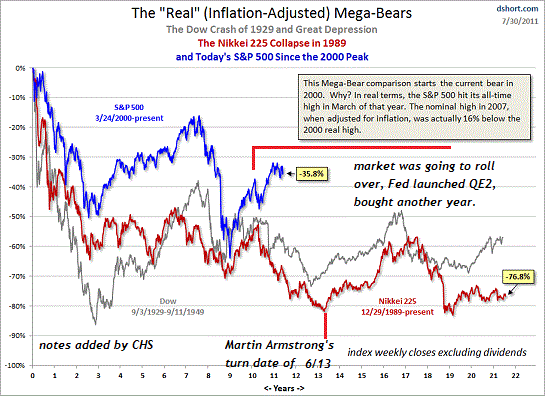
The impeccable Charles Hugh Smith has another nice chart on the inevitably of failure when it comes to currency devaluation, U.S. version this time:
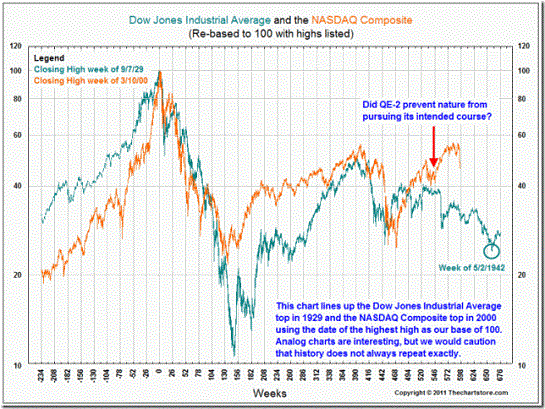
Here is a comparison of the Dow to the Nasdaq during that great period of prosperity known as the Great Depression:
Bernanke can print as much as he want, but mother nature will run its course eventually.

I will end with some good news for gold bugs, looks like Hugo Chavez has decided to push the price of gold even higher, via Wall Street Journal:
CARACAS—President Hugo Chávez said Wednesday he planned to take over Venezuela's largely underdeveloped gold mining industry in an attempt to boost international reserves.
The populist leader has already nationalized banks, telecommunications, oil fields, the power sector, and hundreds of thousands of acres of farmland, making Wednesday's move unsurprising.
Speaking on state television via telephone, Mr. Chávez said he would introduce a new decree in the coming days to put exploration and extraction of gold into the government's hands. It will be "a decree to take the gold sector," which still remains in the hands of a "mafia and smugglers," he said.
It turns out the black market sale of gold in Venezuela is quite the fruitful business:
Venezuela's gold mining industry has not played a mayor role in the country's economy. Although Venezuela is believed to have Latin America's largest gold reserves, the country's oil industry has garnered most of the attention. As a result, Venezuela's gold fields, which are in jungle areas close to the Brazilian border, have been mostly dominated by small, illegal wildcat producers.
"It's the Wild West," said Moisés Naim, a former Venezuelan trade minister. "There are no police, roads, or authority. The industry is dominated by smugglers."
If this so called illegal gold mining is shut down, look for a decrease in supply to the world market unless Chavez is so much of an idiot that he actually sells state-mined gold.  Turns out, he is doing the smart thing and is having his central bank accumulate gold already:
The move comes one day after documents reviewed by The Wall Street Journal showed that the Venezuelan government planned to transfer billions of dollars in cash reserves held abroad to banks in Russia, China and Brazil and tons of gold from European banks to its own central bank vaults. The documents say the South American country aims to move 211 tons of gold it keeps abroad and values at $11 billion to the Central Bank in Caracas, where the government keeps its remaining 154 tons of bullion.
Must be nice to have full control over that much money.

Robert Wenzel is speculating that Chavez's days are numbered:
Chavez has recently been undergoing treatment for what many suspect is cancer. Talk in certain parts of D.C. is that the CIA has slowly exposed him to very toxic, cancer causing materials.
Not sure on the accuracy of this claim, but it wouldn't be surprising if it turned out to be true.  If you can say one thing about conspiracy theories, they sure make the day interesting.

Update- Is former director of the Office of Management and Budget David Stockman an Austrian?  See this interview with Yahoo Daily Ticker:
Here are some quotes:
"The Fed announced last week 0 interest rates through 2013, that's 4 years of zero cost overnight money, a screaming invitation to speculation into the carry trade that is utterly destroying our capital markets."
"...the fact is the Fed is the number one problem holding back this economy, punishing savers, savaging low income people trying to buy food, or energy, or fuel.."
"Ron Paul all along has been the only member of Congress who really understands the fundamentals of the monetary system and what the central bank should and shouldn't be doing..and understands that...QE1, QE2, zero interest rates is making the capital market dishonest, corrupt, rigged...the capital market can't function to give price signals to what risk is and to what various kinds of fixed income instruments ought to trade at if the Fed is in there day in and day out buying this, selling that...."
"What (Bernanke) is doing is making it worse...this economy doesn't need any more debt...the purpose of low interest rates is to encourage people to borrow, that's wrong, we should be encouraging people to save..."
There is some talk in there about how the Fed benefits the banks and how taxes need to be raised to fight the deficit.  Obviously I disagree with the latter, but Stockman is right on, interest rates need to rise, even if it means another downturn.

Matt Taibbi has a great article in Rolling Stone this week on the revolving door between S.E.C., Wall Street, and various coverups:
That, it now appears, is exactly how the Securities and Exchange Commission has been treating the Wall Street criminals who cratered the global economy a few years back. For the past two decades, according to a whistle-blower at the SEC who recently came forward to Congress, the agency has been systematically destroying records of its preliminary investigations once they are closed. By whitewashing the files of some of the nation’s worst financial criminals, the SEC has kept an entire generation of federal investigators in the dark about past inquiries into insider trading, fraud and market manipulation against companies like Goldman Sachs, Deutsche Bank and AIG. With a few strokes of the keyboard, the evidence gathered during thousands of investigations – “18,000 … including Madoff,” as one high-ranking SEC official put it during a panicked meeting about the destruction – has apparently disappeared forever into the wormhole of history.
Under a deal the SEC worked out with the National Archives and Records Administration, all of the agency’s records – “including case files relating to preliminary investigations” – are supposed to be maintained for at least 25 years. But the SEC, using history-altering practices that for once actually deserve the overused and usually hysterical term “Orwellian,” devised an elaborate and possibly illegal system under which staffers were directed to dispose of the documents from any preliminary inquiry that did not receive approval from senior staff to become a full-blown, formal investigation. Amazingly, the wholesale destruction of the cases – known as MUIs, or “Matters Under Inquiry” – was not something done on the sly, in secret. The enforcement division of the SEC even spelled out the procedure in writing, on the commission’s internal website. “After you have closed a MUI that has not become an investigation,” the site advised staffers, “you should dispose of any documents obtained in connection with the MUI.”
There are many more stories in the article about former S.E.C. employees neglecting to prosecute and then being hired by the same firms they were supposed to prosecute.  Big government in bed with big business at its finest.  Check out this disturbing story:
SAC has long been accused of a variety of improprieties, from insider trading to harassment. But no charge in recent Wall Street history is crazier than an episode involving a SAC executive named Ping Jiang, who was accused in 2006 of enacting a torturous hazing program. According to a civil lawsuit that was later dropped, Jiang allegedly forced a new trader named Andrew Tong to take female hormones, come to work wearing a dress and lipstick, have “foreign objects” inserted in his rectum, and allow Jiang to urinate in his mouth. (I’m not making this up.)
Sounds more like a frat than an investment bank, though there is hardly any difference between the two anymore.

Selasa, 16 Agustus 2011

Sarkozy and Merkel Ready Empowered EuroZone, Why Banning Shorts is Bad Policy, John Stewart Tears Apart Media for Ignoring Ron Paul, and Henry Paulson Ripped Off?

Looks like the rumors of a new super European government are finally coming true as French Prez Sarkozy and Germany Prez Merkel met today to discuss a new cockamaney scheme to save the Euro, via Yahoo! Finance:
PARIS (AP) -- All countries that use the euro should have mandatory balanced budgets and better coordination of economic policy, the leaders of France and Germany said Tuesday, pushing for long-term political solutions instead of immediate financial measures like a single European bond.
French President Nicolas Sarkozy and German Chancellor Angela Merkel also pledged to harmonize their countries' corporate taxes in a move aimed at showing the eurozone's largest members are "marching in lockstep" to protect the euro.
Ahh, don't you just love it when two people meet and decide the fiscal fate for millions?  It's almost as if epistemological fallacies don't exist!  This balanced budget talk is all nonsense in the end, every country's budget ends up balanced through money printing or borrowing. Not to delve to much into conspiracy theory, but this just screams new world order:
Sarkozy told reporters that he and Merkel want a "true European economic government" that would consist of the heads of state and government of all eurozone nations.
The new body would meet twice a year -- and more in times of crisis -- and be led initially by EU President Herman Van Rompuy for a 2 1/2-year term. After that, Sarkozy suggested, it could be opened up to other heads of states and government.
The move appeared a step toward the closer long-term economic integration that many analysts have said is inevitable to make the euro experiment survive, though it was unclear how much effect it would have in the short term.
And here is the frosting to top the whole Euro-baked cake off:
U.S. stocks fell, following the biggest three-day rally for the Standard & Poor’s 500 Index since 2009, as French President Nicolas Sarkozy said his nation and Germany will propose a financial transaction tax.
Hmmm, remember my summarizing this Doug Casey interview?
To sum it up, Casey basically warns that U.S. citizens should begin diversifying their financial portfolio internationally.  Casey and Rockwell both predict another Depression coming which will have high bouts of inflation rather than deflation that carried on through the Great Depression.  It will all be followed by another war of course.  Now rather than the federal government swooping in and confiscating gold during the Depression, Casey is worried more about financial controls being implemented that keep capital within the U.S.  Frankly, this type of prediction is not at all farfetched.
Looks like financial controls just aren't coming to the U.S.  Whatever this financial tax turns out to be, look for the bankers to benefit.

Today Gary North asks the right questions to summarize the Euro sideshow today perfectly:
Why didn't all the previous meetings solve the economic problem of PIIGS debt?
What public relations statement do they expect will bring financial stability to the PIIGS?
What new program will they suggest, only to be disavowed as impractical by the European Central Bank, and then adopted a week or two after the official denial?
What program will they ever submit to their respective parliaments, to be debated openly in front of voters? None, you say? I see. Just like before.
What opportunity will voters in France and especially Germany be given to express their view of the new program? None, you say? I see. Just like before.
What indication will investors see that there is any new program that is not merely another Band-Aid?
What program, other than more deficit spending by France and Germany to lend more money to the PIIGS, will ever come forth from one of these meetings?
What solution, other than more purchases of the IOUs of PIIGS bonds by the ECB, will ever be presented?
What will they ever suggest, other than more of the same?
What evidence will ever be presented that the latest round of more of the same will not be followed in a few weeks and months and years by even more of the same?
North should know by now that asking pertinent questions like these never lead to results.  Expect more "emergency" meetings by Euro leaders as they slowly dissolve any sense of sovereignty each country has left.

Key in point: last Thursday, short selling was banned in Italy, France, Belgium, and Spain as the European Securities and Market Authority once again predicted financial calamity.  Damn those dastardly financiers trying to protect their wealth!  John Tamny does a great job today taking on the idiotic notion of banning short selling to quell financial panics:
As evidenced by their violent fluctuations over the last two weeks, stock markets in Europe and everywhere else have a crisis quality to them, thus making the existence of short sellers ever more necessary. Indeed, if they didn't exist, we'd have to invent short sellers precisely for times like the present.
...short selling is often part of a long buying strategy. No doubt there are shares of healthy French and Italian companies that investors find attractive right now, but as a way of protecting their downside, some investors surely want to short the shares of correlated, seemingly less healthy companies as a way of covering their losses assuming their long position proves incorrect.
Thirdly, and perhaps most importantly, it must always be stressed that short sellers are ultimately buyers. To sell shares short, an investor must go into the marketplace to borrow shares from an existing shareholder, then sell them.
All banning short selling does is prolong the reallocation of goods and capital to more profitable and efficient enterprises.  Like printing off funny money and running large fiscal deficits, banning short selling prolongs the downturn, doesn't cure it.  As Tamny writes, "How nice it would have been then to have short sellers who, after profiting from those dives (and aiding the economy in the process), would have re-entered the stock market to put a floor under falling prices."

How nice indeed it would have been for bureaucrats to cease from "doing something" and let the market run its course.

So after all the outcry of the media ignoring Ron Paul following his almost upset victory, John Stewart does a fantastic job skewering the mainstream media for pretending Ron Paul was invisible:
Fox News loves warmongers, no real news there.  Still, it was great to see Paul getting some much needed attention finally.  All day today the 24 hour news networks broadcasted the fact that they ignored Paul, as if they didn't themselves contribute to the idiocy.  Good job news media, good job.
Paul weighs in today on Fox News of all places:
For some cheering up, check out this hilarious scam:
WASHINGTON -- A Maryland man is under investigation for allegedly wiping away his $353,000 mortgage debt by convincing financial giant CitiGroup to accept a money order purportedly backed by then-Treasury Secretary Hank Paulson, FOX News Channel reported Tuesday.
According to court documents filed in the case, 35-year-old Bryan Gardner of Waldorf, Md., sent CitiMortgage a $353,000 money order in January 2009 and indicated that it would be his final payment for a property in nearby Bowie, Md.
Ha!  Though this is blatant fraud, I can't help but laugh as Paulson committed fraud on the whole nation through TARP.  For even more hilarity, check out the laser pistol-toting Rick Perry threatening Bernanke:
Treason? Yes.  Does Perry really get it?  I seriously doubt it, but it's nice to see him try.

I will end with a few new signs of a possible inflation-induced boom coming America's way.  First is via CNBC:
U.S. housing starts fell less than expected in July as builders broke ground on new multifamily units likely to meet demand for rental apartments, while permits for future construction dropped.
The Commerce Department said on Tuesday housing starts slipped 1.5 percent to a seasonally adjusted annual rate of 604,000 units, but above economists expectations for a 600,000-unit pace.
Compared to July last year, residential construction was up 9.8 percent.
It's always tough to judge if the housing market has cleared, but I never get tired of seeing the phrase "more than expected" or "less than expected."  Whether this means that mainstream economists can't predict the velocity of money printing or they are just plain moronic when it comes to business cycles, I don't know.  There seems to be two opposing stories right now, either we are entering an inflationary boom that will surely bust or we are treading right back toward deflation.  The former seems plausible judging by this new Rasmussen report:
Prior to the latest survey, overall confidence in the Fed to handle inflation and interest rates ranged from a low of 32% to a high of 41%. The number who hold no confidence at all is now at its highest level in nearly two years.
This lack of confidence stems partly from the fact that 93% of adults report paying more for groceries now than they did a year ago, the highest finding to date. Only four percent (4%) say they’re not paying more for groceries now compared to a year ago.  Prior to the latest results, the number that said they are paying more for groceries ranged from low of 75% in April 2010 to a high of 91% in May of this year.
Rasmussen is typically known as a conservative source, so Krugman will just deny the results as usual.  It does leave one wondering though.
For a little fun, check out this handy interactive map on whether you should buy or rent housing in many popular U.S. cities:
Click the pic to link to graph.  From the looks of it, Nevada and Arizona's housing market may have hit its bottom at this point.

Update- More proof of an inflationary boom?
A new building for my bank was just put up in my hometown, a business I believe called Zack's just moved into the space Blockbuster left a few months ago, and a shopping center near the Harrisburg International Airport just had huge infrastructure renovations done to the entrance from the road.  Seems like progress to me.
I can't help but post this great graphic:
Update 2- Kudos to Jack Cafferty for this brilliant line:
"Michele Bachmann has no chance of being the next president of the United States, maybe Ron Paul should be."
The hype around the mainstream media's complete disregard of Paul on Sunday is in full force. Whether it lasts will remain to be seen, but one thing is for sure, people are seriously starting to pay attention.