Check out this intriguing debate between the great Gary North and the fantastic Walter Block at Mises University on whether getting a PhD in economics is still a valuable endeavor: As I have professed many times on this blog, I am a huge Gary North fan and think that he is by far the best Austrian writer on political economy in the country. With that being said, it was a tough choice to make on who won the debate. Though I do love Walter Block, especially his "take as much money from the state as possible" theories, in the end he lost for style. North is a phenomenal public speaker and made the moral case against continuing to get an education in the government dominated-education cartel known as higher education. Though North did acknowledge that getting a PhD may be a good idea for some people, he makes it clear that it is a tough journey for many people and needs careful consideration from anybody thinking of pursuing such a degree. Though Block is right in that many students can get a PhD in Austrian economics from a number of professors who are sympathetic to the school of thought, at this point there seems to be way more students than professors, which in itself is a good sign of a growing trend.
My bias with North though resides mainly in that I am following the path he advocates, this blog and my writings are self evident of that. I can only hope to be successful.
Yesterday, in regards to Ron Paul's almost victory in Iowa, I wrote this as a prediction of how the media would react:
Paul wins straw polls all the time, no big deal here
Iowa doesn't represent America, no big deal here
Paul, despite almost coming in first, is still too fringe for the American public despite a growing hatred for war and Wall Street, no big deal here
Bachmann still came in first, no big deal here
Funny, Roger Simon of Politico proves my point exactly by calling out his own industry: Simon is right, Paul barely got any coverage on the Sunday shows this morning. From comment threads I have read elsewhere, it seems that many called into C-Span this morning and bitched about the media's predictable response. Needless to say, there is an editorial brewing inside me right now.
H/T Jonathan Catalan, I will end with this fantastic editorial cartoon:
Hmmm, so why is one demonized by the public and the other is advocated for every Monday and Friday on the New York Times editorial page by Paul Krugman?
Back from the week long conference/ending program gathering in D.C. and the markets have been incredibly volatile to say the least. Though I was able to check news in the morning and at night, I couldn't believe my yes watching all the money manipulation going on across the globe. We got all the goodies: continuing close to 0% interest rats from the Fed, the Australian housing bubble burst, and short sell banning.
Despite all the mass hysteria, there is a silver lining: Ron Paul just placed second at the Ames, Iowa straw poll! Though queen neo-con Bachmann placed first, she only beat Paul by 150 votes! Look for these reactions from the mainstream media:
Paul wins straw polls all the time, no big deal here
Iowa doesn't represent America, no big deal here
Paul, despite almost coming in first, is still too fringe for the American public despite a growing hatred for war and Wall Street, no big deal here
Bachmann still came in first, no big deal here
The Sunday shows should be hilarious as they try and explain why Paul continues to get so much support.
On Thursday, I had an article on the Mises Institute describing a flea market near my house.
While this week was crazy to say the least in terms of macro economic trends, Marc Faber has some wonderful commentary on the path our wonderful overlords at the Fed should take:
"The best they (the Fed) could do for markets is too collectively resign."
Two American men will be allowed to sue former Defence Secretary Donald Rumsfeld over claims that they were unfairly tortured by U.S. troops in Iraq.
While I highly doubt this will amount to anything in the long run, it's always nice to see that war crimes are still acknowledged to have occurred. Rumsfeld will probably get some kind of immunity in the end.
So while Ron Paul was victorious today, this genius contraption at his tent surely helped out:
The new jobs report is being met with all sorts of speculation. Is the slight drop in unemployment a good thing? Does it not reflect all the data? Are we at the beginning of another manipulative boom? Or are we still about to bust?
It didn't take this morning's unemployment numbers for me to understand that we are not going into a double dip recession, that the source of current problems is in Europe and that the bond market will be in trouble, but today's job numbers are helping a few see the light.
–Wages rose 0.4%, double the consensus, 0.2%. This is a relief. We were always deeply suspicious of the June numbers because the seasonals were so savage, and we expected both a rebound in July and an upward revision to June. The July seasonal factor was almost identical to last year. – Ian Shepherdson, High Frequency Economics, Ltd.
–The payroll gain was the strongest in three months and reasonably broad based and there were upward revisions in payroll growth to the prior two months. There is better news on manufacturing in the gain in hours worked and our proxy for wage and salary income rose by 0.5%, which is good news for consumers. This report is very important for investors because the equity market had finally caved in with a 12% drop from the highs and fear…had replaced complacency. We were looking for a better entry point on equities and now we may have it. For bonds this is bad news as investors may look to put more risk on and as the gain in payrolls likely squashes the hopes of some for QE3. –RDQ Economics
–All in all, today’s numbers may quell recession anxiety at the margin – in our judgment, the real source of recession risk is more about European debt contagion than US domestic fundamentals (which, for now, are consistent with sluggish growth, not recession). –Jay Feldman, Credit Suisse
Mish has a different point of view and looks at the drop in the labor participation rate:
Here is an overview of today's numbers.
US Payrolls +117,000
US Unemployment Rate -.1 to 9.1%
Participation Rate -.2 to 63.9% accounting for drop in unemployment rate
Actual number of Employed (by Household Survey) fell by 38,000
Unemployment rose by 156,000
Those dropping out of the labor force rose by 374,000
Civilian population rose by 182,000, Labor Force declined by 193,000
Average Weekly Workweek was unchanged at 34.3 hours
Average Private Hourly Earnings Increased by 10 Cents
Government employment decreased by 37,000 - a genuine bright-spot
Many of those millions who dropped out of the workforce would start looking if they thought jobs were available. Indeed, in a 2-year old recovery, the labor force should be rising sharply as those who stopped looking for jobs, once again started looking. Instead, the labor force is not expanding at all.
Were it not for people dropping out of the labor force for the past two years, the unemployment rate would be well over 11%.
So which is it, are we in a manipulated boom or on the verge of more contraction? Truthfully, I have no idea. I am very new at this and the monetary times we are living in are very unprecedented. What happens from here on out will show how a system of competing fiat currencies on a global level really works. Can one country's central bank inflate to drive economic growth when there is chaos in other major industrialized countries? We are definitely going to find out.
Marc Faber has weighed in on yesterday's stock/equity bloodbath on Bloomberg:
"next week will be important to see if Bernanke is a true money printer or an amateur, and if he is a true money printer he will start printing soon."
Faber is right, if Bernanke turns the printing press on again, it will prove that he genuinely thinks that printing greenbacks drives economic growth. His whole reputation could very well be set in stone next week, I am already buying silver again.
I will end with Judge Napolitano's great summary of the Austrian school he gave on his show last night: I will be in D.C. for a week starting tonight, so posting will be minimal, if done at all.
Happy birthday Mr. President! Looks like the stock market had a big gift for you today! Via HuffPost:
NEW YORK -- Stocks plunged Thursday in the worst one-day drop in more than two years, as investors absorbed fears that the American economy could enter a new recession. The Dow Jones Industrial Average dropped 4.3 percent during the day, and the Standard & Poor's 500 Index lost 4.8 percent, as investors dumped risky assets and clambered for safety. A week's worth of declines in the stock market erupted into an outright plunge as a stream of bad news kept coming: The American economy is barely growing; the federal government is preparing to slash spending; and a growing crisis in Europe increasingly threatens to send shock waves through the system.
And of course this was the Obama economic team in the White House today:
Anybody who has been paying attention knew this correction was coming soon. You can bet your Treasury bonds that Bernanke is watching CNBC closely and is getting ready to pull the switch for QE3. Looks like Bank of New York Mellon Corp. is making lemonade with all those flight to lemon security they are receiving, WSJ:
Bank of New York Mellon Corp. is preparing to charge some large depositors to hold their cash, in the latest sign of the worries roiling global markets.
The big U.S. custodial bank said this week in a note to clients that it will begin slapping a fee next week on customers that have vastly increased their deposit balances over the past month. The bank cited the heavy dollar deposits it has received over recent weeks, as investors and corporations retreat from financial markets amid Europe's debt crisis and the recent debate over U.S. government borrowing.
As Robert Wenzel pointed out, this is simply a storage fee. You can't blame Mellon Corp., the money could leave their coffers any second when things calm down. Looks like the dollar survived along with the franc:
It seems like a lot of this was driven by fear of ECB intervention in Italy/Spain bond auctions, but no worries there, the market stepped up and put the kibosh on any future auction of both:
Via Dow Jones we have learned that Spain, not Italy, has decided to pull its August 18 auction and will instead launch its 5 year auction on September 1. Once again, Zero Hedge being just a little prescient with our 7 am commentary that we "look for Spain to follow Italy in a self-imposed bond market exile." And in far worse news, we now get a schism within the European banking authority itself after Bloomberg reported that the Bundesbank's Weidmann is said to be opposed the resumption of ECB bond buying,
According to a Reuters report, the Italian Treasury has a "larger cash pile than generally perceived according to sources."
Sure enough, the subsequent Reuters headline says that the "Italian Treasury's cash pile is enough to last most of 2011."
Translation: Italy is using some funny accounting to avoid any more bond auctions for fear of skyrocketing yields. Like Trichet says, you gotta lie when the financials get hairy.
So as the world economy continues to tumble, Australia is having its own crisis to deal with:
The building and construction industry seems to be bearing the brunt of the brittle Australian economy, with more than 85 companies either entering administration, liquidation or being hit by a winding up notice over the past month in Victoria and New South Wales alone.
Can you hear that? Can you hear that PPPPPPOOOOOOPPPPP sound? Another property bubble goes bust, another lesson unlearned. Looks like ignorance of asset bubbles is still a worldwide phenomena a few years after 2008.
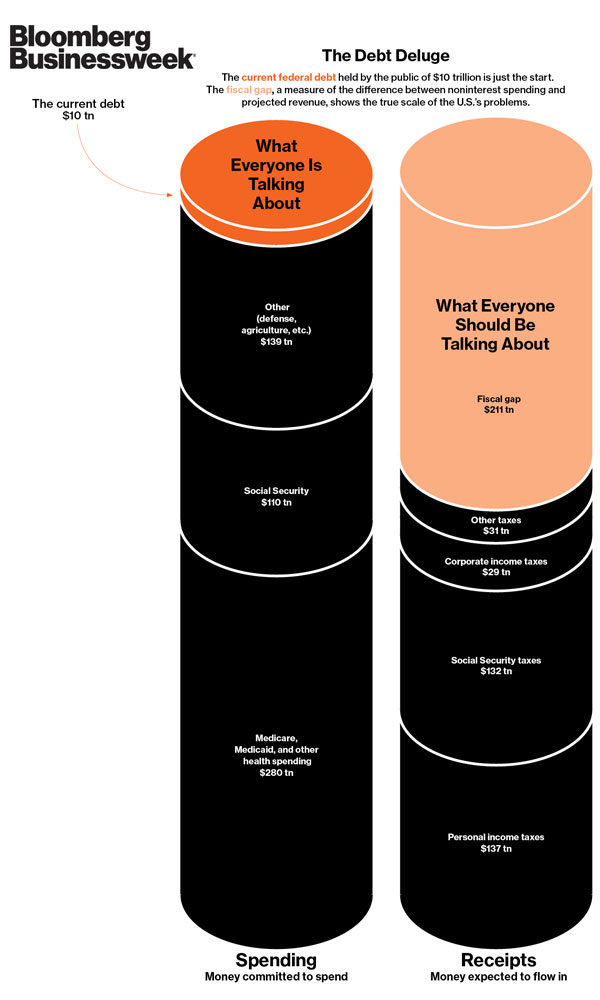
I will end with an interactive graph that highlights the problem of the worldwide economy perfectly: too much debt:
Click the pic for the interactive part, like always.
Former Bank of England policy maker Willem Buiter said the European Central Bank will revive its bond-buying program to safeguard this week’s auction of Italian bonds. “The ECB will intervene on whatever scale is necessary to allow Italy to conduct its auction on Thursday,” Buiter, now chief economist at Citigroup Inc., told reporters in London today. “If the ECB doesn’t come in, the Italian bond auction is likely to fail.”
Translation: "The market doesn't trust Italy anymore, it's unwilling to take the risk and invest, the European Central Bank must step in to save Italy's ass." Simple as that, but then again simple truths have never been a central banker's strong point. How much longer are Germans gonna put up with this?
Now that the ECB printing press seems to be warming up again, Switzerland doesn't want to miss out on the party, via WSJ:
The collateral damage from the U.S. and European debt crises shifted the front lines of the currency wars to Switzerland on Wednesday.
In a surprise effort to fend off a flood of money entering the country from investors seeking a safe haven, the Swiss National Bank cut interest rates to nearly zero and pledged to pump billions of newly minted francs into its markets.
Calling its currency "massively overvalued," the central bank said it "will take further measures against the strength of the Swiss franc if necessary."
What kind of Keynesian moron would advocate for stemming the inflow of capital into a country? Yes, God forbid the citizens of Switzerland have increased purchasing power that may come at the expense of exporters. We must protect the exporters and the banks who specialize in borrowing short and lending long!
America can't be left out of the QE fun now can it? Don't worry, it looks like former director of the Fed's monetary chair committee, Don Kohn, is prepared for QE3, via an interview with WSJ:
In an "exclusive" interview with the Fed's last tree monetary affairs committee, Donald Kohn, Vince Reinhart and Brian Matigan, Hilsenrath observes that according to these masters of the universe the chance of another recession is 20-40%, which we are confident is a given at 100%, but more importantly, he quotes Don Kohn who "said the Fed still has some options to support the economy, but "they're kind of limited." He said he expects the central bank, which holds a policy meeting Aug. 9, to wait and see whether the recovery is really losing steam before taking any action. If that's the case--and inflation is coming down--then he would give "very serious consideration" to a new round of bond purchases, he said."
If the excess reserves keep slipping in the money supply like they recently have, there will be no need to worry about deflation and QE3.
With all the talk of more money printing, the fundamentals for a rise in the price of precious metals look strong. Goldcore agrees an provides plenty of rational and graphs to prove gold is not at all in a bubble:
For more than 3 years - since gold rose above its nominal high of $850/oz in February 2008 - there has been much talk about gold being a bubble. Nouriel Roubini, professor of economics at New York University's Stern School of Business, is one of the more prominent financial and economic experts who said gold was a bubble and many other experts internationally echoed his sentiments. On December 10th, 2009, with gold at $1,100 per ounce, Roubini, said, "all the gold bugs who say gold is going to go to $1,500, $2,000, they're just speaking nonsense". Roubini went on to say ,"I don't believe in gold." Gold has now risen 50% since then and Roubini has been silent on the gold price.
The precious metals of gold and silver are driven by a wide variety of factors, including money supply, debt levels, currencies, CDS spreads, interest rates, inflation and fabrication demand from downstream sectors such as jewelry, electronics, and solar applications. Investment demand has been one of the primary drivers more recently as investors have used precious metals as a store of value in the face of dollar and currency depreciation as well as a general hedge against inflation. Investment demand includes significant and growing demand from store of wealth buyers in Asia, investment and diversification demand from hedge funds, pension funds and central banks and monetary demand from central banks. This demand is due to concerns about the global economy, growing inflation risks and the real risks posed by currency debasement being seen globally. Gold remains the preserve of the smart money, many of whom predicted the current financial and economic travails. Risk aversion and concerns about wealth preservation due to currency depreciation remain the primary demand drivers.
U.S. M2 Growth Expands in June, Correlates High With Gold
The U.S. M2 money supply accelerated in June to a 6.0% yoy pace, the highest reading in 22 months. The U.S. consumer price index (urban consumers) remained at a 3.6% yoy pace in June, in line with May's results. The correlation between the total U.S. M2 and gold has exceeded 0.90 since November 2004.
China M2 Money Supply: M2 Growth is Decelerating, Yet Still Rising
Gold Moves Higher with Chinese Inflation
China’s M2 money supply has been rising by 20%, Switzerland’s by 25%, Russia’s by 30%, and the world’s by 8%-9%. Japan’s M2 is expected to move higher after recent events. In order to fight economic and debt issues, paper currency has been printed at historically high levels.
Rising Debt Levels Drive Gold and Silver Higher
Here is a very entertaining CNBCinterview with the great Marc Faber who has the same sentiments of gold though thinks there may some optimistic exuberance in the market and may lead to a small correction very soon:
Gotta love his suggestion on firing half the government workforce, including the President. I would also throw Congress into that bunch.
Speaking of entertaining, check out this absolutely hilarious Onion article:
Drunken Ben Bernanke Tells Everyone At Neighborhood Bar How Screwed U.S. Economy Really Is
SEWARD, NE—Claiming he wasn't afraid to let everyone in attendance know about "the real mess we're in," Federal Reserve chairman Ben Bernanke reportedly got drunk Tuesday and told everyone at Elwood's Corner Tavern about how absolutely fucked the U.S. economy actually is. Bernanke, who sources confirmed was "totally sloshed," arrived at the drinking establishment at approximately 5:30 p.m., ensconced himself upon a bar stool, and consumed several bottles of Miller High Life and a half-dozen shots of whiskey while loudly proclaiming to any patron who would listen that the economic outlook was "pretty goddamned awful if you want the God's honest truth." "Look, they don't want anyone except for the Washington, D.C. bigwigs to know how bad shit really is," said Bernanke, slurring his words as he spoke. "Mounting debt exacerbated—and not relieved—by unchecked consumption, spiraling interest rates, and the grim realities of an inevitable worldwide energy crisis are projected to leave our entire economy in the shitter for, like, a generation, man, I'm telling you."
The whole article is great and uncannily resembles what is really happening in the U.S. economy. It's hard to believe it even came from the Onion.
I will end with a pretty good interview of Judge Napolitano explaining why the atrocious new "Super Congress" is unconstitutional: Update- Looks like we have an all out currency war on our hands folks. First was the Swiss National Bank, then threat of ECB money printing, now Japan:
And from Bloomberg:
Japan Intervened in Yen, Nikkei Says
Japan Intervened to Sell Yen, Finance Minister Noda Says
Yen Falls as Much as 1.8% to 78.43 Per Dollar After Intervention
Japan’s Intervention Was Unilateral, Finance Minister Noda Says
MOF sold under Y500 billion in intervention: 2 dealers
Noda Says He Hopes Bank of Japan Will Take Appropriate Actions
Bloomberg sums the whole situation up:
Just eight months ago, Brazilian Finance Minister Guido Mantega declared a “truce” in competitive currency devaluations. Now, Japanese and Swiss moves to weaken the yen and the franc show reviving tension in foreign-exchange markets as the deteriorating U.S. economy weighs on the dollar. Japan sold yen today, causing the currency to weaken as much as 3.8 percent against the dollar after rising 5 percent last month. “Ongoing one-sided moves” would hurt the recovery from a March earthquake, Finance Minister Yoshihiko Noda said. Yesterday, the Swiss National Bank cut interest rates to rein in the franc after a gain of about 36 percent in the past 12 months.
Turkey’s lira fell 1.1 percent to 1.7129 per dollar at 12:08 p.m. in Istanbul today after the central bank cut a key interest rate.
South Korea’s government is reviewing “all possibilities” on curbing capital inflows, Finance Minister Bahk Jae Wan told reporters in Seoul today, adding that he’s “closely monitoring” the situation. The won fell 0.1 percent to 1,061.70 per dollar at the 3 p.m. close in Seoul after touching a three- year high on July 27. The Philippines is prepared to impose controls to cap volatility after the peso rose to a three-year high this week, central bank Governor Amando Tetangco said in an e-mail late yesterday. The bank “will not go against the fundamental currency trend but will not hesitate to use tools, including imposing prudential limits on certain transactions of banks,” he said.
As Margaret Thatcher once said, socialism doesn't work because you eventually run out of other people's money. Well currency devaluation doesn't work when every country you are trying to export to does the exact same to their currency. Everyone is left holding on to pieces of paper that buy less and less. Grandma on a fixed income struggles to buy catfood while her grandson, big banker Jimmy, bathes in a bathtub full of dollars/Euro/Francs/Yen/insert major industrial country's currency. It's called the race to the bottom and the U.S. is trying desperately to be number one yet again.
Bill Gross is weighing in on the pathetic debt deal, which predictably passed the Senate today, in a PIMCO newsletter today:
Nothing in the Congressional compromise reached over the weekend makes a significant dent in our $1.5 trillion deficit.
In addition to an existing nearly $10 trillion of outstanding Treasury debt, the U.S. has a near unfathomable $66 trillion of future liabilities at “net present cost.”
Aside from outright default, there are numerous ways a government can reduce its future liabilities. They include balancing the budget, unexpected inflation, currency depreciation and financial repression.
Gross of course has a huge interest in keeping U.S. bond values afloat. While outright default is the right answer, you can bet your bottom greenback that our wonderful leaders in Washington will opt for inflation and currency depreciation. The whole balancing the budget thing is a scam, every federal budget is technically balanced, borrowing just makes up the difference. The sooner the Tea Party drops the issue, the sooner they get back to reality.
Now a big part of the debt ceiling deal is the creation of the atrociously dubbed "Super Congress." Yes, that's right, despite the fact that Congress has the lowest approval rate probably ever, let's make a stronger and more efficient one. Good thing K Street is on the job and ready to infiltrate. ViaPolitico:
K Street wasted little time putting clients on notice about the next phase of the debt ceiling debate with a simple message: Nobody is safe from the super committee. Lobby shops say a much-broader-than-expected range of budget cuts and tax provisions could be in play, especially compared with the relatively small group of industries that were afraid of getting a haircut during the earlier debt ceiling negotiations led by Vice President Joe Biden.
Several lobbyists said they expect companies and industry groups to put a full-court press on Capitol Hill engaging grass roots, advertising and old-fashioned, shoe-leather lobbying to try to minimize the severity of the cuts.
How much influence K Street can have on the process is still unclear.
Looks like being chosen as one of the twelve members of the Super Congress is going to be a very competitive process. Who doesn't like being wined and dined just to save a measly $30 billion tax credit? Bars and restaurants around Capital Hill better prepare and order extra martini mix. Look for it to be staffed with a bunch of moderates like Lindsey Graham who will agree to a bunch of cuts which will never come to fruition.
With the debt ceiling once again raised, all sights are set on Europe as Spain and Italy 10 year bond yields are exploding:
The yield on 10-year Italian bonds rose 13 basis points to 6.14 percent at 4:31 p.m. in London. It earlier surged to 6.25 percent, the most since November 1997. The 4.75 percent security maturity in September 2021 fell 0.895, or 8.95 euros per 1,000- euro ($1,422) face amount, to 90.34. That pushed the difference in yield, or spread, over bunds, to as much as 384 basis points, the most since before the euro was introduced in 1999. Italian bond futures fell, sending the price difference over bund futures to a record. The September Italian futures contract fell 1 percent to 98.21 after reaching a record 96.75, making the difference over its German equivalent 33.52.
Let's not forget about Greece now. While the fiscal can was kicked down the road just a little more, it looks like the Greek citizens are finally seeing the writing on the wall. Via Guardian:
In one of the biggest banks in the centre of Athens a clerk is explaining how his savers have been thronging to pull out their cash. Wary of giving his name, he glances around the marble-floored, wood-panelled foyer before pulling out a slim A4-sized folder. It is about the size of a small safety-deposit box – and those, ever since the financial crisis hit Greece 18 months ago, have become the most sought-after financial products in the country. Worried about whether the banks will stay in business, Greeks have been taking their life savings out of accounts and sticking them in metal slits in basement vaults. The boxes are so popular that the bank has doubled the rent on them in the past year – and still every day between five and 10 customers request one. This bank ran out of spares months ago. The clerk leans over: "I've been working in a bank for 31 years, and I've never seen a panic like this." Official figures back him up. In May alone, almost €5bn (£4.4bn) was pulled out of Greek deposits, as part of what analysts describe as a "silent bank run". This version is also disorderly and jittery, just not as obvious. Customers do not form long queues outside branches, they simply squirrel out as much as they can. Some of that money will have been used to pay debts or supplement incomes, of course, but bankers put the sheer volume of withdrawals down to a general fear about the outlook for Greece, one that runs all the way from the humble rainy-day saver to the really big money.
"Every time the markets move, I get phone calls," says an Athens-based fund manager. "They're from investors asking: 'How can I get my money out of the country?' " One senior investment banker is more blunt: "People are scared that the government doesn't know what the fuck it's doing." He tells a story about an acquaintance who took out €30,000, wrapped it in a bag and stashed it in his garage. "The bag had previously had some food inside," he says. "So it attracted rats, who ate the notes."
Too bad the government knows exactly what the fuck its doing. It's saving the banks at the expense of taxpayers. Same story, same place, nothing changes. Except for the price of gold!
Good thing the Bernank doesn't think gold is money, that way every other Central Bank can keep loading up. Via Zerohedge:
Further confirmation in the continuing stealth accumulation of bullion by central banks came overnight with confirmation that South Korea's central bank bought 25 tonnes of gold over the past two months. The gold is worth $1.24 billion and resulted in a 17 fold increase in their gold reserves. Thailand’s gold reserves rose by 15.5% in the two months and rose to about 4.07 million ounces in June, from about 3.523 million ounces in May, according to figures on the Bank of Thailand’s website accessed by Bloomberg this morning. South Korea is the world’s seventh-biggest foreign-exchange reserve holder and 64% of its reserves are in U.S. dollars. The bank said that it also holds euros and other assets and the move was about achieving diversification.
Hmmm, if Paul Krugman's hypothesis is true and its Glenn Beck and all those dastardly gold sellers on TV are really behind the rise in the price of gold, they must be having some huge international influence. I didn't know Beck was broadcasted out in Korea and Thailand.
While all the recent economic data has been pretty pessimistic, here is a piece of news that will have Keynesians screaming bloody murder for QEIII:
WASHINGTON (AP) -- Americans cut their spending in June for the first time in nearly two years after seeing their incomes grow by the smallest amount in nine months. The latest data offered a troubling sign for an economy that is adding few jobs and barely growing. Consumer spending dropped 0.2 percent in June, the Commerce Department said Tuesday. It was the first decline since September 2009.
Incomes rose 0.1 percent, the smallest gain since September. Many people are also pocketing more of their paychecks. The personal savings rate rose to 5.4 percent of after-tax incomes, the highest level since August 2010.
While Keynesians will tear their hair out at this news, this is actually a great sign. Savings, not consumption, are would lead to productive investment. In a world unaffected by central banking, this type of behavior would bring down interest rates. Too bad Bernanke crazed monetary tools have the system so convoluted with money slipping in from all directions, a change in time preference by consumers may not be enough to offset another manipulated business cycle.
Well what do you know, it turns out the whole debt ceiling debacle was on theater and a back-room deal is making its way through Congress as we speak. The media pundits are of course surprised at such a development and are now trying to pick which side won the debate. The real answer is that each side won, here we get a raise in the debt ceiling without any substantial cuts in the foreseeable future. There is no cut to government spending, just a slight slowing down of the spending rate. On top of that, the so-called "Super Congress" looks like its well on tract to being created. Simply put: its a joke. But then again, everything Congress does is a joke.
Here is the cheat sheet on the deal from the Ministry of Truth a/k/a the White House:
Mechanics of the Debt Deal
Immediately enacted 10-year discretionary spending caps generating nearly $1 trillion in deficit reduction; balanced between defense and non-defense spending.
President authorized to increase the debt limit by at least $2.1 trillion, eliminating the need for further increases until 2013.
Bipartisan committee process tasked with identifying an additional $1.5 trillion in deficit reduction, including from entitlement and tax reform. Committee is required to report legislation by November 23, 2011, which receives fast-track protections. Congress is required to vote on Committee recommendations by December 23, 2011.
Enforcement mechanism established to force all parties – Republican and Democrat – to agree to balanced deficit reduction. If Committee fails, enforcement mechanism will trigger spending reductions beginning in 2013 – split 50/50 between domestic and defense spending. Enforcement protects Social Security, Medicare beneficiaries, and low-income programs from any cuts.
Like always, Ron Paul has the best description of the deal:
One might think that the recent drama over the debt ceiling involves one side wanting to increase or maintain spending with the other side wanting to drastically cut spending, but that is far from the truth. In spite of the rhetoric being thrown around, the real debate is over how much government spending will increase.
No plan under serious consideration cuts spending in the way you and I think about it. Instead, the "cuts" being discussed are illusory, and are not cuts from current amounts being spent, but cuts in projected spending increases. This is akin to a family "saving" $100,000 in expenses by deciding not to buy a Lamborghini, and instead getting a fully loaded Mercedes, when really their budget dictates that they need to stick with their perfectly serviceable Honda. But this is the type of math Washington uses to mask the incriminating truth about their unrepentant plundering of the American people.
The truth is that frightening rhetoric about default and full faith and credit of the United States is being carelessly thrown around to ram through a bigger budget than ever, in spite of stagnant revenues.
Paul also makes sure to lambast the disgusting new "Super Congress:"
Perhaps the most disturbing aspect of this deal is the “Super Congress” provision. This is nothing more than a way to disenfranchise the majority of Congress by denying them the chance for meaningful participation in the crucial areas of entitlement and tax reform. It cedes power to draft legislation to a special commission, hand-picked by the House and Senate leadership. The legislation produced by this commission will be fast-tracked, and Members will not have the opportunity to offer amendments. Approval of the recommendations of the “Super Congress” is tied to yet another debt ceiling increase. This guarantees that Members will face tremendous pressure to vote for whatever comes out of this commission-- even if it includes tax increases. This provision is an excellent way to keep spending decisions out of the reach of members who are not on board with the leadership's agenda.
Look for sneaky entitlement cuts and tax increases to come from this new commission disguised as "comprehensive reform." Barry Ritholz sums up the whole situation perfectly, this is the only thing one needs to look at when gauging how successful the debt ceiling deal is at addressing the accelerating debt problem:
First it was Jefferson County, Alabama, now we have another. In the midst of all the financial difficulty on the federal level, it looks like the much demonized Meredith Whitney may finally be having her prediction of massive municipal bankruptcies come to fruition. Via Bloomberg:
Central Falls, Rhode Island’s poorest city, sought Chapter 9 bankruptcy protection as it struggles to meet pension obligations. A petition was filed today after state officials failed to persuade police, fire and municipal employee unions to accept concessions and to get retirees to agree to lower benefits, according to a statement from Robert Flanders, a former state Supreme Court justice named to oversee the city’s finances. The city asked the court to permit the rejection of union contracts.
Once again, unionized public employee's pensions have brought another government to its knees. Yet the bitching and moaning about the rich not paying their fair share for outrageous pension benefits will continue.
If that isn't aggravating enough, it looks like Lew Rockwell is rightfully taking more shots at Milton Friedman:
How great to have had historian Ronald Hamowy as a distinguished visiting faculty member at Mises University last week. We did a fascinating and moving podcast about his teacher F.A. Hayek, and his close friends Murray Rothbard and Burt Blumert. In his graduate seminar, reports David Gordan, Ronald confirmed that it was indeed Milton Friedman who blocked Hayek from the Chicago economics faculty. As a result of the Miltonian blackball, Hayek had to take an unpaid position at the university, and eventually returned to Austria. His American salary was paid by the heroic Volcker Fund, but there was no pension and certainly no tenure.
The is unforgivable. It will be interesting to see what Don Boudreaux and Russ Roberts say about this over at CafeHayek. After all the depressing news, this graph via Mark Perry shows just how optimistic we should be about the future and humanity's constant need to improve its own condition despite an inevitable fiscal collapse.