Senin, 01 Agustus 2011

Debt Deal On Its Way to Spending Us to Kingdom Come, Another Municipal Bankrupcty, and Friedman Blocks Hayek from University of Chicago

Well what do you know, it turns out the whole debt ceiling debacle was on theater and a back-room deal is making its way through Congress as we speak.  The media pundits are of course surprised at such a development and are now trying to pick which side won the debate.  The real answer is that each side won, here we get a raise in the debt ceiling without any substantial cuts in the foreseeable future.  There is no cut to government spending, just a slight slowing down of the spending rate.  On top of that, the so-called "Super Congress" looks like its well on tract to being created.  Simply put: its a joke.  But then again, everything Congress does is a joke.

Here is the cheat sheet on the deal from the Ministry of Truth a/k/a the White House:
Mechanics of the Debt Deal
  • Immediately enacted 10-year discretionary spending caps generating nearly $1 trillion in deficit reduction; balanced between defense and non-defense spending.
  • President authorized to increase the debt limit by at least $2.1 trillion, eliminating the need for further increases until 2013.   
  • Bipartisan committee process tasked with identifying an additional $1.5 trillion in deficit reduction, including from entitlement and tax reform. Committee is required to report legislation by November 23, 2011, which receives fast-track protections. Congress is required to vote on Committee recommendations by December 23, 2011.
  • Enforcement mechanism established to force all parties – Republican and Democrat – to agree to balanced deficit reduction. If Committee fails, enforcement mechanism will trigger spending reductions beginning in 2013 – split 50/50 between domestic and defense spending. Enforcement protects Social Security, Medicare beneficiaries, and low-income programs from any cuts.    
Like always, Ron Paul has the best description of the deal:

One might think that the recent drama over the debt ceiling involves one side wanting to increase or maintain spending with the other side wanting to drastically cut spending, but that is far from the truth.  In spite of the rhetoric being thrown around, the real debate is over how much government spending will increase. 
No plan under serious consideration cuts spending in the way you and I think about it.  Instead, the "cuts" being discussed are illusory, and are not cuts from current amounts being spent, but cuts in projected spending increases.  This is akin to a family "saving" $100,000 in expenses by deciding not to buy a Lamborghini, and instead getting a fully loaded Mercedes, when really their budget dictates that they need to stick with their perfectly serviceable Honda.  But this is the type of math Washington uses to mask the incriminating truth about their unrepentant plundering of the American people.
The truth is that frightening rhetoric about default and full faith and credit of the United States is being carelessly thrown around to ram through a bigger budget than ever, in spite of stagnant revenues.
Paul also makes sure to lambast the disgusting new "Super Congress:"
Perhaps the most disturbing aspect of this deal is the “Super Congress” provision.  This is nothing more than a way to disenfranchise the majority of Congress by denying them the chance for meaningful participation in the crucial areas of entitlement and tax reform.  It cedes power to draft legislation to a special commission, hand-picked by the House and Senate leadership.  The legislation produced by this commission will be fast-tracked, and Members will not have the opportunity to offer amendments. Approval of the recommendations of the “Super Congress” is tied to yet another debt ceiling increase. This guarantees that Members will face tremendous pressure to vote for whatever comes out of this commission-- even if it includes tax increases.  This provision is an excellent way to keep spending decisions out of the reach of members who are not on board with the leadership's agenda.
Look for sneaky entitlement cuts and tax increases to come from this new commission disguised as "comprehensive reform."
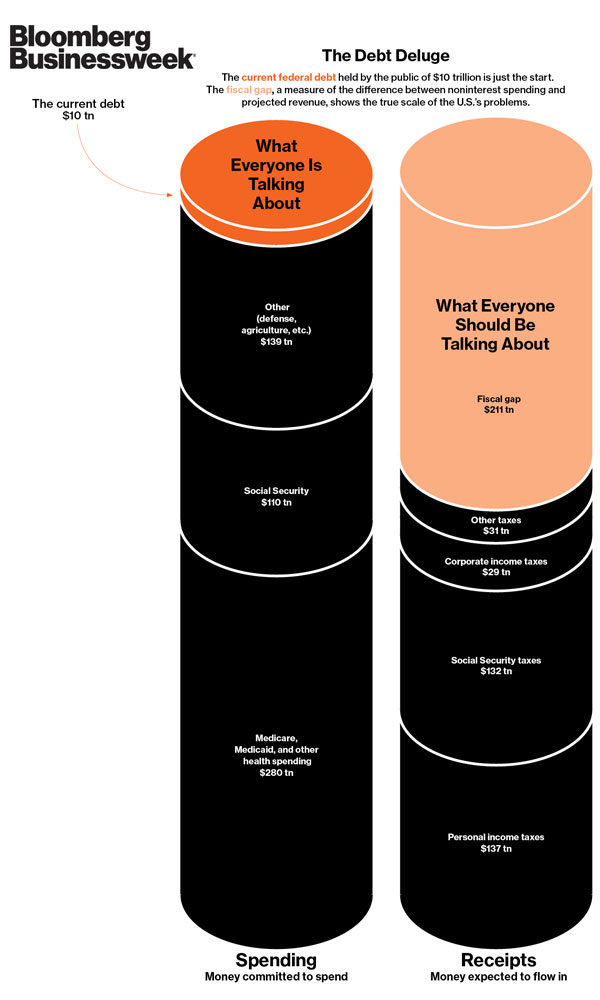
Barry Ritholz sums up the whole situation perfectly, this is the only thing one needs to look at when gauging how successful the debt ceiling deal is at addressing the accelerating debt problem:
First it was Jefferson County, Alabama, now we have another.  In the midst of all the financial difficulty on the federal level, it looks like the much demonized Meredith Whitney may finally be having her prediction of massive municipal bankruptcies come to fruition.  Via Bloomberg:
Central Falls, Rhode Island’s poorest city, sought Chapter 9 bankruptcy protection as it struggles to meet pension obligations.
A petition was filed today after state officials failed to persuade police, fire and municipal employee unions to accept concessions and to get retirees to agree to lower benefits, according to a statement from Robert Flanders, a former state Supreme Court justice named to oversee the city’s finances. The city asked the court to permit the rejection of union contracts.
Once again, unionized public employee's pensions have brought another government to its knees.  Yet the bitching and moaning about the rich not paying their fair share for outrageous pension benefits will continue.

If that isn't aggravating enough, it looks like Lew Rockwell is rightfully taking more shots at Milton Friedman:
How great to have had historian Ronald Hamowy as a distinguished visiting faculty member at Mises University last week. We did a fascinating and moving podcast about his teacher F.A. Hayek, and his close friends Murray Rothbard and Burt Blumert.
In his graduate seminar, reports David Gordan, Ronald confirmed that it was indeed Milton Friedman who blocked Hayek from the Chicago economics faculty. As a result of the Miltonian blackball, Hayek had to take an unpaid position at the university, and eventually returned to Austria. His American salary was paid by the heroic Volcker Fund, but there was no pension and certainly no tenure.
The is unforgivable.  It will be interesting to see what Don Boudreaux and Russ Roberts say about this over at CafeHayek.  After all the depressing news, this graph via Mark Perry shows just how optimistic we should be about the future and humanity's constant need to improve its own condition despite an inevitable fiscal collapse.

Minggu, 31 Juli 2011

John Walsh Praises Ron Paul, Ron Paul vs. Rick Perry, and Some Graph Porn on Debt

Normally when I read Joan Walsh (a rarity), I end up having to desperately hold my own vomit back.  Seeing that she wrote a column about Ron Paul entitled "Ron Paul's Challenge to the Left," I had an e-mailed drafted to her ready to fill with a scathing refute of anything she said.  To my pleasant surprise, Walsh makes a great case on why the anti-war left should support Paul, via Dissident Voice:
On the question of war and empire, the Republican presidential candidates from Romney to Bachmann are clones of Obama, just as surely as Obama is a clone of Bush.
There is, however, one exception, Rep. Ron Paul (R, TX) the only contender who is a consistent, principled anti-interventionist, opposed to overseas Empire, and a staunch defender of our civil liberties so imperiled since 9/11. These are not newfound positions for Paul, come upon along the campaign trail or via a focus group, but long standing convictions, rooted in libertarian principles and verified by countless votes in the House and speeches on the Floor. You can take them to the proverbial bank. Nothing approaching this phenomenon has been seen in a major party since George McGovern. And even McGovern did not identify, let alone oppose, the U.S. as an Empire.
Paul must be taken seriously; he is not a candidate without real prospects.
The question must be asked, what is to be done by the antiwar Left? This question may be put in a variety of ways. The Left often acknowledges its obligation to those in developing countries, people of color over the planet whose standard of living and life itself is held back by the depredations of the U.S. Empire. If the Left acknowledges such a primary obligation, does it not need to support an antiwar candidate like Paul when there is no other around? Look at Libya with thousands killed by NATO bombing and the infrastructure of the African country with the highest Human Development Index being systematically destroyed. It is a war that is undeclared by Congress, therefore in violation of the Constitution and thus an impeachable action. Or Iraq where a million have been killed and four million displaced. Paul takes an unequivocal stance to stop this killing. How can the Left justify withholding its support?
Walsh is one of the last people I thought would come out in defense of Paul.  She not only does that but asks the obvious question to the left: Ron Paul has always been the true anti-war candidate, is the fact that he has an R next to his name enough to give your vote over to the war mongering Obama?

Walsh continues to impress with this biting criticism of Obama:
But what of other issues – like Medicare, Medicaid and Social Security which the libertarian Paul wants to phase out, albeit gradually. Paul, the country doc, knows full well how people of little means rely on these programs and he proposes no sudden termination of them. But this author and others on the Left want to extend those programs. How do we square that circle? I contend it is no problem, because Paul is committed to preservation of civil liberties and the prerogatives of Congress. I am confident that under those conditions, where the discussion is open and free, my views on these social democratic programs will prevail. I am sure that my Libertarian friends feel the same way. And what more can we ask for in a democracy? Under Paul I do not have to worry about being locked up for my views. I am confident of that under Paul; I am not with any other candidate. Certainly not with Barack Obama.
Now if only everyone on the HuffPost would read this, Paul should have no problem beating Obama in the general election if it should ever pan out that way.

*Update- I read the author wrong, it was actually John Walsh who wrote the great piece.  My bad.  I should have suspected that something written so brilliantly didn't come from the pen of Joan Walsh.

The debt ceiling drama is continuing once again today as there are rumors of a secret deal in the works.  No surprise there.  If you want to see the few Republicans who were actually principled enough to vote against the Raging Boehner's plan, here they are:
Justin Amash (Mich.)
Michele Bachmann (Minn.)
Chip Cravaack (Minn.)
Jason Chaffetz (Utah)
Scott Desjarlais (Tenn.)
Tom Graves (Ga.)
Tim Huelskamp (Kans.)
Steve King (Iowa)
Tim Johnson (Ill.)
Tom McClintock (Calif.)
Mick Mulvaney (S.C.)
Ron Paul (Texas)
Connie Mack (Fla.)
Jim Jordan (Ohio)
Tim Scott (S.C.)
Paul Broun (Ga.)
Tom Latham (Iowa)
Jeff Duncan (S.C.)
Trey Gowdy (S.C.)
Steve Southerland (Fla.)
Joe Walsh (Ill.)
Joe Wilson (S.C.)
First Joan Walsh comes out in favor of Ron Paul, now the Texas Tribune has this video comparing Paul to christian fundamentalist-neo conservative extraordinaire Rick Perry:
To sum up the video is 10 words: "Paul is the real constitutional candidate, Perry is a sham."

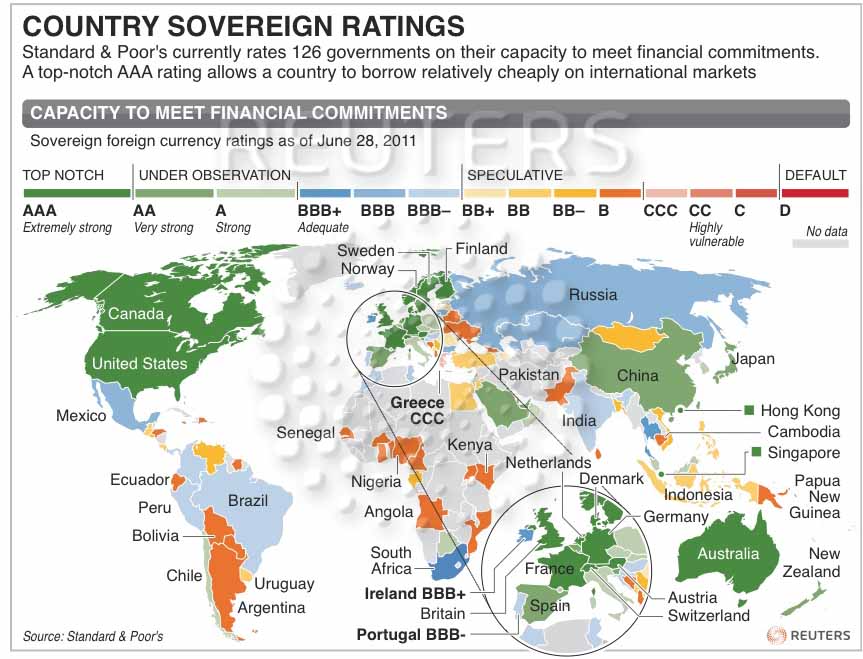
There isn't much news today, so I will end with these two terrific graphs via The Big Picture.  First is this hilarious graph of sovereign debt ratings worldwide:
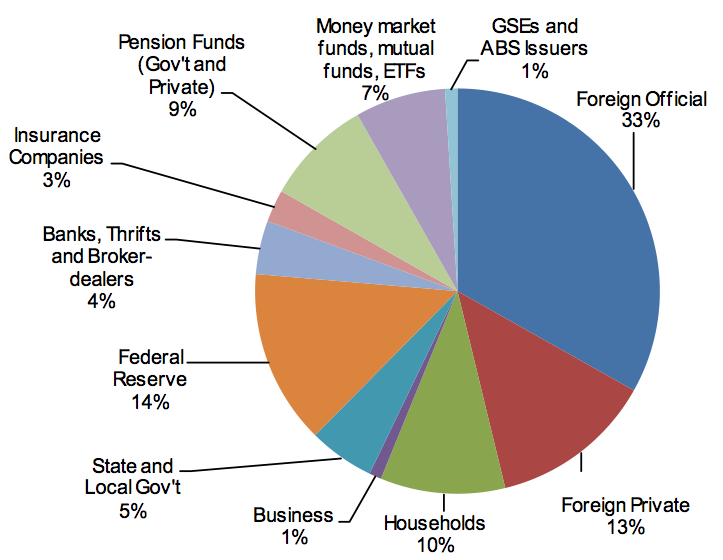
Notice how Greece and the rest of the PIIGS are shaded green?  And you wonder why no one takes the credit rating industries seriously.  Next is an interactive graph on how much of debt of the U.S. is owned by foreign countries.  Click on the graph to link to the interactive part:
Hmmm, I wonder how big of an area the Fed would take up if domestic holders were included. 

Lastly, check out this great Dilbert comic on the coming fiscal collapse:
Looks like Alice needs to buy some silver!

Sabtu, 30 Juli 2011

Jim Lacamp's Brillian Defense of the Free Market and Ron & Rand Paul on the Debt Ceiling

Really not a lot of news today.  Jim Lacamp has a great article on RealClearMarkets making the case for why the free market didn't cause our current economic malaise and why it will eventually triumph.  Some key excerpts:
To a large degree, governments and policymakers have gotten what they want: control. They have brought free market mechanisms to their knees, to the point of submission, almost to the point of being unrecognizable. Free markets, particularly in developed nations, are no longer free. As the Egyptians, Libyans and other subjects of suppression have shown, breaking free from these chains often causes violent, volatile reactions.
Sometimes it requires a volcano to light a match.
George Orwell and Franz Kafka could scarcely have imagined many of these recent events and governmental action and inaction. Rules, treaties and laws are now tossed aside with alarming alacrity. Discipline? It has given way to euphemisms, semantics, legislative parlor tricks and recalculations. Greece doesn't hit their mandated targets? Give the money anyway!
Now anyone can criticize government intervention and blame it for wrecking the economy, but unless you mention Federal Reserve money manipulation, I start losing respect.  Fortunately Lacamp follows through:
The Fed has created a junkie. Get this: There's an over 85% correlation between US stocks and quantitative easing programs. Unbelievable. The recent market reaction to Ben Bernanke utterances illustrate just how significant a stronghold Fed policy now has on stocks. All this despite the fact that Bernanke has been consistently dead wrong about the direction of the economy and that QE2 hurt more than helped our recovery. Incidentally, those higher stock prices? They were more than offset for most Americans by significantly higher food and fuel costs.
The big enabler here though is a much bigger issue. It's our currency system. When you can print money, you don't have to balance trade. It gives policymakers way too much room to tinker with the economy in order to retain their power. Look, when you don't balance trade, and can print money, it gives license to simply take on more debt to allow continued trade. This allows China to build up huge sovereign wealth pools, and to buy commodity resources around the world, rather than balance trade. 
Back before we had the Fed, before we went off the gold standard, our economy had shorter recessions and less debt
Mix in some attacks on Keynesianism and you definitely win the key to my heart:
Many of America's politicians, still drunken on ill-advised dogma that Keynesian spending can solve our problems, continue to contrive New Deal-type schemes that ultimately leave more debt and crowd out the private sector and again, free market forces.
Lacamp even ends with a powerful closing paragraph to boot:
In the long run, we are not Keynesian and we are not all dead. Allowing free people to pursue what is economically best for them and their families is the only way that governments and their people can peacefully and prosperously co-exist. And thrive. Despite the worst efforts of policymakers, free market forces are still alive. They are starting to fight back. We can argue about how, we can argue about when, but we cannot argue about whether they will win in the end. They will win.
As Ron Paul keeps warning, the current financial/Wall Street/Federal Reserve/politicians-buying-votes-with-money-that-isn't-theirs system can't lost forever.  Free markets will eventually prevail, it is just a question of when.

As the debt ceiling charade continues, check out this great interview of Ron and Rand Paul by Neil Cavuto:
Pay attention to how Rand notes that many financial institutions are contemplating changing their rules and restrictions to allow them to hold only AAA securities and, get this, government securities!  Ha! Very clever on their part.  Also pay attention to Ron Paul's call for more inflation starting next summer.  Quite the unusual call to make but he probably pays attention to the money supply more than I do.

Jumat, 29 Juli 2011

Gary North Weights in on Rothbard Vs. Friedman and the Treasury Able to Issue Platinum Coins to Extend Borrowing Capacity?

Buzz around the econ-blogosphere seems to be the ongoing feud between the Milton Friedman and Murray Rothbard camps.  It all started with this article in The Economist I already commented on asserting that the "ghost of Murray Rothbard" was lingering in the grassroots of the Tea Party and their reluctance to accept more inflationary monetary policy.  This of course undermined the so-called pragmatic legacy of the great Milton Friedman who claimed that the Fed did not provide enough liquidity at the onset of the Great Depression.  Lew Rockwell, in typical Lew Rockwell fashion, came out attacking Friedman's inflationist views.  David Friedman, Milton's son, has come out in defense of his father and attacked Rothbard.

Needless to say, this whole thing has ignited a slew of comment threads on the various blogger websites which have brought up the issue.  Gary North is out today with an article that I think lays out the issue very well in favor of all those "Rothbard cultists:"
To some, even to play the game of identifying optimal rules for the centralised state monetary authority is to give away the game to the Keynesian social planners. Here's Rothbard on Friedman:
In common with their Keynesian colleagues, the Friedmanites wish to give to the central government absolute control over these macro areas, in order to manipulate the economy for social ends, while maintaining that the micro world can still remain free. In short, Friedmanites as well as Keynesians concede the vital macro sphere to statism as the supposedly necessary framework for the micro-freedom of the free market.
In reality, the macro and micro spheres are integrated and intertwined, as the Austrians have shown. It is impossible to concede the macro sphere to the State while attempting to retain freedom on the micro level. Any sort of tax, and the income tax not least of all, injects systematic robbery and confiscation into the micro sphere of the individual, and has unfortunate and distortive effects on the entire economic system.
This upset our anonymous author years ago. He is just as upset today.
As a veteran of the "free-market movement", I can attest to the remarkable influence of this line of thinking. Now, Milton Friedman was one of the 20th century's great economists as well as one of its most formidable debaters. This made him a powerful check on the influence of anarcho-capitalist Austrians, obviously much to the chagrin of Rothbard. "As in many other spheres," Rothbard wrote, "[Friedman] has functioned not as an opponent of statism and advocate of the free market, but as a technician advising the State on how to be more efficient in going about its evil work." Rothbard's fulminations notwithstanding, Mr Friedman died a beloved figure of the free-market right. Yet it does seem that his influence on the subject of his greatest technical competence, monetary theory, immediately and significantly waned after his death. This suggests to me that Friedman's monetary views were more tolerated than embraced by the free-market rank and file, and that his departure from the scene gave the longstanding suspicion that central banking is an essentially illegitimate criminal enterprise freer rein. When a significant portion of a political movement's activists believe that the whole point of central banking is "systematic robbery", and that inflation is the means by which this robbery takes place, widespread, reflexive opposition to inflation is not surprising.
I'll say his influence waned. Why? Because he was a self-conscious disciple of Irving Fisher, the self-professed socialist (if push ever came to shove) and incomparably bad forecaster who announced in September 1929 that the stock market had reached a permanent plateau. He went on to lose his personal fortune (he invented the Rolodex) and his sister-in-law's fortune in the Great Depression. He became a laughing stock among economists, a great embarrassment to the profession. Yet he invented the index number, which is basic to the ideal of targeting inflation by the Federal Reserve System. It was Friedman who almost single-handedly resurrected Fisher's reputation in the 1950s from the grave that it so rightly deserved. Friedman called him the greatest American economist in history.
The Friedmanites, who did not see the crisis coming in 2007 -- but a lot of Austrians did, and said so in print -- were caught flat-footed. They are now enraged at Ron Paul and the Austrian economists. So, there is no hue and cry from Fiedmanites over the massive expansion of the monetary base.
Friedman spent his career devising strategies to make the government more efficient. He was a technician who, as a Treasury Department staff economist, advised the U.S. Treasury on how to be more efficient, beginning in 1943, with his technical support for New York Federal Reserve Chairman Beardsley Ruml's plan to impose withholding taxes on the American people. The government got more efficient, fast. Revenues from income taxes (personal and corporate) quadrupled from $8 billion to $34 billion, 1942-1944.We need less efficient government. Friedman never grasped this. Rothbard did. The few Establishment economists and columnists who have read Rothbard have never forgiven him for this.
From what I have read since this whole debacle began, it seems like Friedman was beginning to come around toward the end of his life to the side of Rothbard (and his son and grandson Patri).  However you feel about him, Milton Friedman made great strides in promoting liberty and non-liberty.  Probably his best contribution for advancing liberty was rigorously advocating for the abolishment of the draft and drug war.  His worst contributions toward libertarianism were promoting the idea that the Fed did not undertake enough liquidity-inducing measures at the onset of the Great Depression and the plan he developed for the federal government to withhold income taxes.  Whether the gains outweigh the losses, I don't know, but I am inclined to say that the losses were probably greater.

So as the soap opera of the debt ceiling issue continues (that "raging Boehner" didn't get his way last night on getting a vote on his plan, further showing his loss of influence as Speaker) an interesting proposal comes up via Joe Firestone on how to give the Treasury more borrowing room a/k/a more revenue:
So, coin seigniorage looks like a solution to the debt ceiling crisis and also to Congress's requirement, which is the cause of our having a national debt, that the Treasury must issue new debt when it plans to deficit spend. To meet the coming debt ceiling crisis, I think the President ought to use it to preempt the Republican House by doing the following.
-- Direct the mint to create a jumbo platinum coin with face value $500 Brillion.
-- Direct the mint to deposit the coin in its account at the New York Federal Reserve.
-- Direct the Treasury to “sweep” the mint's account to collect profits from coinage (this would result in marking up Treasury's account at the New York Fed by $500 Billion).
And what gives the President the authority to take such action?

§ 5112. Denominations, specifications, and design of coins

(k) The Secretary may mint and issue platinum bullion coins and proof platinum coins in accordance with such specifications, designs, varieties, quantities, denominations, and inscriptions as the Secretary, in the Secretary’s discretion, may prescribe from time to time.
Wow.  I am not sure how much platinum the federal government actually owns, but it seems like kind of an accounting trick (which means it will probably work knowing Congress).  A better solution would be to sell all the gold, silver, and platinum back to U.S. citizens or foreigners (not other governments) and then allow payments of taxes to be done in precious metal.  An even better solution would be an outright default thereby crippling the U.S.'s credit rating and forcing Congress to be adults and start making substantial cuts.  That or the Fed will jump in and accelerate the destruction of the dollar.  A colleague and I got into a discussion yesterday on who owns U.S. federal government debt.  Thanks to The Big Picture, this graph should answer his question:
Jim Rogers weighed in again on the debt ceiling and the coming hard economic times for America in an interview with RT:
Nothing new here, though Roger's assertion that Asia is the continent of the 21st century and that's why he is raising his kids in Singapore so they learn Mandarin is interesting.

Update- Well now I don't know what to think of Milton Friedman, watch this interview with Charlie Rose:
First he calls Alan Greenspan the greatest Fed chairman to ever live, then claims the Great Depression wouldn't have happened if the Fed didn't exist, and then goes to say that Bernanke is a "very able man."  It makes me wanna punch myself in the face when Friedman tries to explain Greenspan's genius despite Rose pointing out inflation was creeping in 2005.  What I would give to hear Friedman's opinion of Greenspan after the 2008 crash.  Friedman may have been a great advocate of individual liberty but fell miserably short when it came to predicting the consequences of monetary policy.

Kamis, 28 Juli 2011

NASA Proves Global Warming Alarmists Wrong, Choose What to Cut, and Geithner Once Again Shows his Allegiance to the Banks

I never really like addressing the topic of global warming.  I constantly hear arguments back and forth stipulating each side.  The evidence for each side seemed too muddled to be conclusive either way.  I have very little knowledge on the topic and have always reasoned that if global warming is a problem, than free market-driven innovation is better equipped to handle it rather than government mandates.  Even so, it looks like all the big government environmentalists may be in for a surprise from this report:
NASA has released a new study that may prove global-warming alarmists have been wrong all along.

Data from NASA's Terra satellite covering the period 2000 through 2011 shows that when the earth's climate heats up, the atmosphere appears to be better able to channel the heat to outer space.

The satellite data call into question the computer models favored by global warming believers and may put to rest controversy over the discrepancy between the computer models and actual meteorological readings.

Co-author of the study, Dr. Roy Spencer of the University of Alabama's Earth System Science Center, said in a press release, "The satellite observations suggest there is much more energy lost to space during and after warming than the climate models show. There is a huge discrepancy between the data and the forecasts that is especially big over the oceans." 
Ha!  Though I am skeptical of the scandalous nature of the infamous Climategate findings, the fact that NASA put this report out is just great.  Don't get me wrong, emissions aren't something that should be encouraged (though they are currently necessary to sustain our standard of living), but this new NASA report seems to show the issue isn't as urgent as Al Gore would like everyone to believe.

As the debt ceiling side show continues into tonight, the Washington Post has this neat interactive graph where you can choose how to prioritize federal government payments for the month of August if the ceiling is not raised.  Basically you are given $172.4 billion and have to choose what to fund from the $306 billion bill.
Choices include such things as entitlement program spending, payments on Treasury debt, Defense Department funding, and various other federal agencies.  I chose not to pay for anything, garnering a savings of $172.4 billion.  Even if you choose Medicare/Medicaid/Social Security, you still get a $73.2 billion surplus.  What did you choose?

Though the Post's graph is make believe, it looks like Geithner has already made the decision for everyone:
The U.S. Treasury will give priority to making interest payments to holders of government bonds when due if lawmakers fail to reach an agreement to raise the debt ceiling, according to an administration official.
Like TARP, Geithner chooses the banks and idiotic creditors of the U.S. over grandma.  Of course even grandma may be vested indirectly in the federal government, but that is beside the point.  Shorting creditors would send the perfect signal to investors to stray away from lending money to the U.S. government. Of course the inability for the federal government to borrow would spur Bernanke to crank the printing press up, but massive inflation creates more opposition to unsustainable spending than taking out another Visa to pay back the past Visa, MasterCard, American Express, or loan sharks.

I will end with pointing out this interesting graph on foreign investment in the United States:
Remember, Florida, Arizona, and Nevada were ground zero for the housing bubble.

Update- Wow, check out this awesome interview of Hayek in Gold and Silver Newsletter.  Hayek explains how he predicted the inflationary boom of the 20's lead to the Depression, why Keynes was ready to denounce his own theories because of their ultimate goal of totalitarianism, and his accurate prediction that inflation would grip the late 1970's.  The interview is highly recommended.

I also can't go without pointing out this crudely ironic New York Post article title:

Raging Boehner

Bullies GOP to back debt plan

Rabu, 27 Juli 2011

Debt Ceiling Rap, Compare and Contrasting Boehner Plan V. Reid Plan, Simon Black on Why to Buy Gold, and Tom Woods Tears Up Unions

And here I thought the Keynes Vs. Hayek rap battles were the only good economic rap videos out there.  Well check this out from ReasonTV:
Not gonna lie, I had the hook in my head all day.  I especially love the line "all up in the club we be louding out, while in the market yeah we be crowding out."

The Committee for a Responsible Federal Budget has a nice cheat sheet up today comparing Speaker's John Boehner's bill to raise the debt ceiling along with Senate Majority Leader Harry Reid:
 Reid Proposal  Boehner Proposal
Debt Ceiling Increases        
  • Raises debt ceiling by $2.7 trillion immediately, which would last until 2013
  • Allows President to request $900 billion increase in debt ceiling, $400 billion immediately and rest subject to vote of disapproval
  • If more than $1.6 trillion additional savings from special committee enacted, President authorized to request $1.6 trillion debt ceiling increase, subject to vote of disapproval
Discretionary Spending       
  • $1.2 trillion in savings over 10 years from discretionary caps
  • Caps grow roughly with inflation
  • Firewall between security and non-security spending for FY 2012 and FY 2013
  • Limits war spending to $450 billion over the 2013-2021 period
  • Enforcement: 60-vote point-of-order on bill that would cause spending to exceed caps or to increase caps AND automatic, across-the-board cuts if caps are exceeded
  • $1.2 trillion in savings over 10 years from discretionary caps
  • Caps grow roughly with inflation
  • Details range for defense spending in FY 2012 and FY 2013
  • Enforcement: Automatic, across-the-board cuts if caps not met
Specified Other Mandatory Savings        
  • $70 billion in other mandatory savings (savings other than from Social Security and federal health programs)
    • $40 billion from program integrity to achieve savings from waste, fraud, abuse
    • $15 billion from spectrum sales
    • $10 - $15 billion from agricultural reforms
    • Higher education reforms whose savings go to Pell Grants
  • $16 billion from program integrity to achieve savings from waste, fraud, abuse
  • $13 billion from higher education reforms to go to Pell Grants
Special Committee to Identify Additional Savings       
  • Joint, bipartisan committee of 12 lawmakers to "present options for future deficit reduction"
  • Goal: Reduce deficit to below 3% GDP
  • Mandate: Make recommendations to meaningfully improve short and long term fiscal imbalance, may include tax reform, shall consider bipartisan plans
  • Recommendations guaranteed to receive up or down Senate vote under expedited process by the end of the year
  • Joint, bipartisan committee of 12 lawmakers to report deficit reduction legislation by November 23
  • Goal: $1.8 trillion in deficit reduction
  • Mandate: Make recommendations to meaningfully improve short and long-term fiscal imbalance
  • Enforcement: Second $1.6 trillion debt ceiling increase not authorized without enactment of at least $1.6 trillion additional savings
  • Recommendations considered under expedited process
Balanced Budget Amendment (BBA)       
  • None
 
  • Requires vote on BBA in House, and subsequent vote in Senate if BBA passes House

A dominant feature of both is the silly notion that if the majority of cuts are "back loaded" then they may actually happen.  This of course is never the case, but politicians never gets tired to trying the same strategy over and over just to get a talking point. Hell, Boehner's plan only makes cuts of $4 billion in 2012 by itself.  Even more ridiculous is Reid's plan that relies on cuts from limiting war spending.  I will have to see this war "scaling down" to  believe it.  Rep. Paul Ryan, a highly overrated cost cutter, actually does a pretty good job of tearing down Reid's plan:
Reality: The Reid plan relies on the inaccurate assumption that surge-level spending in Iraq and Afghanistan is scheduled to continue over the next decade. An honest budget cannot claim to save taxpayers’ dollars by cutting spending that was not requested and will not be spent. Senate Democrats are employing a budget gimmick that will not fool the credit markets and does not address the urgent need for Washington to get its fiscal house in order.
Well shit, why not just declare war on Mars, allocate $100 trillion for the invasion, and then write a bill not allowing disbursement of the payments?  Instant $100 trillion in savings!

I got into an argument with a colleague today about whether or not one should buy gold.  He claims gold is in a bubble.  I said the reason for gold's rise has been loss of confidence in fiat currencies caused by money printing which doesn't look to be slowing down anytime soon.  Simon Black backs me up on Sovereign Man today:
So instead of worrying about buying gold at its all time high, ask yourself another question instead: Over the next few years, do you expect that these broken, bankrupt governments will inspire confidence among institutional investors, or do you think that confidence will continue to erode?
If you’re leaning towards the latter, you can be sure that more money will flow into gold, and that prices will rise.
Indeed, the question is not to ask if the gold price has plateaued but what are the fundamentals driving it and are those fundamentals going to continue.  Italy and Spain are going to need bailed out soon, the Fed will implement QEIII, and China is beginning to slow down.  Seems to me that precious metals are good for the long haul.  I saw this pic today on Zerohedge and had to put it up:
I will end with this fantastic video of Tom Woods and Damon Root of Reason discussing myths of unions and the New Deal on Stossel:
Update- Just to bolster my previous gold argument, here is the impeccable Marc Faber:
I just calculated if we take an average gold price of say around $350 in the 1980’s and then we compare that to the average monetary base in the 1980’s, and to the average US government debt in the 1980’s...but if I compare this to the price of gold to these government debts and monetary base, then gold hasn’t gone up at all. It’s gone actually against these monetary aggregates and against debt it has actually gone down. So I could make the case that probably gold is today very inexpensive... - in Business Insider

Selasa, 26 Juli 2011

Alan Greenspan Out of Hiding Again, Home Prices Up a Bit, Jefferson County Finally Goes for Bankruptcy, and Ron Paul Provides the Perfect Analogy

Every time former Fed chairman Alan Greenspan comes out of the hole he should be hiding in to offer some of that wonderful financial advice he used to literally bring the global economy to its knees, I am always amazed that any self-respecting publication actually allows him to have a say in anything.  Though I would love nothing more than to never hear a word from this man again, I even have to admit that he makes some sense in his latest Financial Times column:
What is not conjectural, however, is that American policymakers, in recent years, faced with the choice to assist a major company or risk negative economic fallout, have regrettably almost always chosen to intervene. Failure to act would have evoked little praise, even if no problems subsequently arose; but scorn, and worse from Congress, if inaction was followed by severe economic repercussions. Regulatory policy, as a consequence, has become highly skewed towards maximizing short-term bail-out assistance at a cost to long-term prosperity.
Sorry Greenspan, it doesn't take a genius to figure out that bailing out what is essentially bad behavior leads to the perpetrator to keep engaging in it.  While Greenspan's overall point in the article is good, he does make mention of the $1.6 trillion in excess reserves being stored at the Fed. He refers to them as a "buffer" being used by the banks to retain easy capital.  The new Case Shiller Home Price data seems to suggest otherwise:
New York, July 26, 2011 – Data through May 2011, released today by S&P Indices for its S&P/Case-
Shiller1 Home Price Indices, the leading measure of U.S. home prices, showed a second consecutive month
of increase in prices for the 10- and 20-City Composites. The 10- and 20-City Composites were up 1.1%
and 1.0%, respectively, in May over April.
The money supply is expanding, whether or not it means the housing market has finally bottomed off remains to be seen.  I can't help but notice that a modestly busy shopping center near the Harrisburg International Airport is going through major renovations after construction on it ended a few years ago.  There is a Members 1st Credit Union building coming close to being fully constructed in Middletown after the plot of land it is on was empty for over a year.  A new low-income apartment complex has sprung up in my neighborhood even though there is still a decent amount of houses that are for sale.  On top of all this, the Blockbuster that went out of business in Middletown now has a "coming soon" sign for a new business.  I suspect Bernanke's printing press at work, but that will remain to be seen.  Since I mentioned Greenspan's article, I should also point out Jonathan M. Finegold Catalan's great Mises Daily article today "Greenspan's Fatal Conceit."

While Middletown seems to be okay with attracting capital for building projects, it looks like Jefferson County, Alabama is doing the adult thing and finally biting the bullet, via Bloomberg:
Jefferson County, Alabama, which may vote in two days to file a record U.S. municipal bankruptcy, hired attorneys who represented Orange County, California, when it sought protection from creditors in 1994.
Now if only Mayor Thompson and the rest of the PA legislature would grow up and let Harrisburg do the same thing, I wouldn't have to read about the side show going on in the paper anymore. Zerohedge has this map posted today on Pew Center estimates of pension obligations for each state:
Whether or not this is new data from the report Pew put out a year ago on pensions, I don't know.  Still, the map is quite handy to see which states are screwing over both their taxpayers and state workers.

While Obama and Boehner went back in forth the kabuki theater that is the debt ceiling debate last night, Ron Paul, in true Ron Paul fashion, makes the perfect analogy for the debt ceiling: the pesky neighbor!
Imagine you had a pesky neighbor who somehow took out a mortgage on his house in your name and by some legal trickery you were obligated to pay for it. Imagine watching this neighbor throw drunken parties, buy expensive cars, add more rooms to the house, and hire dozens of people to wait on him hand and foot. Imagine that he also managed to take out several credit cards in your name. One by one, he would max them out and then use your good name and credit to obtain another credit card, then another and then another. Each time, this neighbor would claim that he needed the new credit card to pay interest on the other maxed out credit cards. If he defaulted on those cards, your credit score would be hurt and when you wanted to buy something for yourself, it would be more difficult to get a loan and the interest you paid would be higher. Imagine that you mulled this over, and time after time, said nothing as he filled out more credit applications so he would not have to default on the other debt taken out in your name. Meanwhile, another shiny new Mercedes appears in his driveway. At what point do you think you might get tired of this game? And, even though you are left with no really good options, do you think you might eventually tell him to go ahead and default, just stop spending your money!
While Congress will undoubtedly raise the debt ceiling very soon, check out this latest Rasmussen poll on our elected "leaders" in Washington:
Voter approval of the job Congress is doing has fallen to a new low - for the second month in a row.
Just six percent (6%) of Likely U.S. Voters now rate Congress' performance as good or excellent, according to a new Rasmussen Reports national telephone survey.
And of course the obvious question is, who the hell is the 6% that actually like what Congress is doing?

I will end with this trailer for the new movie on the financial crisis entitled Margin Call:
A few things to look for in this movie:
  • An oversimplification of the crisis which places the blame completely on Wall Street
  • The non-mention of the Federal Reserve's role in the crisis
  • The brief mention of the role Fannie Mae and Freddie Mac played in the crisis
  • The wonderful job the federal government did with privatizing profits and socializing losses
It will be capitalist bashing Hollywood gold at its finest.