Selasa, 26 April 2011

Ron Paul Makes It Official, Inflation in Airlines & Diapers? And Why I Might Be Wrong On Selling Silver

Well Ron Paul made it official on Hanity last night:
Texas Republican Rep. Ron Paul announced on Sean Hannity’s Fox News show Monday that he is creating an exploratory committee for a presidential run, a key step that likely indicates the unpredictable libertarian with diehard followers will run for president against President Obama in 2012.
While his chances of even winning the nomination are slim, I am hopeful an attitude change is coming in the majority of the public.  Caroline Baum lays it out precisely in her Bloomberg column today:
Americans have a fundamental philosophical dilemma over what we want from our government. In good times, we want an arms-length relationship. In bad times, we want a nanny looking out for us. We can’t have it both ways. This mind-set needs to change.
A change in mind-set is precisely what is coming and it can either happen the hard way (dollar crisis) or the easy way (stopping the non-stop spending and continual growth in government).

To push the point home a little more, here are a few more signs of prices rising. First is Delta Airways and U.S. Airways Group announcing higher fares to make up for higher fuel costs:
The two U.S. airlines reported smaller-than-expected losses on Tuesday and their share prices rose, with Delta up 11 percent, even as some analysts questioned how much longer consumers, paying more for gasoline and food, would tolerate higher air fares.
"We must fully recapture our costs on every flight every day to maintain and improve our earnings performance," Delta Chief Executive Richard Anderson told analysts on a conference call, adding that high fuel was "the new norm."
Blaming higher fuel costs should come as no surprise, but now Huggies?  From Yahoo! Finance:
DALLAS (AP) -- Kimberly-Clark Corp., the maker of Huggies and Kleenex, said Monday that it plans to raise prices, its third such announcement since the middle of March.
The company said it's merely passing along the higher prices that it has to pay for raw materials like oil and wood pulp. It also more than doubled its predictions for how much the prices for such commodities will increase.
Even if you claim inflation is not here, inflationary expectations surely are.

So yesterday, I made the claim to not begin selling silver with such high demand.  I also pointed out how the high demand has created a short-term shortage.  Well, a few articles may have proven me wrong today.  First is Simon Black over at Sovereign Man:
Silver’s rise (in US$ terms, at least) over the past several weeks has been nothing short of phenomenal. The chart has effectively “gone parabolic,” and people I’ve never met have started to e-mail me (in my capacity as a registered investment advisor) for advice on silver.
silver chart Should I sell my silver?
It doesn’t matter whether it’s silver, tech stocks, emerging markets currencies, or pork belly futures… any time these two events coincide (a parabolic chart pattern, and strangers asking me for advice), it sets off ALARM BELLS in my head.
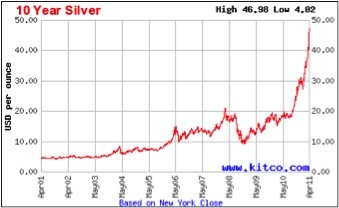
Yes, silver's rise in recent weeks has been nothing short of daunting.  But the question is, are we due to see a correction?  Perhaps, more from Black on what investors do :
So, what do most of them do? They sell out for a small profit. That’s why it is said that bull markets are constantly climbing a “wall of worry.” And that’s why ALL markets have corrections. Corrections happen when enough people are FEARFUL of losing the gains they’ve made so far, and start to sell out in large enough numbers to temporarily reverse the trend.
So what to buy then if you fear losing your profits?
Long-term ETF positions are risky, but you may consider a short-term position in the ProShares UltraShort Silver ETF (ZSL on the New York Stock Exchange). This instrument is designed to move TWICE as much as silver bullion, but in the OPPOSITE direction.
For example, if silver falls 5% in a day, this security should GAIN 10%. Of course, it works both ways. If silver keeps on rising, then the price of ZSL will lose twice the amount silver rises by.
During this bull market, silver has already seen one “correction,” during the financial crisis, of more than 60%. That was an anomaly. But, a typical 10% or 20% correction would not be surprising to see at some stage — quite possibly soon.
Perhaps if I had more skin in the game, I would follow his advice.  On the thoughts of a silver in shortage, Bob Moriarty sets it straight:
There is no shortage of silver. There never has been a shortage of silver. Until the laws of supply and demand are repealed, there never will be a shortage of silver.
My question is, "If you were smart enough to buy 100 ounces of silver at $4 an ounce, a 5000-year low in real terms, how much profit have you made if silver goes to $50 or $100 or $300 and you never, never, ever sell? The answer, of course, and ignored by all the silver "GURUS" is that if you buy low and don't sell ever, you don't make any profit. That may be the dumbest investment advice I have ever heard.
Silver is a commodity like any other. If you are smart enough to buy it cheap and you are smart enough to sell it when it gets expensive, you will profit. If you want to buy at all time highs, good luck with that.
Despite APMEX being out of silver eagles till May 13th, if you really want silver, you should be able to find it.  There are a lot of rumors out there about silver, and some have merit.  I may be wrong on whether you should sell silver right now, but I won't be as wrong as this David Lereah. Here is just one pic:
Check out the post on The Big Picture to see some hilarious Amazon.com comments on the books.

Senin, 25 April 2011

Ron Paul on The View, Silver Crisis, Tamny on Deflation, and China Overtaking the U.S.?

Here is Ron Paul from The View today:
Not too bad, he holds his own next to Whoopi.  More good news as it has almost been confirmed that Paul will announce a presidential exploratory committee tomorrow.  From National Journal:
Rep. Ron Paul, R-Texas, whose outspoken libertarian views and folksy style made him a cult hero during two previous presidential campaigns, will announce on Tuesday that he's going to try a third time.
Sources close to Paul, who is in his 12th term in the House, said he will unveil an exploratory presidential committee, a key step in gearing up for a White House race. He will also unveil the campaign’s leadership team in Iowa, where the first votes of the presidential election will be cast in caucuses next year.
Just for kicks, here is Paul on Hardball with Chris Matthews:
And Russ Roberts just been announced that the second version of the infamous Keynes vs. Hayek rap video will be released this Thursday.

Now for the bad news on the announcement front, APMEX is out of silver eagles until May 13, 2011.  Here comes a bubble?
And now they are offering to buy anyone's silver for $3 over spot:
And now CME has hiked silver margins by 9%.  With such demand, you would be an idiot to sell silver right now.  It's tough to see it going anywhere but up for now.  Check out this article from Lewrockwell.com which warns of placing your faith in physical storage. Check out Bill Cramer's story:

I have been pondering why deflation is so bad for the government over the past few days.  John Tamny answered my prayers in his Forbes column on Japan's mythical "lost decade" today:
Much as a weak currency pushes up the broad price level, deflation pushes it down. It wreaks havoc on commerce simply because nominal prices must eventually account for the rising currency, but if debts were taken on when the currency was weaker, the falling prices make debt service more difficult.
To put it more simply, imagine taking out a $1 million loan to buy barrels of oil at $100 in order to sell them at oil’s current price of $112/barrel. If the price stays the same there’s a nice return, but if the dollar’s value strengthens such that the price of oil falls below $100, the near-term deflation wipes out any nominal profits on the investment, and if it strengthens substantially, the investor is out a lot of money.
Japan suffered a real deflation whereby a rising yen forced down all prices. For those not in debt this was a Godsend, but for those heavy on debt the deflation not only erased profits, but it effectively made Japanese companies insolvent.
Awww, not it makes sense why the government pursues inflation.  After all, why should a system built on debt not fix itself?
So the IMF has caused a stir today in predicting that China would overtake the U.S. economically by 2016.  Thankfully, that prediction has be refuted by the International Business Times which points out China's huge property bubble and coming hard landing:
Here is how they do it:
1) Average the annual growth rate over some past period
2) Adjust that rate up or down a few percentage points based on contemporary biases
2) Extrapolate the adjusted growth rate over the desired period
These “adjusted extrapolations” are virtually worthless because the “adjustments” are guesses derived from plugging past data into models. Moreover, they’re often wrong because reality doesn’t simply extrapolate from historic data.
These economists are notorious for missing "big picture" events and shifts. They largely missed the 2008 global financial crisis and China’s astronomical ascent in the 2000s.
And of course news like this doesn't help China's prospects, from Xinhua:
China's consumer prices may increase about 4.5 percent this year, exceeding the government's full-year target of 4 percent, an official said Monday.
I will end by mentioning a great article in the Washington Examiner on Boeing's close relationship with the Obama administration.  After mentioning the NLRB's recent decision to not allow Boeing to set up shop in South Carolina:
This extraordinary abridgement of economic freedom might suggest an anti-Boeing vendetta from President Obama, except that this administration's Export-Import Bank has subsidized Boeing with nearly $15 billion in loan guarantees in the past two years -- roughly three-quarters of all of Ex-Im's guarantees during that time.Boeing and Obama, both based in Chicago, have a real political friendship. In 2008, Obama was by far the biggest recipient of campaign contributions from Boeing employees and executives, hauling in $197,000 -- five times as much as John McCain, and more than the top eight Republicans combined.
And check out this great, but also sad, series of e-mails on Mish from a surgeon who has officially "shrugged." (left the medical field because of abundant government regulation)

Update- USDA reporting higher prices of meat by 6% to 7% up this year, 12% higher than they were last year.

Here is Ron Paul on the Colbert Report:

And check out this great article from Business Insider by Joe Weisenthal on why Ron Paul's presidential run will matter so much more this time.

Minggu, 24 April 2011

Don Boudreaux Provides the Pefect Analogy to Rationalize Market-Based Education

Bourdeaux's recent CafeHayek post deserves a post in itself.  I cannot stress how great it is in advocating for a market-based education system over a government dominated one.  Highly recommended! I would provide an excerpt, but the whole post needs to be read in order to have the best effect.

NYT Reports On Increase in Clothing Prices, Wages Up for Class of 2011, Current Average Price of Gasoline in All 50 States, and China Cutting Holdings of USDs

It's Easter and I have a lot of work to do, so today is a quick post.
New York Times reported on increase in clothing prices Friday:
As retailers have been warning, their costs are rising as cotton and other materials get more expensive, laborers in China demand higher wages and fuel prices go up.
No mention of Bernanke and Fed money printing in the article, big surprise.  Mark J. Perry has a graph and post on rising wages of new college graduates:
2. NACE -- "The good news continues to roll in for the Class of 2011 as results from NACE’s Spring 2011 Salary Survey show that the average salary offer to all Class of 2011 graduates now stands at $50,462, which is up 5.9 percent over the overall average of $47,673 to Class of 2010 graduates."
Inflationary expectations?
Here is a great chart on average gas prices in all 50 states from AAA

And now China Central Bank Governor Zhou Xiaochuan is announcing that he is looking to drop 2/3 of the $3 trillion in U.S. dollar reserves the Central Bank currently has. From Xinhua:
China's foreign exchange reserves increased by 197.4 billion U.S. dollars in the first three months of this year to 3.04 trillion U.S. dollars by the end of March.

Xia Bin, a member of the monetary policy committee of the central bank, said on Tuesday that 1 trillion U.S. dollars would be sufficient. He added that China should invest its foreign exchange reserves more strategically, using them to acquire resources and technology needed for the real economy.
The problem is, where are they going to be invested into?  Who is going to want to buy dollar reserves?


I will end with this idiocy you have probably heard of by now:
In what may be the strongest signal yet of the new pro-labor orientation of the National Labor Relations Board under President Obama, the agency filed a complaint Wednesday seeking to force Boeing to bring an airplane production line back to its unionized facilities in Washington State instead of moving the work to a nonunion plant in South Carolina.
Unbelievable, nothing like the government telling a business where they can set up shop.  Mish nails it:
The National Labor Relations Board is not acting like a group of thugs. Rather, the NLRB instead acting like a group of slave-masters attempting to put balls-and-chains on Boeing.
Even if Boeing benefits greatly from the military industrial complex, this still isn't right.

Sabtu, 23 April 2011

Wage Rates Rising-Another Sign of Inflation? Mises on Why the Stock Market Rises First with Fed Money Printing And a Video Both Paul Ryan and President Obama Must Watch

There was a post on Robert P. Murphy's blog a few days ago that generated quite a lot of conversation.  Some of the more Keynesian leaning commentators kept asserting that without a subsequent rise in wages, major price inflation cannot occur.

Well, EPJ has this report:
Well, the wage surge is starting. Late last year, Google gave all its employees a 10% pay increase.  Now Microsoft is giving a pay raise to all its employees. FT reports:
Microsoft’s 90,000 employees are to receive a company-wide pay increase, in the latest escalation of the war for talent among technology companies.

The pay increases, announced on Thursday in an internal e-mail by Steve Ballmer, chief executive, are aimed particularly at software engineers at the early stage of their careers and mid-level employees with expertise that is in short supply.
Wenzel explains:
It makes sense that the pay raises are coming first in the high tech sector. In the high tech sector, you have competition for techies to design consumer software and business (i.e. capital goods) software. The high tech industry is in some sense the equivalent of oil in the natural resource sector. Because it faces demand from across the structure of production, it experiences increasing demand at almost all times, but especially during a period of serious central bank money printing. Since during those periods the capital goods sector will have the money to bid away software engineers from consumer businesses.
Awww, computer software is the equivalent of a capital good since so many businesses rely on software for operations (payroll, inventory, etc.).  Like the stock market, computer software acts a capital good and begins to rise when Central Banks engineer an inflation fueled boom.  Mises explains:
the moderated interest rate is intended to stimulate production and not to cause a stock market boom. However, stock prices increase first of all. At the outset, commodity prices are not caught up in the boom. There are stock exchange booms and stock exchange profits. Yet, the “producer” is dissatisfied. He envies the “speculator” his “easy profit.” Those in power are not willing to accept this situation. They believe that production is being deprived of money which is flowing into the stock market. Besides, it is precisely in the stock market boom that the serious threat of a crisis lies hidden.
Not sure where that quote is from, read it somewhere on the web.  I believe it is from Mises' The Causes of Economic Crisis.

Here is a video both Paul Ryan and Pres. Obama need to watch for their horrid budget proposals which fail to take into account rising interest rate payments.

Update- Another sign of wage hikes?  From EPJ:
Paul Kedrosky says the demand for engineers is super hot right now in Silicon Valley--as hot as 1998-99.
For some reason, I am unable to get upload the youtube video, but Kedrosky basically lays out (unknowingly?) a simple structure of production in asserting that once the software is designed and built, it must be shipped out and sold.  Hence, the increase in hiring of salespeople.  They will be the next line of workers to receive Bernanke's newly printed "wealth."

Update 2- Portugal revised its deficit upwards to 9.1% of GDP for 2010 (up from 8.6%) and Greek 2-year hits 23%:

Jumat, 22 April 2011

Krugman Ignores Economic Reality in Health Care, McDonalds' Inflation, and Silver Up to $47

Paul Krugman's New York Times column is extra infuriating today.  How in the hell does a Nobel Prize winning economist not apply economic principles to an industry such as health care?
Here’s my question: How did it become normal, or for that matter even acceptable, to refer to medical patients as “consumers”? The relationship between patient and doctor used to be considered something special, almost sacred. Now politicians and supposed reformers talk about the act of receiving care as if it were no different from a commercial transaction, like buying a car — and their only complaint is that it isn’t commercial enough.
Hate to break it to you Krugman, health care is not a right, it is a commodity like anything else.  It is unbelievable how he thinks that health care does not fall under the constraints of the law of scarcity, the law of diminishing marginal utility, or the law of the subjective theory of value.  Krugman is infuriating, but I am not as pissed as this guy:
Sorry to bring this picture up again, but these kids are gonna be pissed to:
From EPJ:
McDonald's now expects food costs to rise between 4 percent and 4.5 percent in the United States this year. That is up from its prior call for a rise of 2 percent to 2.5 percent.
Chief Financial Officer Pete Bensen said McDonald's in March put through a 1 percent menu price rise in the United States, and that it plans additional increases.
At least silver got another bump:
Here are a few more tidbits, former Prime Minister Gordon Brown wants to head the IMF.  I guess he thought he did such a good job with the U.K., he needs to take his policies to a global scale.  Think he can solve Greece's coming default?  From the Guardian:
Greece is considering ways to restructure its debt – such as by extending the life of its loans – two national newspapers claimed on Friday, joining a flurry of recent reports on the prospect that Athens might be forced to default.
Greek and EU officials have steadfastly denied a debt restructuring is planned in the face of mounting evidence that markets are factoring one in.
And the revolving door continues:
Stephen M. Hoffman  has let his position as a Federal Reserve regulator to join  Promontory Financial Group, a Washington D.C. financial services consulting firm.

The founder of Promontory is  Eugene A. Ludwig, former U.S. Comptroller of the Currency and former Vice Chairman of Bankers Trust/Deutsche Bank.
Update- Mark J. Perry provides a nice graph and explanation to refute much of what Krugman stipulates in his column: 
But Krugman seems to be arguing that regardless of who is paying for health care, "there’s something terribly wrong with the whole notion of patients as “consumers” and health care as simply a financial transaction." Krugman's further claims that “'Consumer-based' medicine has been a bust everywhere it has been tried."
Well, what about LASIK surgery, retail health clinics, concierge medicine, medical tourism and cosmetic surgery, to name just some of the successful "consumer-based" medical services?
When we think about soaring health care costs in the United States, isn't one of the main reasons precisely because patients have NOT been treated as consumers spending their own money?  In that case, I think Krugman has it backwards.  If the goal is to control health care costs, that will never happen until patients are treated like consumers. 

Kamis, 21 April 2011

Bernanke Set to Take Questions, Ron Paul Esquire Profile, Trouble in China, and Obama Investigates Oil Speculators

Bernanke fielding questions from the media next week?  This will be good.  From the Wall Street Journal:
Next Wednesday, Federal Reserve Chairman Ben Bernanke will do something no Fed chief has done before: Stand before a room full of journalists after officials conclude a policy meeting and answer questions about the central bank's decisions.
So what would I ask the Ber-nank?  For starters, how plausible is this picture?
                                              (inflation will solve childhood obesity)
Clearly Bernanke is taking a queue from Michele Obama.  Maybe he could explain why silver hit $46 today?
Perhaps he could explain this hilarious picture:
Free helicopter inside!? I bet it is filled with loads of greenbacks!
More importantly, he could explain why the Fed is paying 8 times the market rate for banks to keep their excess reserves stocked away with him.

Seriously though, I doubt the media will push him too much.  They will ask about inflation, he will say some b/s about emerging markets and Middle East turmoil and assure everyone he has everything under control. *Yawn*

Maybe he should read his arch-nemesis' bio in Esquire today:
See, it's not about him. Ron Paul doesn't think that way. It's about this neat idea, principles versus incrementalism. That's why he's taken more lonely stands than any other politician in American history: against the Iraq war even though he's a Republican, against the Defense of Marriage Act even though he's a conservative Christian, against farm subsidies even though he represents a rural district, against the Texas Medical Center even though he's from Texas — the list goes on and on. He refused to award congressional medals to Rosa Parks, Ronald Reagan, the Pope, and Mother Teresa. After Hurricane Katrina, he voted against sending federal help to Louisiana.
The bio is great with the exception of this line:
If we had stuck to what Congressman Paul views as our founding principles, we would have undoubtedly been a smaller and poorer and less consequential country, but also purer and freer and more peaceful.
Undoubtedly? Really? I would love to see proof of that.  John H. Richardson needs to stick to writing, not economics.  I believe it was America's semi-adherence to a free market that lead to our explosive growth in productivity and wealth accumulation.  To think we would be poorer with a free market lacks any basis.  I agree on one thing though, the U.S. probably wouldn't be as big of a country.  But we also wouldn't have the blood of a thousand native Americans and Mexicans on our hands either.

Going back to Bernanke, I would love to know what he thinks of this:
Chinese oil giant Sinopec has stopped exporting oil products to maintain domestic supplies amid disruption concerns caused by Middle Eastunrest and Japan's earthquake, a report said Wednesday.
The state-run Xinhua news agency did not say how long the suspension would last but it reported that the firm had said it also would take steps to step up output "to maintain domestic market supplies of refined oil products".
Get ready for another rise in gas prices.  No doubt Big Ben is looking at events like these as the race to the global currency bottom is being printed in front of our very eyes:
"A two-day strike over rising fuel prices turned violent in Shanghai on Thursday as thousands of truck drivers clashed with police, drivers said, in the latest example of simmering discontent over inflation. About 2,000 truck drivers battled baton-wielding police at an intersection near Waigaoqiao port, Shanghai's biggest, two drivers who were at the protest told Reuters. The drivers, who blocked roads with their trucks, had stopped work on Wednesday demanding the government do something about rising fuel costs, workers said."
So what are the chances of QE3?  Jim Grant explains:
Bernanke was hard put to explain why he chose to let Lehman go while acting to save Bear Stearns. He would be harder put to explain why he chose to implement QE1 and QE2 but, in another hour of need, refused to launch QE3." And "Sooner or later, gravity turns speculative markets into investment markets. When this transformation occurs, the Fed will confront the need to bail out the innocents it had previously bailed in. Hence, QE3."
To make matters worse, Obama is now trying to cover for Bernanke:
 RENO (Reuters) – President Barack Obama said on Thursday the U.S. attorney general was assembling a team to root out any fraud and manipulation in the oil markets that might be contributing to higher U.S. gasoline prices.
"The truth is, there's no silver bullet that can bring down gas prices right away," Obama said in prepared remarks for his opening statement at a townhall-style meeting in Nevada.
"The Attorney General's putting together a team whose job it will be to root out any cases of fraud or manipulation in the oil markets that might affect gas prices - and that includes the role of traders and speculators. We are going to make sure that no one is taking advantage of the American people for their own short-term gain," Obama said.
That's right, refuse to open up more federal land for oil drilling and invade an oil producing country which has the opposite effect of soothing turmoil.  Right, the speculators who are predicting a supply gut and bidding up prices are the ones who are screwing over the American people.

I will end with a few more tidbits of news.  First is Jim Rogers who announced he may be shorting U.S. Treasuries bonds if the price goes up anymore:
 "If the bond goes up another 3 or 4 points, I for one am going to sell it short," he told Reuters Insider in an interview from Singapore, where he is based.

Rogers was not specific about which duration bonds he was referring to, beyond mentioning 30-year paper in a comment about what he sees as a coming sell off.
Seems too late to me.  Next is Gary Johnson who has announced (to little fanfare) he is running for president officially today.  Check out this cheesy campaign video:
Also check out this video of Sandy Springs, Georgia (the town that outsourced everything) from Reason TV:
Greece's growing insolvency poses a huge threat to France and Switzerland according to The Guardian:
France and Switzerland have more exposure to Greek debt than any other countries in the world, and more than twice as much as Germany – perhaps adding fuel to the hesitance of the Germans to help bail out the troubled country.
And apparently Sen. Rand Paul challenged Rep. Paul Ryan's budget project before it was revealed behind closed doors.  From the HuffingtonPost:
WASHINGTON -- Before releasing his budget publicly, Rep. Paul Ryan (R-Wis.) gave Senate Republicans a private briefing about the plan in early April. During that meeting, Sen. Rand Paul, a Tea Party-backed freshman from Kentucky, challenged Ryan in front of the rest of their party, according to two GOP aides briefed on the meeting.
Sen. Paul said Rep. Ryan's plan did not do enough to cut spending and relied on too much deficit spending for too long, according to the aides.
See my post yesterday for an interactive chart comparing Obama's budget to Ryan's.